Get Full Government Meeting Transcripts, Videos, & Alerts Forever!
Get email alerts on the Groundwater Surface Water Study topic
No spam. Unsubscribe anytime.
State Water Board launches groundwater–surface water study after high compliance with Clear Lake information orders
Summary
State Water Resources Control Board staff said they collected extensive groundwater and surface-water data from landowners in the Clear Lake watershed under a 2023 information order, will analyze results this year and run hydrologic models through 2026–27 to evaluate how pumping and diversions affect streamflows critical to the Clear Lake hitch.
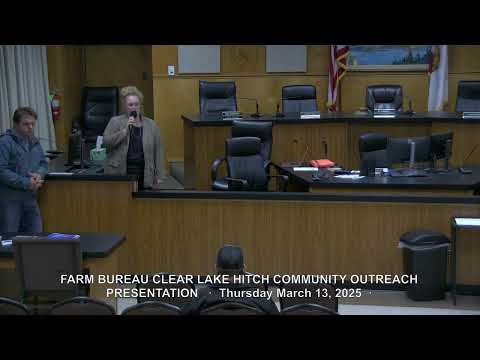
Jessica Bean, a Division of Water Rights staffer at the State Water Resources Control Board, told a Lake County Farm Bureau meeting that the board will use information gathered under an emergency information-order regulation to build a groundwater–surface water model aimed at understanding how well pumping and surface diversions affect tributary flows that the Clear Lake hitch use to spawn.
Bean said the emergency regulation issued in late 2023 was active for one year and the board chose not to readopt it after receiving strong voluntary cooperation. “We got 90% compliance with the regulation,” she said, and information orders had been sent to more than 1,800 parcels in the watershed.
The study will address four questions Bean listed: whether groundwater levels affect streamflows used by hitch; how past and present pumping affect groundwater levels; what other physical factors (for example legacy gravel mining or barriers in creeks) influence flows; and what actions could address those drivers. She said data collection began in 2023 and continues, that staff are synthesizing years of local monitoring and the information-order returns, and that preliminary results or raw data will be shared “by the middle of the year” before the board develops and applies models in 2026–27 with a final model expected in 2027.
Bean described the types of data already assembled for the study: well locations, pumping reports from information-order respondents (including both direct reporting to the board and submissions through a memorandum of understanding with the Lake County Farm Bureau), surface-water diversion reports held by the board, seasonal and monthly groundwater level monitoring done by the county, streamflow gages (longer records on creeks such as Kelsey Creek and newer gages on other tributaries), and monitoring shared by tribal partners and local GSAs. She said the information-order returns focused outreach on larger agricultural and commercial users after staff determined many parcels were domestic or dry-farmed and did not require follow-up.
Bean asked landowners to help with additional monitoring the board needs for model development: continuous groundwater-level monitoring from volunteer wells, access to wells suitable for two-week aquifer pump tests, and ongoing streamflow measurements. “If you have a well you’re interested in letting us put some equipment into, we have lots of equipment, and we'd be happy to have somebody come out,” she said.
The board intends to publish preliminary data and then use the assembled datasets to run hydrologic models that can be used to evaluate management options — including voluntary local actions and potential regulatory steps — once modeling is complete.
Ending: State Water Board staff said they will share slides and a recorded information item from the board’s public meeting; people who volunteered wells or monitoring access were encouraged to contact Jessica Bean for details and to arrange equipment installation.