Get Full Government Meeting Transcripts, Videos, & Alerts Forever!
Get email alerts on the Wastewater Treatment topic
No spam. Unsubscribe anytime.
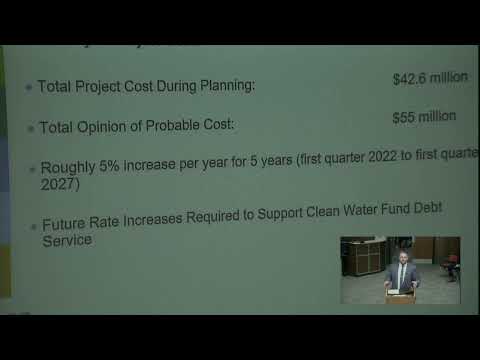
Portage City, Strand Associates update wastewater plant redesign and raise cost estimate to about $55 million
Summary
City staff and Strand Associates presented a final design for Portage City's wastewater treatment plant that replaces aging rotating biological contactors with oxidation ditches, adds a dryer for Class A biosolids, and raises the project cost estimate to roughly $55 million because of poor soils and rising construction prices.
Portage City officials and engineers from Strand Associates presented a final design update for the city's wastewater treatment plant and an updated project cost estimate on a facilities-plan item, saying the work is intended to meet upcoming Wisconsin DNR permit limits and to replace aging 1980s equipment. The firm and city staff said ground improvements and rising trade costs raised the planning estimate to about $55 million and that construction would likely finish in mid to late 2028.
The design replaces the plant's rotating biological contactors (RBCs) with two large oxidation ditches (with space for a future third), installs larger, deeper final clarifiers, adds a new return activated sludge (RAS) pumping building and a new electrical room, and upgrades the biosolids process with drying equipment and a dried-biosolids silo. Strand described reusing existing anaerobic digesters for a waste-activated-sludge (WASS) step, then drying cake from the belt press to roughly 90% solids to produce dried (Class A) biosolids for off-site disposal or beneficial reuse.
City staff emphasized the project responds to looming WPDES phosphorus limits in the DNR permit, aging infrastructure, and projected growth over a 20-year planning horizon. Strand representatives said the oxidation ditches provide larger process volume and operational reliability compared with the existing RBCs, and that the new layout allows for future capacity expansion.
Engineers identified a major unforeseen cost driver: poor site soils under the plant. Geotechnical borings showed near-surface materials unsuitable for new tanks and structures, so the design now includes ground improvements (a grid of aggregate columns) under the oxidation-ditch, clarifier and pumping-building footprints to limit settlement. Strand said the ground-improvement approach is more cost-effective than driving piles and is required unless the city relocates the site, which the firm described as infeasible because of existing infrastructure connections.
Strand also said costs rose for several reasons beyond the soil work. The firm projected roughly a 15% increase from the plan's 2022 estimate based on construction-cost indices through mid-construction, and it reported extra upward pressure on concrete and reinforcing-steel prices (as much as 20% over the trend line), plus higher electrical and piping costs. Strand cited limited contractor capacity on similar-sized projects and potential tariff impacts for electrical and control components. The engineers noted Portage must meet the federal American Iron and Steel rules tied to Clean Water Fund financing, but the city does not score as a Build America, Buy America (BABA) threshold community; Strand said that reduces, but does not eliminate, tariff exposure in the supply chain.
Strand walked the council through the construction sequencing required to keep the existing plant in service while new components come online. The firm described building the oxidation ditches, clarifiers and the RAS pumping building outside the footprint of current operating equipment so the new facilities can be started and then the RBCs and old clarifiers taken out of service. Strand said the startup requires seeding the new biological process with mixed liquor from another plant that already operates biological phosphorus removal.
On operations and odor, Strand said converting the former anaerobic digesters to an aerobic WASS process should reduce strong anaerobic odors; the firm also noted the dryer will exhaust water vapor and some volatile compounds and that the design leaves space to add activated-carbon odor control in the dryer room if odors become a problem.
Schedule and financing details presented: the design team expects to submit plans to the Wisconsin DNR for review in April, advertise the project in July and open bids in August, with major ground improvements beginning once a contractor is under contract (anticipated in the fall). Final construction completion was estimated for mid to late 2028. The city is pursuing Clean Water Fund financing; Strand and city staff said the loan structure and timing will determine how quickly wastewater rates must rise to cover debt service. Staff noted a potential $3 million in principal forgiveness is available under the state program and that Ehlers (financial consultant) is advising on phased rate adjustments to spread increases over several years.
No formal votes on the project were recorded in the transcript of this agenda item; the presentation was an informational update with substantial public and council questions about breakdowns, redundancy, staffing impacts, and financing. Speakers asked about equipment life, ability to service mixers and aerators without taking units offline, dryer redundancy, odor control options, and how the city will handle sludge in a dryer outage (temporary storage of current cake sludge or offloading liquid biosolids for land application).
The presentation and Q&A highlighted the long timeline and cost uncertainty until bids are received; Strand repeatedly described the $55 million figure as an opinion based on current indices, scope refinements and identified soil work, and said final bids will set the contract value. City staff flagged that rate increases to support Clean Water Fund debt service will be discussed in follow-up budget and finance meetings.
Portage's next steps as described in the presentation are completing final structural/electrical/mechanical design details, submitting to DNR, advertising for bids, and returning to council with contract recommendations and a financing plan once bids are opened.