Get Full Government Meeting Transcripts, Videos, & Alerts Forever!
Get email alerts on the Student Questioning And Searches topic
No spam. Unsubscribe anytime.
School committee begins a first read of proposed updates to student questioning and searches policy
Summary
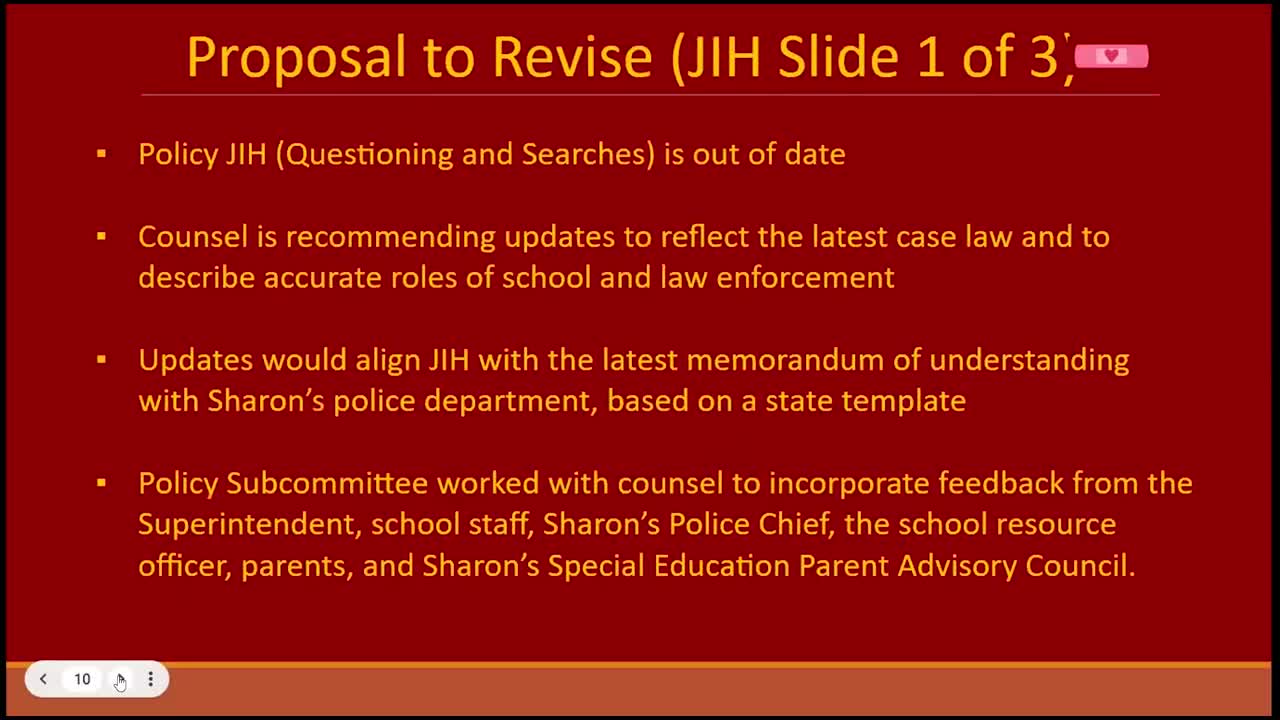
The Sharon School Committee conducted a first read of a proposed update to policy JIH (questioning and searches) on Feb. 5; the draft was prepared with legal counsel, includes expanded procedural protections for students and references the district’s police MOU, and drew extended public comment and committee debate.
The Sharon School Committee conducted a first read on Feb. 5 of a revised policy (JIH) addressing student questioning and searches, drawing extended public comment and debate among committee members. Committee members did not vote on the draft and asked administration and counsel to return with additional legal guidance.
The proposed policy was prepared with the district’s legal counsel and is intended to reconcile the existing policy, the district’s memorandum of understanding with the Sharon Police Department and recent Massachusetts case law. Committee member Dan, who presented the subcommittee’s work, said counsel had both modernized the policy to reflect current law and added protections beyond the legal floor. "If we were to go this direction with these updates, Sharon's version of this policy would be the most up to date and, in my opinion, the most protective of students' rights in any school district in Massachusetts that I've seen, bar none," Dan said during the presentation.
The draft inserts additional procedural protections: clarifying that school officials should attempt to contact parents before questioning students, adding language on Miranda warnings and knowing waivers, and specifying safeguards for students with disabilities or diminished capacity. The draft also reminds school staff that questioning by school officials can have judicial consequences and references the district’s MOU with police.
Stakeholder concerns focused on two lines of risk: that any policy granting law enforcement access to students could be used by out-of-district or federal agencies, and that the committee must preserve student civil liberties. Committee member Avi asked for clearer process protections and objected to edits being finalized between subcommittee and full-committee meetings without broader committee review: "I'm uncomfortable with and I'd like to see a little bit of change in the process here," he said, adding that substantive legal edits should return to the policy subcommittee for vetting.
Legal and operational questions raised during the meeting included: the legal difference between custodial and noncustodial questioning, how Massachusetts juvenile case law treats ages 14–18 for waivers, and whether the policy should require successful parent presence rather than merely an attempt to contact parents in all circumstances. Several speakers emphasized the district should err on the side of student protections, while recognizing that in some emergency or criminal-investigation circumstances law enforcement involvement may be necessary.
Why it matters: The policy governs when and how students may be questioned or searched on school property and what safeguards parents and students must receive. Changes could affect civil-liberty protections, how the district handles incidents that implicate criminal law and the relationship between school staff and law enforcement.
Next steps: Committee members asked administration and legal counsel for further clarification on the legal distinctions raised during the discussion — including how state case law applies to 14– to 18‑year‑olds and how 'custodial' status is defined in practice — and requested a follow-up presentation. No vote was taken at the Feb. 5 meeting.