Dracut advances Campbell schematic design with MSBA; officials warn a failed town vote could restart years of capital planning
Loading...
Summary
The Dracut School Building Committee will vote March 19 on a preferred schematic design for the Campbell School and submit the recommendation to the Massachusetts School Building Authority; district leaders warned a failed town vote later could force the district to restart MSBA processes and forego tens of millions in state reimbursement.
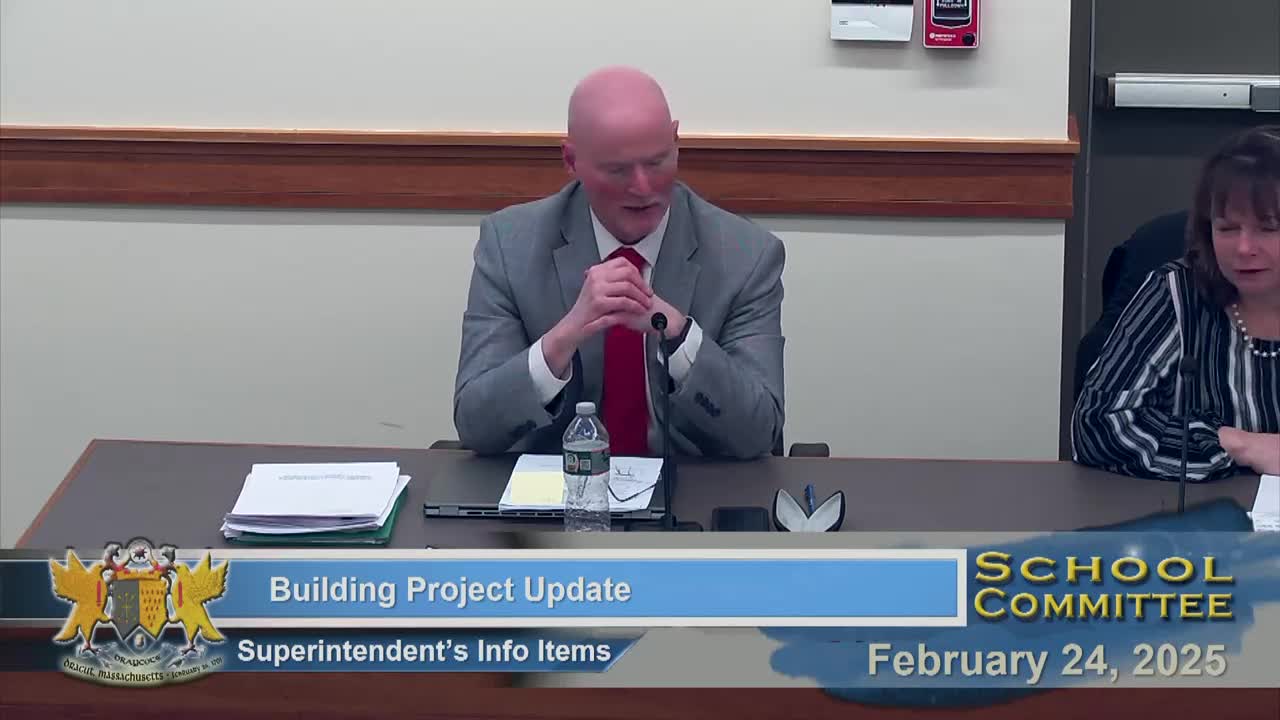
Dracut School Committee members and district officials said Monday that the Campbell School project is moving into the MSBA schematic design phase and that a Building Committee vote on a preferred schematic is scheduled for March 19.
Superintendent Steven Stone told the committee the administration and architects are finalizing a preferred design to submit to the Massachusetts School Building Authority (MSBA). The timeline presented calls for the Building Committee to select either a new‑building or add/reno option; if the committee approves a schematic, the MSBA process would proceed into a period of detailed schematic design.
Stone cautioned that a town rejection of a later ballot vote would have significant consequences. "They would discontinue working with us and we will have lost our opportunity for reimbursement of $60–70 million dollars from the state to build or renovate a school," he said, describing the MSBA funding relationship and the state reimbursement the district expects if a project is approved through the MSBA process and the town subsequently votes to proceed.
Greenmont, Brookside and sequencing: Stone said the district will not file a separate Statement of Interest (SOI) for Greenmont this cycle. He said MSBA staff view Greenmont "as being in the pool for the Greenmont" and advised the district not to file a separate SOI this year because of timeline overlap with the Campbell project. Stone said Brookside will need its own SOI in the near term and that a longer, multi‑year pipeline of school projects (Brookside, Inglesby, then the middle school) will require town attention even if Campbell moves forward.
Why it matters: Stone and committee members emphasized that the town faces a sequence of school facilities needs. They noted that, even with a successful Campbell project, Brookside and other buildings will require planning, and that failure of a Campbell vote would likely force the town to restart MSBA engagement and delay other projects. Stone said that cumulative construction escalation and multiple concurrent projects could create a bottleneck for town capital planning.
Process and timeline highlights - Building Committee: scheduled meeting to review the latest design and vote on a preferred schematic on March 19 (public meetings noted to be held at Harmony Hall on Wednesdays at 4 p.m.). - MSBA sequencing: Stone said that, if Campbell fails at a town vote, Greenmont and Brookside would both have to be re‑entered into MSBA processes that could push other planned submissions to later cycles and risk higher construction costs. - Potential enrollment and development implications: Stone noted local development proposals (a referenced 269‑unit development example) could add dozens of students at the elementary, middle and high school levels and would affect redistricting and capacity planning.
Committee context: Committee members asked clarifying questions about the MSBA process, the possibility of resubmitting if a town vote fails, and whether the MSBA evaluates educational program needs as well as building condition. Stone and staff said MSBA evaluates both building health and program capacity; they cautioned the committee that resubmission is possible but would restart the timeline and expose the town to further cost escalation.
Next steps: The Building Committee will meet as scheduled to review the architects’ schematic options. Stone said the next public milestones will be the Building Committee preferred schematic vote (expected March 19), subsequent schematic design work with the MSBA, and then town‑level votes that would trigger formal project authorization and potential reimbursement agreements.
Ending: Committee members reiterated the need for public information and a townwide conversation about sequencing school capital projects, because a failed vote on a single project could force simultaneous or back‑to‑back submissions for multiple schools and increase the town’s long‑term capital burden.