Get Full Government Meeting Transcripts, Videos, & Alerts Forever!
Dracut School Committee opens public hearing on proposed FY26 budget as superintendent warns of rising health‑insurance, special‑education and enrollment head‑c
Summary
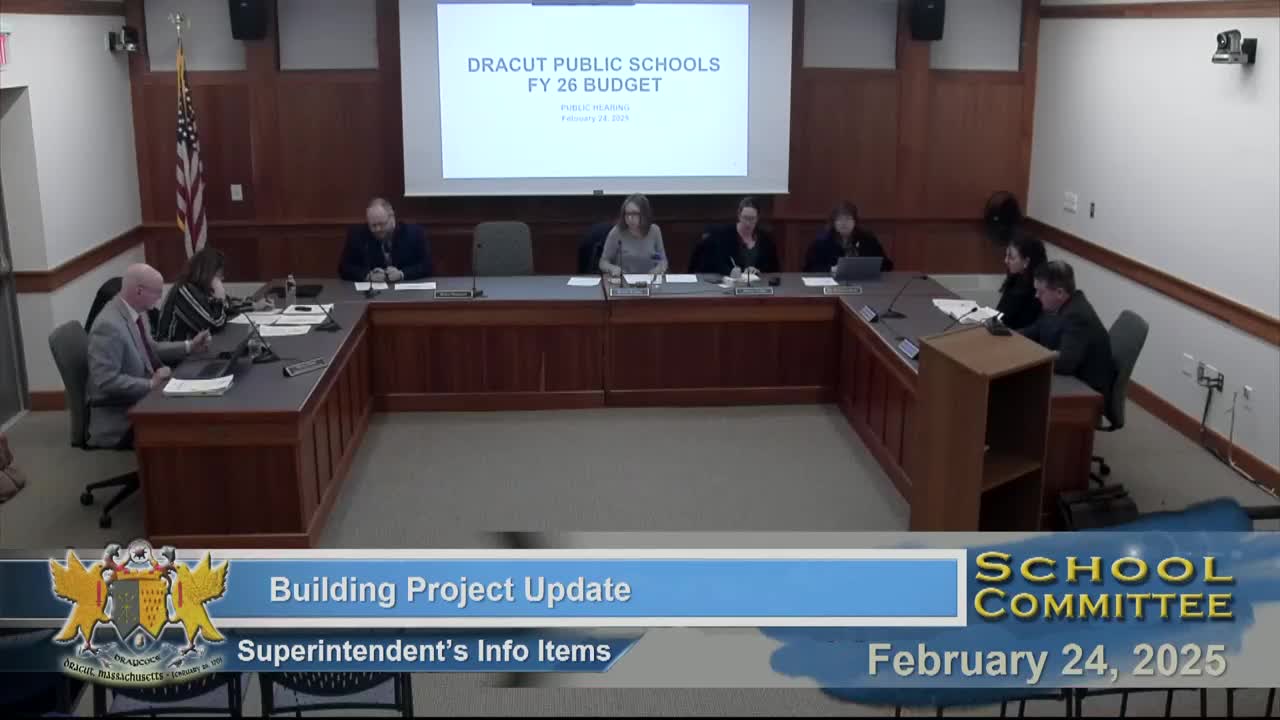
Dracut School Committee members opened a public hearing Monday, Feb. 24, on the proposed FY2025–26 Dracut Public Schools budget. Superintendent Steven Stone said state aid, enrollment shifts and sharply rising benefits — notably a projected ~19.94% increase in the district’s health insurance premiums — could erase available new state revenue and force difficult tradeoffs.
Dracut School Committee members opened a public hearing Monday, Feb. 24, on the Dracut Public Schools proposed fiscal year 2025–26 budget as Superintendent Steven Stone presented a first look at state and local drivers that he said could make maintaining current services difficult.
Stone said the governor’s proposed state budget includes a $75 per‑pupil increase in the foundation and a roughly 2.6% overall rise in total state education funding, but that the district faces local shortfalls because of formula mechanics, enrollment changes and sharply rising benefit costs. "There is nothing that we're buying that has only gone up by 1.4%," Stone said, describing the stated inflation factor baked into state aid calculations and the district's mismatch with actual on‑the‑ground cost increases.
The superintendent told the committee the district is currently classified in Group 7 under the Student Opportunity Act (SOA) reimbursement groups. He said Dracut fell from Group 8 to Group 7 last year after a roughly one‑percentage‑point drop in students identified as economically disadvantaged, and that change cost the district about $800,000 in state aid last year. Stone said restoring that classification would likely produce an additional roughly $800,000–$900,000 for the district but that the district is currently about 0.83 percentage points short of the next threshold.
Why it matters: Stone emphasized two linked dynamics. The state formula ties many increases to enrollment and an inflation factor (he said the FY26 factor is budgeted at 1.9%), while the district’s actual costs — including a health‑insurance increase the town has been notified may be…
Already have an account? Log in
Subscribe to keep reading
Unlock the rest of this article — and every article on Citizen Portal.
- Unlimited articles
- AI-powered breakdowns of topics, speakers, decisions, and budgets
- Instant alerts when your location has a new meeting
- Follow topics and more locations
- 1,000 AI Insights / month, plus AI Chat