Get Full Government Meeting Transcripts, Videos, & Alerts Forever!
Get email alerts on the School Budget topic
No spam. Unsubscribe anytime.
Dracut School Committee opens public hearing on proposed FY26 budget as superintendent warns of rising health‑insurance, special‑education and enrollment head‑c
Summary
Dracut School Committee members opened a public hearing Monday, Feb. 24, on the proposed FY2025–26 Dracut Public Schools budget. Superintendent Steven Stone said state aid, enrollment shifts and sharply rising benefits — notably a projected ~19.94% increase in the district’s health insurance premiums — could erase available new state revenue and force difficult tradeoffs.
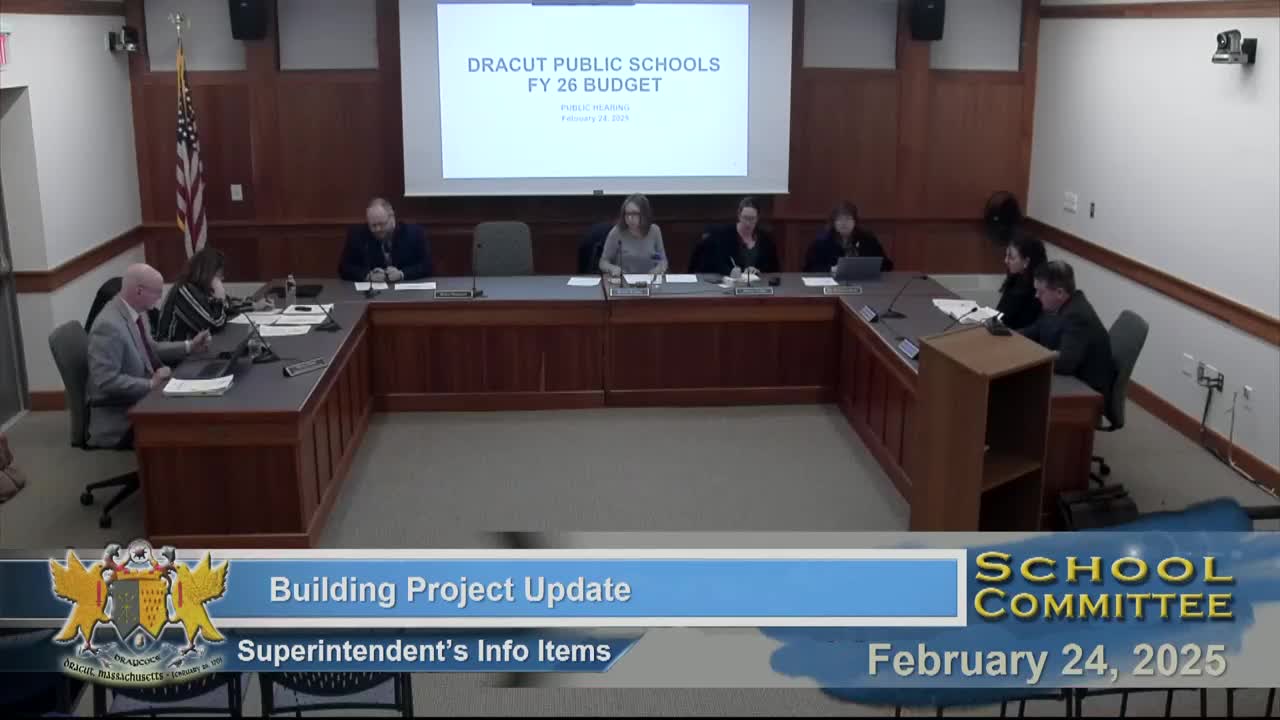
Dracut School Committee members opened a public hearing Monday, Feb. 24, on the Dracut Public Schools proposed fiscal year 2025–26 budget as Superintendent Steven Stone presented a first look at state and local drivers that he said could make maintaining current services difficult.
Stone said the governor’s proposed state budget includes a $75 per‑pupil increase in the foundation and a roughly 2.6% overall rise in total state education funding, but that the district faces local shortfalls because of formula mechanics, enrollment changes and sharply rising benefit costs. "There is nothing that we're buying that has only gone up by 1.4%," Stone said, describing the stated inflation factor baked into state aid calculations and the district's mismatch with actual on‑the‑ground cost increases.
The superintendent told the committee the district is currently classified in Group 7 under the Student Opportunity Act (SOA) reimbursement groups. He said Dracut fell from Group 8 to Group 7 last year after a roughly one‑percentage‑point drop in students identified as economically disadvantaged, and that change cost the district about $800,000 in state aid last year. Stone said restoring that classification would likely produce an additional roughly $800,000–$900,000 for the district but that the district is currently about 0.83 percentage points short of the next threshold.
Why it matters: Stone emphasized two linked dynamics. The state formula ties many increases to enrollment and an inflation factor (he said the FY26 factor is budgeted at 1.9%), while the district’s actual costs — including a health‑insurance increase the town has been notified may be about 19.94% next year — are substantially higher. Stone estimated current district health‑insurance expenditures at about $4.5 million and called a nearly 20% increase “a killer” relative to the modest inflation assumption used in state aid calculations.
Key elements of the presentation - Enrollment trends and SOA: Stone noted statewide enrollment declines post‑COVID, with cities generally gaining students while many suburban districts — including Dracut’s suburban neighbors — are losing enrollment. He said 233 of 319 state districts receive only the minimum SOA aid. The SOA intentionally directs more funding to districts with higher concentrations of low‑income and English‑learner students. - Special education and EL pressures: Stone said more than 700 students in the district (about 19% of enrollment) currently receive special education services, and special education accounts for roughly 24–25% of the district’s expenditures. He said English‑learner services have grown substantially in recent years (Stone cited a quadrupling in students receiving direct EL services and noted 202 students receiving direct services plus another 132 requiring monitoring). Both categories, he said, are consuming a growing share of the budget. - Fixed costs and municipal chargebacks: Stone described increases in fixed costs pushed into the town’s municipal cost agreement (he said some chargeback numbers remain preliminary while the district continues to work with the town manager). He told the committee that, under a level‑service assumption, the district would be seeking roughly a 5.39% increase to maintain current services (Stone characterized the figure as the result of rising fixed costs combined with limited state revenue gains). - Substitutes, transportation and other lines: Stone reported this year’s tracked cost for substitute teachers at roughly $609,000 and said transportation costs are expected to rise consistent with contract escalators and fuel/indexes (he cited a typical 6% annual increase for some transportation lines). He said the district had built conservative inflation estimates into some supply lines (about 3%) but that energy and benefit lines are the dominant pressure points.
State perspective: A state legislator who addressed the committee (identified in the record as "Representative Gary") urged vigilance about federal and state funding risks. The representative said the state budget is substantially supported by federal dollars (roughly one quarter of the state budget, she said) and cautioned that potential federal Medicaid cuts (MassHealth-related changes) could have cascading effects on state programs and local budgets. "If there is massive MassHealth cuts because of Medicaid cuts on the federal level ... I don't think the state can backfill any of that," the legislator said.
Public questions during the hearing: Parent and Dracut resident Allison Cillian asked detailed line‑item questions about the proposed budget, requesting clarification on legal expense lines, advertising expenditures, substitute costs, translation services, technology supplies, health‑office staffing and athletics. Stone and staff provided line‑by‑line clarifications, noting that some increases reflect new or expanded staffing tied to student need (for example, an expanded supervisor of nursing position and additional LPN capacity), some reflect anticipated increases in contracted services, and some are reclassifications between operating and revolving accounts (for example, athletic transportation).
What the hearing was not: The Feb. 24 meeting opened and later closed the public hearing on the proposed budget; the committee did not adopt the final FY26 appropriation that night. Stone repeatedly described the presentation as an initial, working look at numbers that remain under discussion with the town manager and subject to collective bargaining results. He also noted all seven district bargaining unit contracts expire at the end of the next school year, meaning negotiations will be a near‑term fiscal factor.
Committee actions at the meeting: The committee voted to open the public hearing on the proposed FY26 budget and later voted to close the hearing. The committee also approved routine business including minutes and warrants.
Next steps and timeline: Stone said the district will continue to refine chargeback figures with the town manager and to update the committee as DESE releases FY24 comparative data. He urged committee members and the public that the next several months are likely to be "a sobering season" for town budgets and district decisions, given the combination of formula limits, rising benefits and pending collective bargaining.
Ending note: The public hearing was closed by a roll call vote at the meeting’s conclusion; the committee still must deliberate and vote on a final proposed appropriation in subsequent meetings as the town and school department finalize municipal chargeback figures and bargaining assumptions.