Get Full Government Meeting Transcripts, Videos, & Alerts Forever!
Get email alerts on the Federal Park Staff Cuts topic
No spam. Unsubscribe anytime.
Minnesota lawmakers hear from fired park staff and DNR on local impacts of federal workforce cuts
Summary
Senator Houchow convened an informational hearing March 13 to examine how recent federal terminations of National Park Service and U.S. Forest Service employees are affecting Minnesota parks, visitor services, conservation programs and wildfire response.
Senator Houchow convened an informational hearing on March 13 to examine the local effects of recent federal terminations of National Park Service and U.S. Forest Service employees and to hear from affected former employees and the Minnesota Department of Natural Resources.
Two former National Park Service employees, Kate Severson and Jessica Loeffler, described personal and program losses after being removed from their positions in mid‑February. Severson, who said she had been the chief of interpretation and education at Voyageurs National Park, told the committee that her firing during a probationary period has disrupted education and visitor programs and could force her to leave International Falls. “The National Park Service system is under attack by the current administration,” she said, and she described the parks’ economic role, citing a 2023 report showing $20,400,000 in visitor spending associated with Voyageurs National Park.
Jessica Loeffler said she was a biological science technician at the Mississippi National River and Recreation Area (MINRA) and listed conservation duties that are no longer being done because of staff reductions, including a monarch monitoring program, heron rookery monitoring and planning for endangered amphibians. “We were promoted only to receive an email stating that we are being terminated due to poor performance,” she said, describing a workplace climate where employees with positive reviews received termination notices. Loeffler said her position had included preparing grant applications and that, with her termination, terrestrial wildlife representation at her park is effectively zero.
Patty Tylen, Forestry Division Director for the Minnesota Department of Natural Resources, explained how the DNR coordinates wildfire suppression with federal partners and outlined contingency plans. Tylen said DNR coordination with the U.S. Forest Service, National Park Service, U.S. Fish and Wildlife Service and Bureau of Indian Affairs improves response but that Minnesota’s wildfire response “is not contingent on federal partners' availability.” She said the DNR recently received Infrastructure Investment and Jobs Act (bipartisan infrastructure law) grants that will support local volunteer fire departments, state fire capacity, wildfire mitigation, and a Community Wildfire Defense Grant for St. Louis County to implement treatments around Ely and Vermillion.
Tylen acknowledged that some federal employees who participated in wildfire suppression have been separated but said DNR does not yet know the magnitude of federal reductions. The department has proactively reached out to known recently separated federal employees to inform them about seasonal firefighter openings and is relying on multi‑state mutual aid through the Great Lakes Forest Fire Compact (GLIFSI) and other reciprocity agreements to meet surge needs. “We will continue to prepare for and respond to wildfire in Minnesota, to the best of our capabilities,” Tylen said, noting DNR participates in weekly coordination calls among firefighting agencies.
Committee members pressed DNR on near‑term fire risk and local capacity. Tylen said spring risk changes rapidly and DNR staff monitor conditions full time, using aerial detection and public reports. She said DNR can move resources within the state and request reciprocal assistance from other states, though that can be more costly than using in‑state staff.
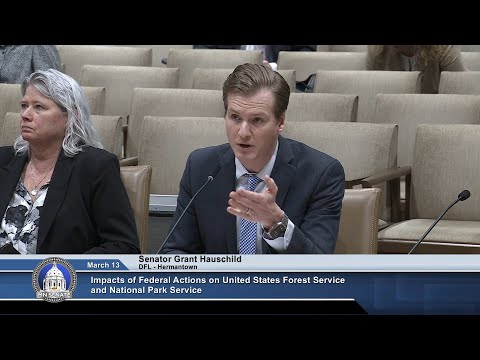
Lawmakers from northern districts expressed strong concern about the local consequences of federal cuts for recreation, education and fire protection, and several said they are pursuing state options to support affected workers and communities. Senator Hauschild said many federal employees report pressure to take early retirement and described draft state legislative language to help employees access unemployment benefits under some circumstances. Committee members also discussed broader ecosystem management concerns raised by staff reductions, including cross‑border programs for fisheries and invasive species that depend on federal coordination.
No formal action was taken; the hearing record will be available to the committee for any follow‑up work.
Ending: Committee members said they will continue to monitor federal workforce changes and their implications for Minnesota and may pursue state measures to support wildfire response and affected workers.