Get Full Government Meeting Transcripts, Videos, & Alerts Forever!
Get email alerts on the Elections Administration topic
No spam. Unsubscribe anytime.
Senate elections committee advances secretary of state election-administration bill with chain-of-custody, reporting and absentee changes
Summary
The Senate Elections Committee on March 13 advanced Senate Bill 2,384, the secretary of state's elections-administration package, as amended, and sent it to the Judiciary and Public Safety Committee.
The Senate Elections Committee on March 13 advanced Senate Bill 2,384, the Office of the Secretary of State’s election-administration package, as amended, and recommended it to the Judiciary and Public Safety Committee.
The bill, carried by Senator Westland, bundles technical updates and policy changes that supporters say respond to administrator and voter feedback from recent elections. Key provisions include changes to proof-of-residence rules for election-day registration and candidate filings, new requirements for county chain-of-custody plans, expanded early-voting options, changes to absentee-ballot handling and retention, and a statutory requirement that the secretary of state maintain an unofficial Election Night Reporting system (ERS).
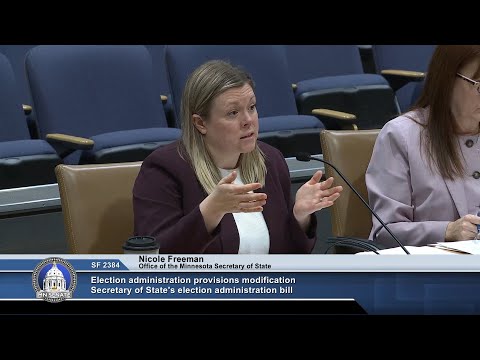
Nicole Freeman of the Office of the Secretary of State, a principal presenter, described the measure as “technical as well as small policy changes to election provisions that were both passed recently, as well as some that, were passed not so recently based on the experiences of voters and election administrators in recent elections.” Freeman said the bill reflects input from local partners including county and municipal administrators and tribal representatives.
Major provisions summarized during the committee hearing: - Election-day registration: the bill updates allowed proof-of-residence and removes an employer-list requirement for staff at residential facilities, substituting a requirement that employees provide proof of employment when vouching. - Students: additional proofs of residency for students are allowed during the 18-day early-voting period and on Election Day. - Permanent absentee list: the application flow is changed so requests to join the permanent absentee list are handled on the absentee application rather than the voter-registration application. - Absentee handling and retention: counties must account for and log discrepancies between envelopes and ballots, retain absentee envelopes for the contest period, and reconcile counts inserted into ballot boxes. - Chain-of-custody plans: counties must file chain-of-custody plans with the secretary of state and review them before every election; the initial county plans must be filed by September 1, 2025. - Election Night Reporting (ERS): the bill requires the secretary of state to maintain an ERS for unofficial results and requires counties to test their reporting at least seven days before Election Day; it clarifies that ERS results are unofficial until canvass certification. - Candidate filings and privacy: candidates for county attorney and sheriff need not include a full residence address on affidavits but must provide phone and email; mailed proof-of-residence is treated as private data. - Timing and canvass changes: municipal and school district canvassing timelines are extended in several places (up to 14 days after the election) to give local bodies more scheduling flexibility.
Local election officials and the Minnesota Association of County Officials (MAKO) testified in favor of many provisions. Michael Stahlberger of Blue Earth County, representing MAKO, said the association “would like to express our support for many of the provisions in Senate File 23 84” and urged continued coordination on items such as student housing lists and permanent-absentee application design.
Committee members pressed staff and witnesses on implementation details and limits of local authority. Senator Lucero raised concerns about the authenticity of digitally delivered utility bills used as proof of residence, noting that “technology exists out there to artificially present...fabricated” documents and asking the committee to consider protections against fraudulent documents. Freeman replied that original bills are accompanied by required identification types under statute and rule and that mailed copies of proof-of-residence are not retained by election officials.
Committee counsel walked members through statutory cross-references and the sponsors addressed numbering and drafting cleanups in the next engrossment. After questions and discussion, the committee adopted the author’s A4 amendment by voice vote and then voted to pass the bill as amended and forward it to the Judiciary and Public Safety Committee.
The committee record shows the amendment was adopted (voice) and that the motion to pass SB 2,384 as amended carried; no roll-call vote tally was recorded in the transcript.
The bill contains multiple changes that administrators said will require follow-up rulemaking or templates from the secretary of state (for example, for chain-of-custody plan templates and ERS testing procedures). Supporters asked the committee to keep working with counties and municipalities on details such as exact deadlines, plan templates and how to operationalize student and tribal off‑reservation voting locations.
Votes at a glance: The committee adopted the author’s A4 amendment by voice and approved a motion to pass SB 2,384 as amended and forward it to the Judiciary and Public Safety Committee.