Get Full Government Meeting Transcripts, Videos, & Alerts Forever!
Get email alerts on the Attorney General Prosecution Of Election Crimes topic
No spam. Unsubscribe anytime.
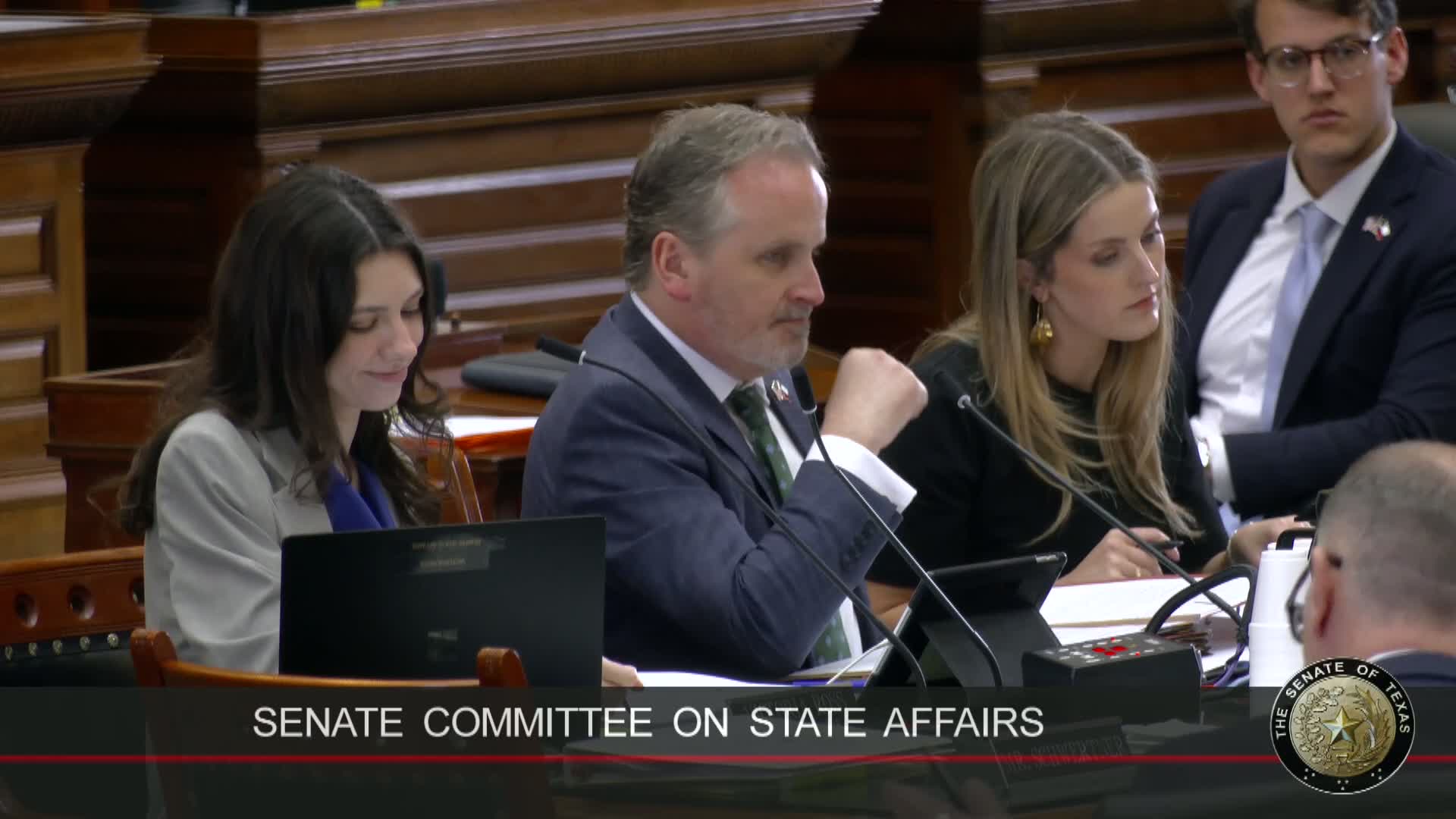
Committee hears bill to restore attorney generalauthority to prosecute some election offenses
Summary
The Texas Senate Committee on State Affairs heard testimony on Senate Bill 10 26, which would require local prosecutors to act on election-offense reports within six months or be deemed to have consented to the attorney generalprosecuting; witnesses and resource counsel disagreed about constitutional limits after the Stevens opinion.
Senate Bill 10 26, introduced by Chairman Hughes, would change long-standing statutory language to require the attorney general to prosecute election-law violations if a local prosecutor has not begun proceedings within six months. The bill would also require local law enforcement to forward reports of probable cause about election offenses to the attorney general and, on request, to turn over investigative materials.
The billauthor, Chairman Hughes, told the Committee that the Texas Court of Criminal Appealsin Stevens held the attorney general cannot initiate prosecutions unilaterally under current statutory language and that the billwould address that by changing statutory "may" language to "shall" and creating an implied consent if the local prosecutor does not act within six months.
Jeff Barr, chief of the Election Integrity Division in the Office of the Attorney General, told the Committee that the AGpreviously had concurrent authority to prosecute election offenses and that the Stevens decision has hamstrung that function. He said the bill would create two principal changes: an implied consent where a local prosecutor takes no formal action within six months and replacing "may" with "shall" in statute so the AG has clearer statutory footing to proceed.
Civil-rights advocates and policy groups urged caution or opposed the bill. Andrew Hendrickson of ACLU of Texas argued the Stevens opinion rests on a longer line of separation-of-powers precedent (citing ex parte Giles and the Meshel case) and said the Court of Criminal Appeals concluded the AG lacks independent criminal-prosecution authority absent an express constitutional grant. Veronica Warms of the Texas Civil Rights Project said expanding AG authority risks chilling voters and removing prosecutorial discretion from local district attorneys. Dr. Laura Presley of True Texas Elections and several individual witnesses supported the bill, saying local prosecutors sometimes decline to pursue serious allegations.
During questioning, Senator Birdwell and other members pressed resource counsel and the AGwitness about preserving prosecutorial discretion so the AG would not be compelled to file meritless cases. Jeff Barr responded that prosecutorial ethics and evidence sufficiency would still govern charging decisions, and his office could provide statutory language to make that explicit.
The committee heard varied legal analysis about the Stevens decisionand whether a statutory "shall" would be sufficient given Texas separation-of-powers precedent. Several witnesses urged a narrowly drafted fix to avoid creating a statutory scheme that would itself run afoul of state constitutional limits. The committee took public testimony and left the bill pending.
Ending: Committee testimony closed after several witnesses testified both for and against the bill; the bill was left pending for further consideration.