Get AI Briefings, Transcripts & Alerts on Local & National Government Meetings — Forever.
Senate committee hears testimony on bill to remove state ban on short‑barreled rifles
Loading...
Summary
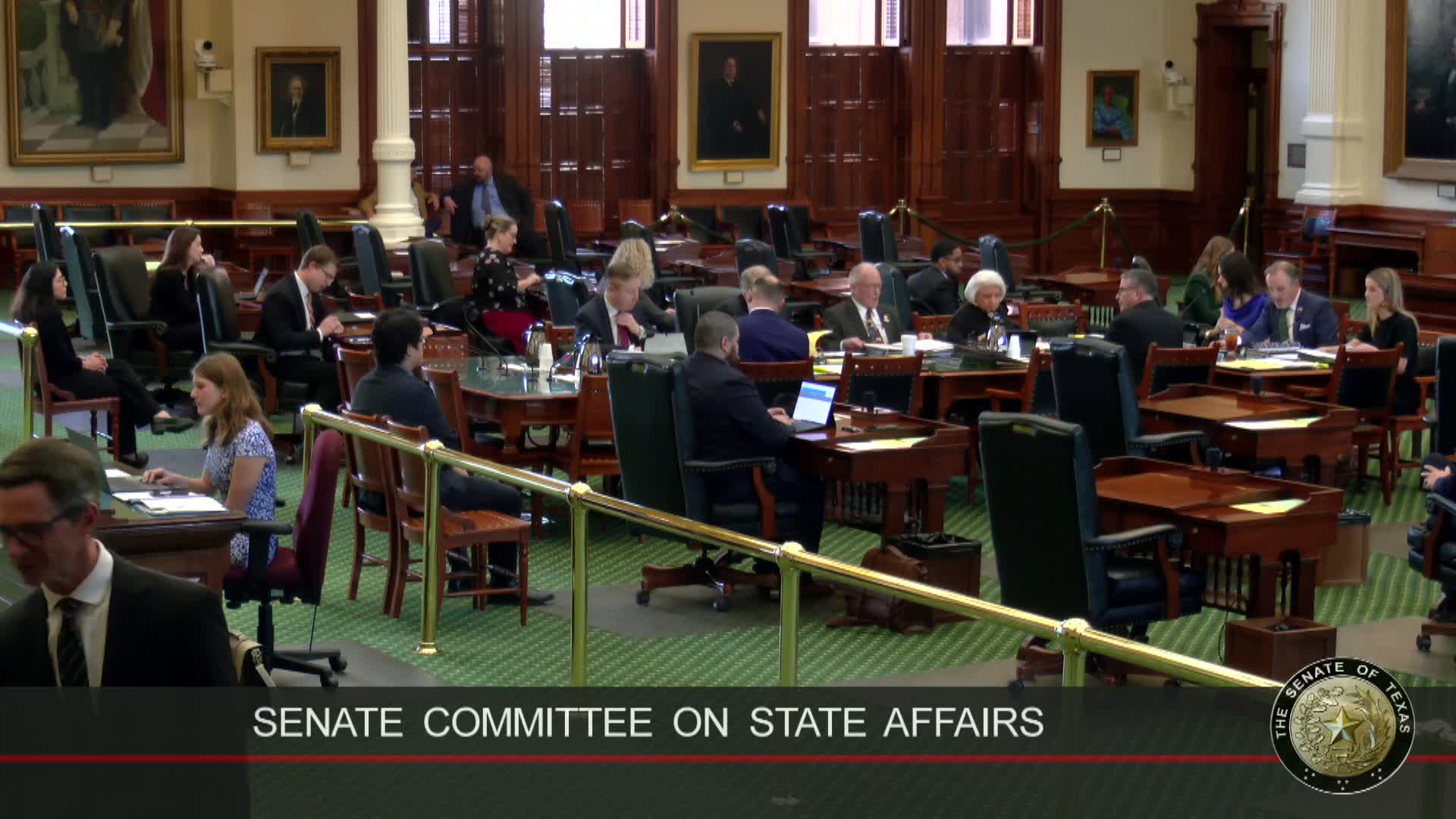
At a meeting of the Senate Committee on State Affairs, members heard testimony on Senate Bill 15‑96, a proposal to remove short‑barreled firearms from the list of prohibited weapons in the Texas Penal Code.
At a meeting of the Senate Committee on State Affairs, members heard testimony on Senate Bill 15‑96, a proposal to remove short‑barreled firearms from the list of prohibited weapons in the Texas Penal Code. The author, Senator Centra Hagenboo, introduced the measure and explained its intent.
The bill would delete short‑barreled rifles (SBRs) from state criminal prohibitions while leaving federal law unchanged, including the National Firearms Act’s registration and $200 tax stamp requirement. Senator Centra Hagenboo said the state prohibition is an anachronism dating to the 1934 National Firearms Act and that “short rifles are never a problem and continue not to be a problem.” He told the committee that a recent ATF classification of certain pistols with stabilizing braces as SBRs has the practical effect of criminalizing firearms for many Texans under state law.
The measure drew detailed pro‑bill testimony from invited witnesses. Kyle Carruth, legislative director for Gun Owners of America, said the bill would prevent Texas law from becoming more restrictive than future federal policy and argued that short‑barreled rifles can be safer and more controllable than pistols in some self‑defense or hunting situations. “If we do pass this bill and within the next two years, the ATF does remove those short barrel rifles from the NFA, then Texas law would be more restrictive than even federal law,” Carruth said. Attorney CJ Grisham, lead counsel for Texas Gun Rights, urged passage as a narrowly drawn change that would remove the state felony while federal prohibitions would remain in place.
Opponents included survivors and gun‑safety advocates. Flo Rice, who identified herself as a survivor of the May 18, 2018, Santa Fe High School shooting, described being shot and her continued concern about the lethality and ease of concealment of shortened shotguns and rifles. Rice said the federal process for registering short‑barreled firearms includes heightened scrutiny that she fears would be lost if state prohibitions are removed. Nicole Golden, executive director of Texas GunSense, described the 1934 National Firearms Act and the U.S. Supreme Court’s 1939 decision in U.S. v. Miller, saying Congress historically regulated short‑barreled weapons because they are more easily concealed and have been used in mass‑casualty events.
Other public speakers included Ken Moore and Lauren Pena, who testified in favor of the bill citing controllability and accessibility for smaller shooters and families, and Christina Delgado, a Santa Fe resident and advocate who opposed the measure while identifying herself as a Second Amendment supporter.
Committee members asked clarifying questions of the author and witnesses on federal registration requirements, the $200 tax stamp, the 16‑inch barrel threshold, and how many firearms might be affected. Senator Centra Hagenboo and witnesses cited an estimate that a federal ATF reclassification would criminalize about 360,000 firearms under current state law, and they repeatedly noted that federal law (the National Firearms Act) would still require registration and payment of the tax stamp to make an SBR lawful under federal law.
Public testimony on the bill was closed and the chair announced that “bills left pending at this time.” No committee vote on SB 15‑96 occurred during the hearing.
The committee recessed for the senate floor session and said it would return to continue business later in the day.