Get Full Government Meeting Transcripts, Videos, & Alerts Forever!
Get email alerts on the Community Corrections Funding topic
No spam. Unsubscribe anytime.
Witnesses urge full funding for HB 5004, citing $18.18 daily cost study and staffing shortfalls
Summary
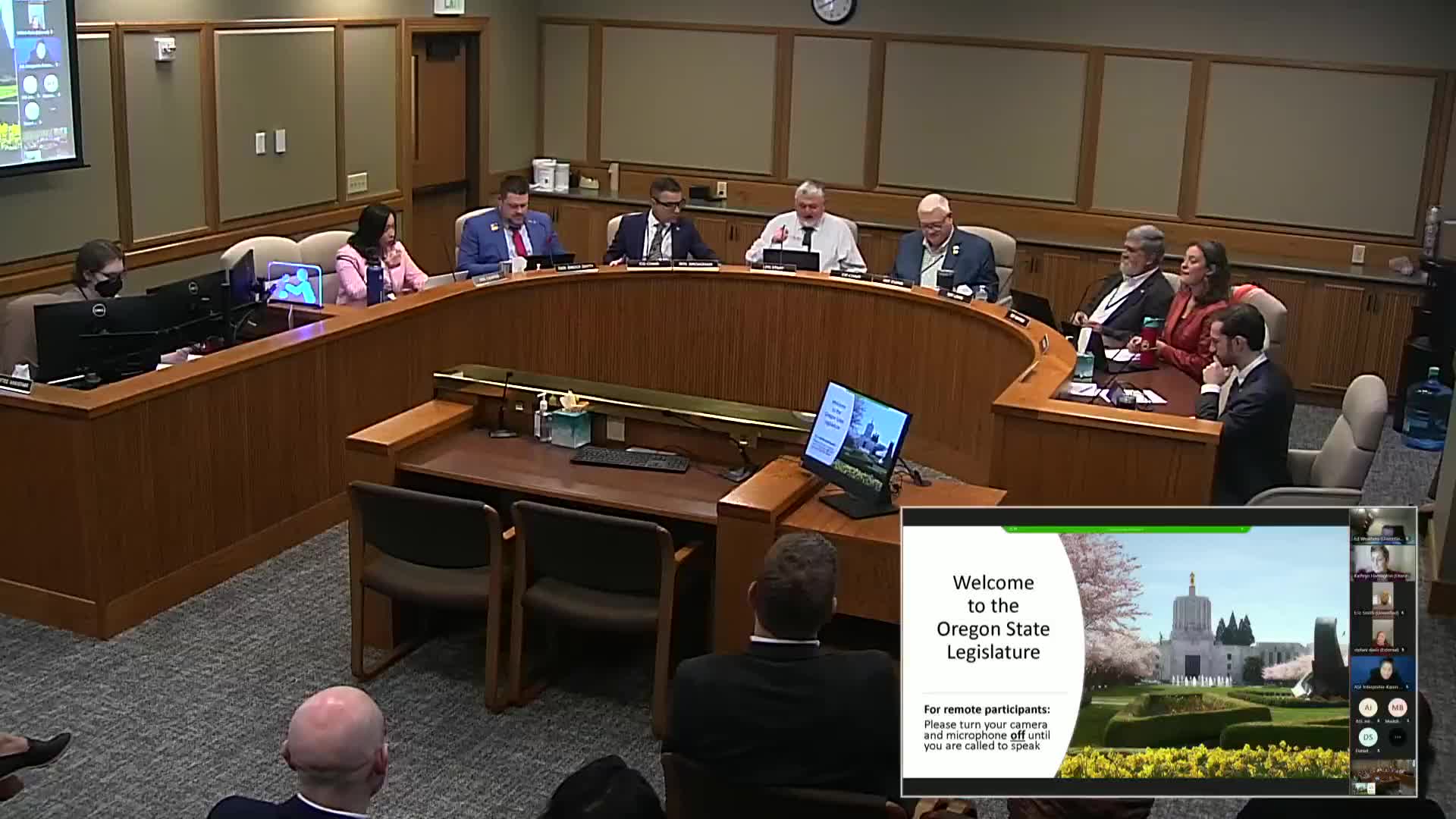
The Public Safety Subcommittee opened a March 13 public hearing on House Bill 5004, the Department of Corrections’ budget bill, where dozens of county officials, corrections directors, formerly incarcerated people and nonprofit partners urged the Legislature to fully fund community corrections at the $18.18 per‑day rate identified in a 2024 cost study.
The Public Safety Subcommittee opened a public hearing March 13 on House Bill 5004, the Department of Corrections’ budget bill, where dozens of county officials, corrections directors, formerly incarcerated people and nonprofit partners urged the Legislature to fully fund community corrections at the $18.18 per‑day rate identified in a 2024 actual cost study.
The request matters because counties operate community corrections programs that supervise, treat and assist people released to the community. Witnesses said underfunding has forced staff reductions and program cuts and increases pressure on probation officers, jails and other public safety systems.
DV Holcomb, director of Deschutes County Community Justice, told the committee that Deschutes reduced its share of the prison population by 48% since 2015 and cited local outcomes while urging full funding of the cost study and support for policy option package 102. “We have reduced our share of the prison population by 48% since 2015 without compromising public safety,” Holcomb said. He added that community supervision in Deschutes costs $18.18 per client per day according to the 2024 study and warned that shortfalls would force a return to a “passive, operation” model that could increase incarceration.
Erica Wimbish, who identified herself as a peer support specialist formerly supervised on parole and probation, described how local supervision and programming contributed to eight years of sobriety and employment and said, “I am in full support of this bill and support full funding for the actual cost of community corrections.”
Kiki Parker Rose, Community Justice Director for Jackson County, said Southern Oregon counties employ 194 staff, including 111 parole and probation officers, and supervise roughly 4,883 people. She said average caseloads there run 50 to 55 high‑ and medium‑risk adults, which she called “simply too high.”
Jeff Wood, executive director of the Oregon Association of Community Corrections Directors (OACCD), and Nate Goweyran, president of OACCD and director of Washington County Community Corrections, urged the committee to adopt the department’s cost study findings. Goweyran noted the Legislature convened a 2023 work group to review funding and recommended maintaining the current funding formula but acknowledged the 2024 study showed the daily capitated rate must increase. Several witnesses repeated the $18.18 figure and contrasted it with lower current state grant levels reported during testimony ($15.09 and $13.83 were cited as existing benchmarks in different remarks), and county representatives said the gap totals roughly $380 million for the 2025–27 biennium under the $18.18 rate.
Tim Dooley of the Association of Oregon Counties said the state has not fully funded community corrections’ actual costs since 2006 and estimated counties receive about $0.76 on the dollar, leaving a persistent shortfall. Polk County Commissioner Jeremy Gordon and Washington County Chair Harrington (recorded by surname) described local impacts: Polk County probation officers carry 65–70 people per caseload versus a preferred 40–45, and Hood River County Commissioner Ed Weathers said his county supervises about 90 people with two probation officers and faces a $152,000 local budget gap in the program fund.
Sheriffs and law‑enforcement groups also testified. Marion County Sheriff Nick Hunter, speaking for the Oregon State Sheriffs Association, and Yamhill County Sheriff Sam Elliott urged support for the governor’s proposal to raise grant funding to the $18.18 level and said increased funding would allow counties to reduce PO caseloads, restore programs such as work release and specialty courts, and expand treatment and housing supports.
Formerly incarcerated witnesses and program partners gave examples of reentry and training programs that supporters said depend on stable funding. Lauren Bulling of Ironworkers Local 29, Rachel Smith and Ashley Lautenschlager—graduates of a prison‑based pre‑apprenticeship program described as U Pack/Oregon—testified that the program reduced waits for union apprenticeship and that graduates gained immediate employment and housing upon release. Santino Westcott and other instructors described how the program offers tangible post‑release job pathways.
Providers and nonprofits also testified in favor of DOC budget items beyond the capitated rate. Heather Fick of East Cascades Works and representatives from the Inside Out Network, CLEAR Clinic and Lines for Life described legal clinics, workforce centers, transition coordinators, mental‑health first aid trainings and other reentry supports. Daniel Sims and Stephanie Davis of CLEAR Clinic described regular legal clinics held inside Coffee Creek that help expunge records, address eviction records and seek fee waivers—services they said materially affect chances of stable housing and employment after release.
Multiple witnesses called for additional DOC investments: Susan Allen of Oregon AFSCME asked for workforce and recruitment funding to reduce mandated overtime; Trish Houts and other DOC staff described persistent overtime and nursing shortages; and Recidivis’ Evan Greenlow urged relatively small investments in IT modernization—an example figure of $5.6 million was offered as a potential leverage point to replace aging software used across DOC and county operations.
Committee procedure: the subcommittee opened the public hearing and received oral testimony; committee staff said the verbal record was closed but that written testimony would be accepted for 48 hours. There were no committee votes during the hearing.
Why it matters: witnesses framed HB 5004 and policy option package 102 as a corrective to decades of underfunding that they say has eroded probation staffing, program capacity and recovery supports. Several county officials warned that without full funding, counties will have to reduce services and staff, which they said would shift costs back to prisons and other public safety systems.
The subcommittee adjourned after hearing testimony; written comments will remain part of the record for 48 hours following the hearing.