Get Full Government Meeting Transcripts, Videos, & Alerts Forever!
Get email alerts on the Senate Bill 1113 Out Of State Placement Restraint topic
No spam. Unsubscribe anytime.
House committee hears overview of Senate Bill 1113 on out‑of‑state placements, restraints and oversight of youth care
Summary
Lawmakers and advocates described systemic harms experienced by youth sent to out‑of‑state facilities, outlined protections proposed in Senate Bill 1113 and discussed restraint, licensing and oversight changes being considered.
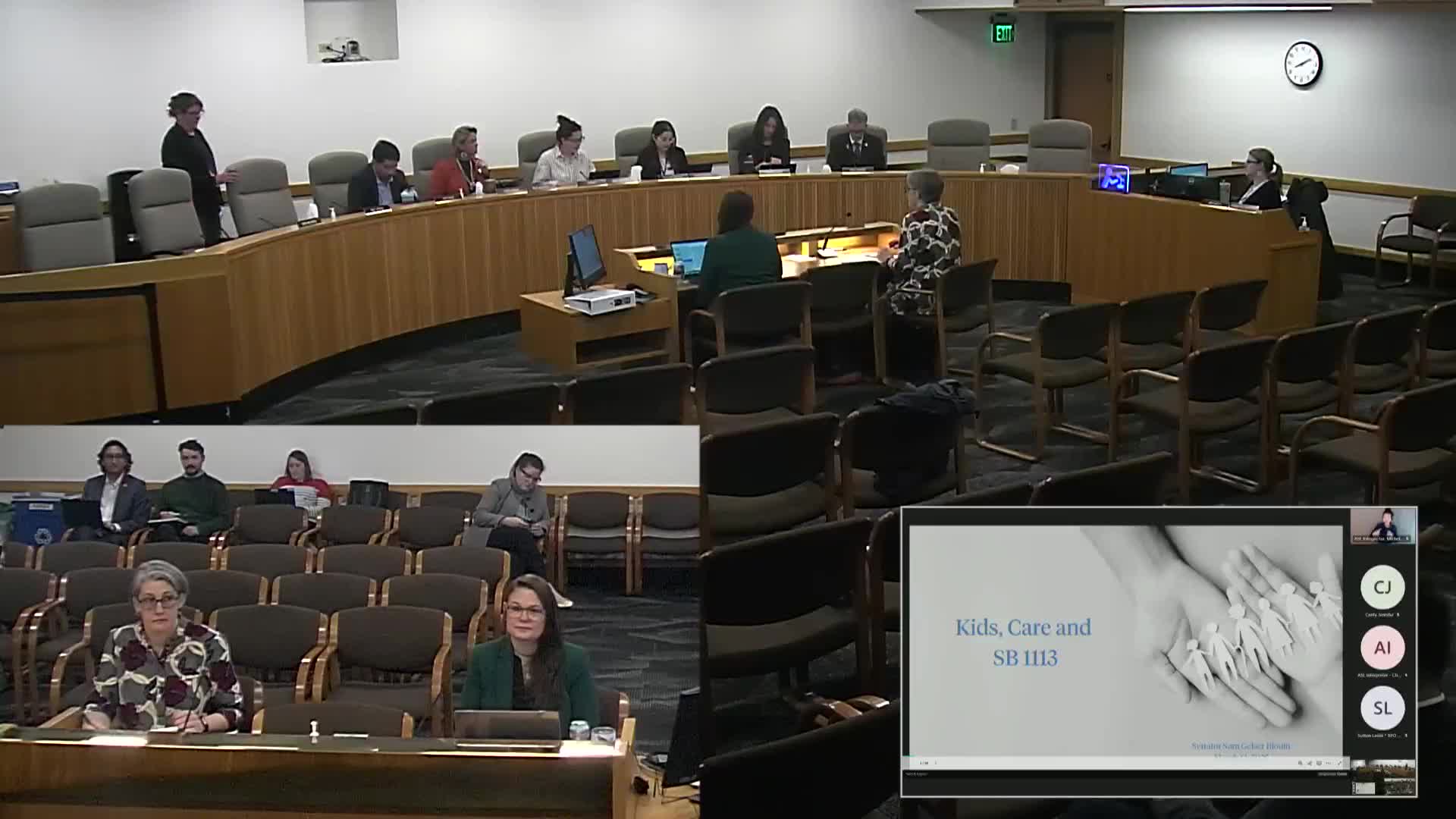
The House Committee on Early Childhood and Human Services held an informational hearing March 13 on Senate Bill 1113, which sponsors and advocates said would tighten oversight of out‑of‑state placements for youth in state care, clarify when use of force and restraint are abuse, and preserve long‑standing rules preventing private‑equity ownership of child‑caring agencies.
Senator Sarah Gelser Blumen, a state senator from Senate District 8 and chair of the Senate Human Services Committee, told the committee that SB 1113 is intended to protect children and to “build a system that recognizes . . . their vulnerability, their humanity, and their identity.” She said the bill seeks clarification on abuse definitions for older youth in care, strengthens prohibitions on certain restraints and seclusion, and adds legislative oversight and civil penalties for regulatory noncompliance.
The bill would explicitly extend child‑abuse protections to older youth who remain in state care, Senator Gelser Blumen said, because existing abuse definitions in the statute did not always apply to 18‑ to 21‑year‑olds who were still receiving services. She described provisions that would bar sexual contact between staff and clients regardless of a foster youth’s legal age, broaden the set of people who can be investigated for abuse (including non‑staff residents and frequent visitors), and add definitions for financial exploitation and verbal abuse.
The committee also heard testimony about the history and harms of out‑of‑state placements. Leslie Sutton, Oregon’s Residential Facilities Ombudsman and a member of Governor Brown’s Child Welfare Oversight Board in 2019, said the board found more than 80 high‑needs children in facilities outside Oregon at the height of the review and that many returned with abuse allegations. "These children and youth sustained physical and emotional injuries at those facilities far from home," Sutton said, urging stringent rules so out‑of‑state placements are used only when medically necessary and subject to oversight.
Survivors and advocates described individual harms from placements. A 12‑year‑old witness introduced as Uvea recounted being physically abused at an out‑of‑state residential treatment program and said the experience "only caused more trauma and gave me more reasons not to trust." Senator Gelser Blumen and witnesses described photographs and reports showing unsafe conditions at some programs, and said several facilities closed after other states or regulators raised concerns.
Advocates and the senator repeatedly emphasized the bill’s restraint and seclusion language. SB 1113 would continue existing prohibitions on prone and supine restraints for children with intellectual and developmental disabilities and would add statutory clarity distinguishing safe cueing or light touch from physical restraint. The bill would include explicit exceptions allowing certified foster parents and, in an amendment described as forthcoming, Department of Human Services (DHS) employees to intervene in emergencies such as a suicide attempt without triggering an automatic abuse substantiation.
Presenters supplied data the committee used to frame the scope of the problem. Witnesses said Oregon sent roughly 160 youth out of state in 2018 and 106 in 2019; at one point in 2019 the committee was told 88 youth were out of state. Testimony noted the youngest out‑of‑state youth was 9 years old and that some youth remained out of state for more than three years. On restraints, witnesses said that from Sept. 1, 2021 (the effective date of Senate Bill 710) through Dec. 30, 2024, Oregon child‑caring agencies recorded 15,754 restraints; those incidents allegedly produced about 2,815 injuries, 123 child‑abuse investigations and 27 substantiations.
Senator Gelser Blumen and other witnesses said SB 1113 would preserve Oregon’s long‑standing requirement that child‑caring agencies be incorporated (a barrier to private‑equity LLC ownership the senator traced to a mid‑20th‑century statute). She said the statute’s corporate requirement helps limit private‑equity entry that can make oversight harder and can deter disclosures by youth.
Witnesses discussed alternatives to out‑of‑state placement, citing Oregon’s “K plan” for Medicaid services for people with developmental disabilities and arguing for fuller use of home‑ and community‑based Medicaid authorities that could be eligible for federal matching funds. Leslie Sutton and Emily Grama of The Arc Oregon urged investment in community‑based treatment and workforce development to reduce the need for congregate placements.
Committee members pressed proponents on tradeoffs: Representative Volker and Representative Walters asked whether stricter regulation could reduce capacity and put other children at risk or make it harder to find providers. Senator Gelser Blumen and others responded that the balance is training and resources earlier in the care continuum, not lowering standards. She noted the legislature allocated $4 million in the prior session for de‑escalation training, and witnesses urged better licensing enforcement and clearer statutory authority for the department.
The hearing was informational; no committee vote was taken. Senators and witnesses said amendments were under development to clarify secure and medical transportation exclusions, to modernize mechanical‑restraint language, and to add civil penalties and clearer exceptions for emergency interventions by caregivers and DHS staff.
The committee chair closed the hearing saying lawmakers will continue the conversation and asking members to consult with agencies, schools and providers. The bill’s backers recommended further data and site‑visit reviews and urged legislative oversight to ensure transparency and quicker action if facilities fail to meet standards.
Ending notes: proponents said SB 1113 aims to reduce harm by narrowing where and how youth are sent out of state, by clarifying restraint rules and by strengthening oversight and reporting; opponents or questioners asked how the state will ensure safe capacity in Oregon without creating gaps in care.