Get Full Government Meeting Transcripts, Videos, & Alerts Forever!
Get email alerts on the Business Oregon Budget topic
No spam. Unsubscribe anytime.
Business Oregon officials outline $2.1 billion budget, warn of one‑time carryover needs and performance measure gaps
Summary
Business Oregon leaders presented the agency's governor-recommended request under House Bill 5024, describing a roughly $2.1 billion portfolio dominated by pass-through infrastructure funding, the need to carry forward one-time project authority, and key performance measures — notably jobs created — that are below targets.
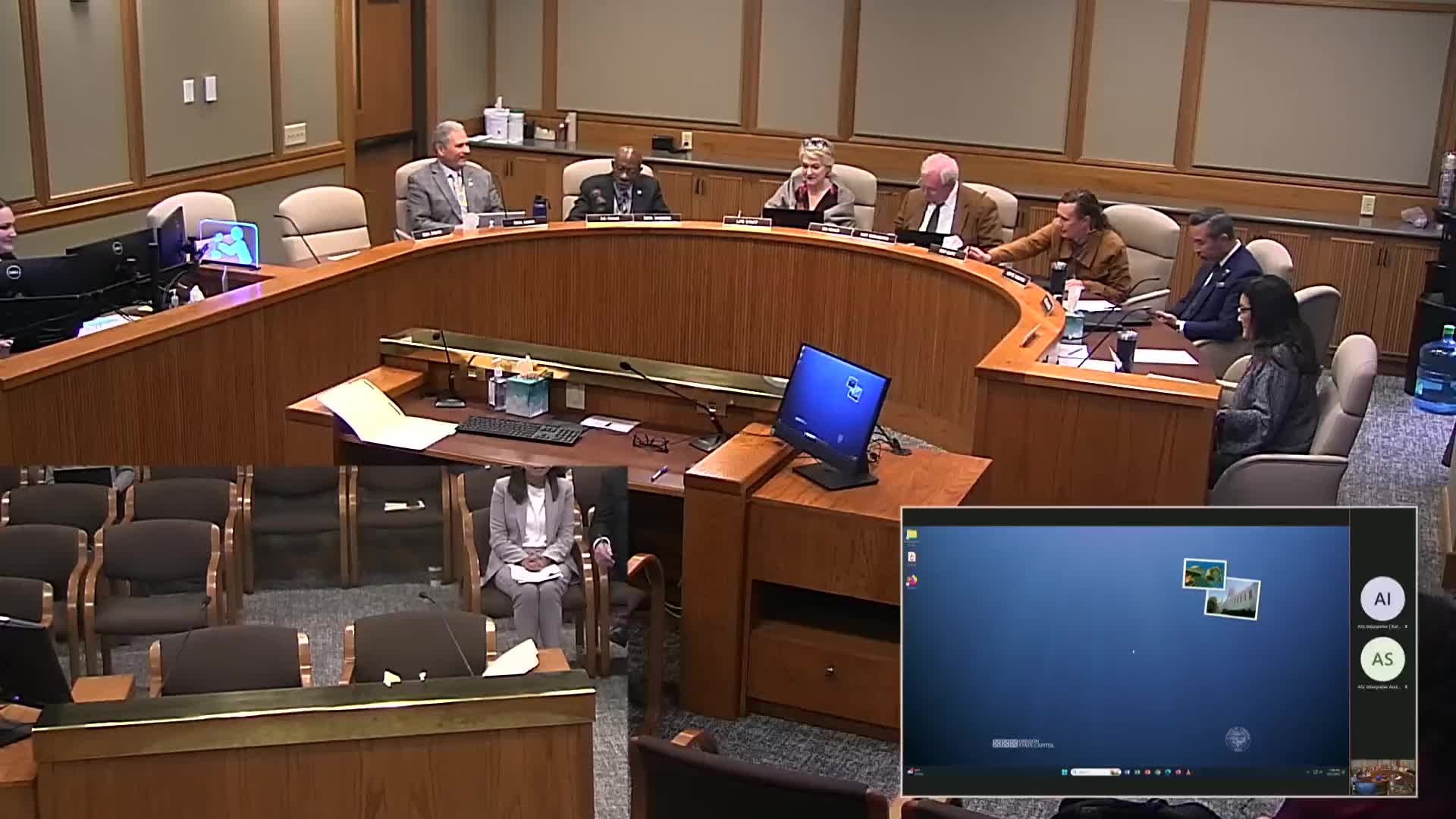
Business Oregon Director Sapon Tieng and Deputy Director Chris Cummings presented an overview of the agency's portion of the governor's budget (House Bill 5024) at an informational meeting of the Transportation and Economic Development Subcommittee, saying the agency's work will be heard across three hearings this week and public testimony will be scheduled separately.
Tamara Brickman, budget and policy analyst at the Department of Administrative Services's Chief Financial Office, told the committee the agency has grown in the dollar value of projects it manages but has not staffed central support functions at the same pace. "The agency has grown in size with respect to the number of dollars that they get out the door, but have not kept up pace with respect to their central services staffing to provide the support to those programs," Brickman said.
The governor's recommended budget request that Business Oregon presented totals roughly $2.1 billion and is dominated by other funds (primarily bond proceeds), with the infrastructure program representing about 74% of planned expenditures. Officials said a substantial portion of the biennial spending is pass-through project payments and debt-service obligations rather than agency operating costs.
Why it matters: The presentation underscored two practical budget issues for the legislature: the agency's need for carryover authority to finish one-time projects funded in the current biennium, and the tension between large, pass-through capital programs and the agency's relatively small operations budget.
Key points from the meeting
- Funding mix and scale: Business Oregon officials said other funds (largely bond proceeds) are the largest funding source, with lottery and federal grants also contributing. Brickman noted 80%+ of Business Oregon's expenditures are special payments that go out the door to local governments, businesses or project sponsors; personal services are roughly 3% of the budget and services and supplies about 2%.
- One-time funds and carryover: Committee members and fiscal staff highlighted that the agency's current-service-level budget is lower than the legislature's approved biennium because a significant share of current spending is one-time. Those projects, many reimbursed on a drawdown basis, will require carryforward expenditure limitation to complete contracts already in progress.
- Program priorities: The governor's request includes recapitalization of several infrastructure funds (special public works, seismic school rehabilitation, and childcare infrastructure), additional port revitalization funding, investments in brownfields redevelopment, a proposed industrial site loan fund, and housing infrastructure support to advance shovel-ready housing projects.
- Performance measures: Deputy Director Chris Cummings walked the committee through key performance measures (KPMs). He said the jobs-created KPM is below its target and noted the metric counts jobs tied to a limited set of direct-investment programs and uses a multi-year horizon. "These targets ' are based only on a few programs that we have," Cummings said. The agency also reported a high number of jobs retained coming out of the pandemic but said those figures were driven by last biennium's policy and funding mix.
- Customer feedback and data limits: Director Tieng and staff said Business Oregon surveys its customers but acknowledged the response rate is low; the agency reported sending about 7,800 surveys and receiving roughly a 5% response rate (about 353 responses), which committee members flagged as a limitation for interpreting satisfaction scores.
- Staffing and vacancies: Business Oregon officials said the agency has expanded staffing in recent biennia and requested approximately 211 positions (about 205 FTE) in the governor's request; they reported roughly 22 current vacancies (about 10% of positions) and said some limited-duration positions were converted to permanent as programs matured.
- Proposed reductions and budget choices: Staff described a vacancy-savings adjustment and several policy option packages, including some reductions required to meet the governor's target. The slides included a hypothetical agency-wide 10% reduction exercise and identified specific proposed adjustments; staff cautioned that most of the agency's dollars are pass-through and cuts would reduce funds to local projects. The presentation also referenced a $10 million lottery bond allocation for county fair resiliency in the package list.
Quotes from the meeting
"The agency has grown in size with respect to the number of dollars that they get out the door, but have not kept up pace with respect to their central services staffing to provide the support to those programs," Tamara Brickman, budget and policy analyst, Department of Administrative Services.
"These targets ' are based only on a few programs that we have. They're not all of our work by any means," Chris Cummings, deputy director, Business Oregon.
Discussion, open questions and follow-up
Committee members pressed staff on how KPMs are constructed, whether job metrics capture the agency's full impact, and how the agency validates job and tax impacts with the Oregon Employment Department. Members also questioned the representativeness of the agency's customer survey sample and requested clearer mapping between specific funding sources (general fund, lottery, bond proceeds, federal grants) and program expenditures.
Next steps
Business Oregon will return for two more informational sessions the committee scheduled; staff said public testimony will be scheduled for a later date (tentatively Tuesday). The agency's slides and project listing are available online and staff offered to provide district-level project detail to legislators on request.
Ending
The subcommittee adjourned after the presentation and discussion, with chairs and members asking the agency to bring more detail on specific KPM calculations, carryover needs, and the fiscal impact of any proposed reductions.