Get Full Government Meeting Transcripts, Videos, & Alerts Forever!
Get email alerts on the Ode Operations topic
No spam. Unsubscribe anytime.
ODE officials outline operations budget, staffing and pandemic-era phase-outs
Summary
Oregon Department of Education officials summarized the agency’s operations budget, described federal off‑ramps and listed governor’s recommended investments in grants management and state school fund modernization.
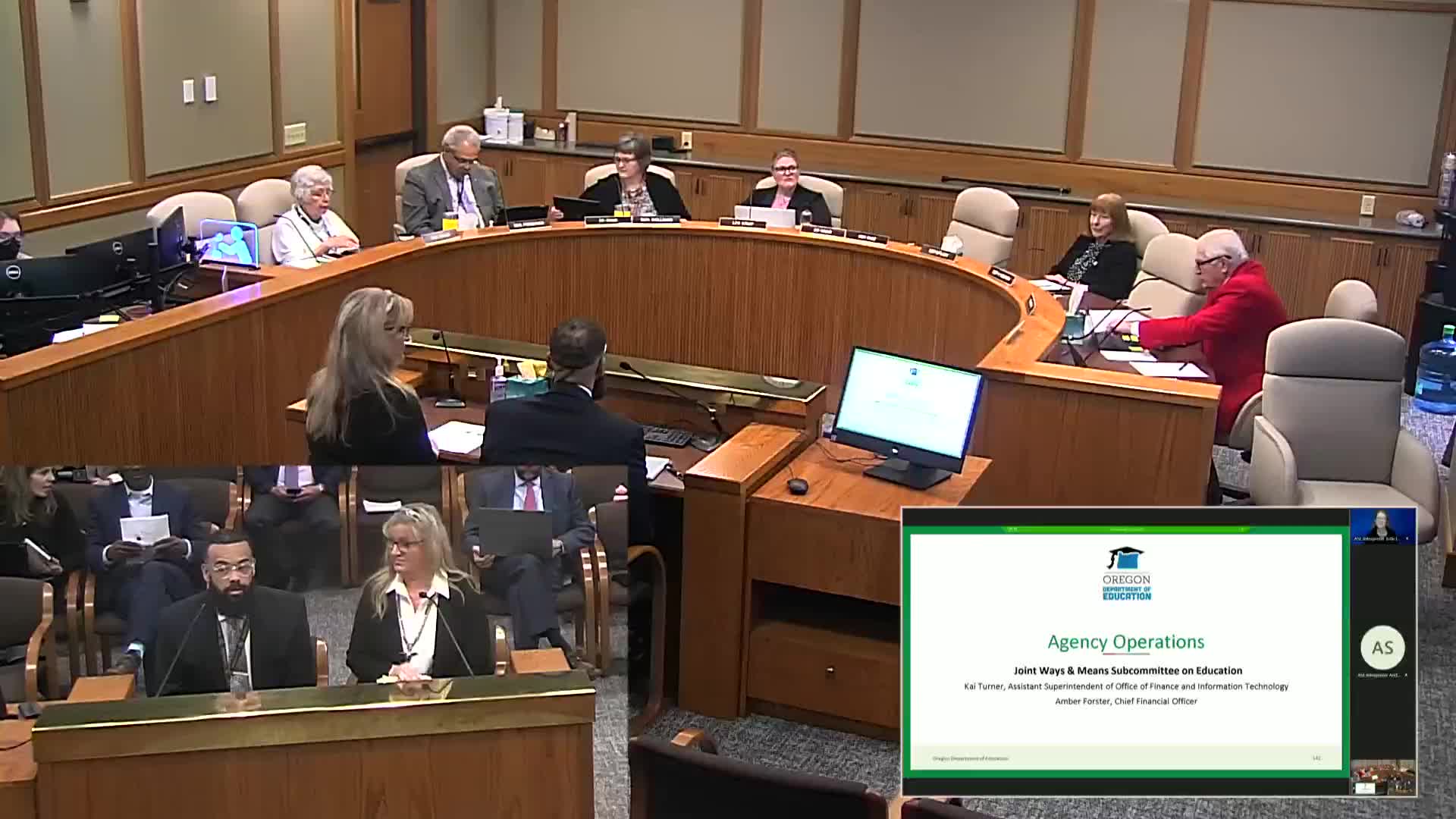
Kai Turner, assistant superintendent of the Office of Finance and Information Technology, and Amber Forster, the department chief financial officer, presented an overview of Oregon Department of Education operations and staffing to the Ways and Means subcommittee on March 12.
Nut graf: The presentation covered the department’s current‑service operational baseline, a sizable phase‑out of pandemic-era federal funding, and governor-recommended investments such as a state school fund modernization effort and a grants management replacement. Officials said back-office costs and state government service charges make up a substantial share of the operations budget.
Top-line figures and structure: Forster told the committee the department’s operations (current-service level, excluding the State School Fund and debt service) totaled roughly $333.6 million with about 692 positions at the 2023–25 LAB. Turner and Forster noted that the Office of Finance and Information Technology represents the largest operations line — in part because it includes rent, agency-wide state service charges and hardware/software costs — and that those agency-wide charges drive a large portion of the operations budget.
Pandemic off‑ramps and technical adjustments: Both presenters said the 2025–27 current-service level reflects the scheduled expiration of pandemic federal funds (for example ESSER) and other one-time funds, which reduces FTE and overall dollars compared with recent biennia. They described cross-cutting technical reductions across operational line items and said the governor’s budget includes targeted investments in specific offices.
Noted investments and program-level details: Presentation highlights included an accountability initiative staffing package, a summer learning evaluation infrastructure package (identified as package 585 in materials) and investments to modernize the State School Fund system and replace the department’s grants-management system. The presenters identified the Office of Equity, Office of Teaching, Learning and Assessment, RADAR (Research, Assessment, Data, Accountability and Reporting), and the Office of Education Innovation and Improvement as major program offices with specific CSL budgets and staff counts.
Questions and follow-up: Committee members asked about changes since the last biennium, interactions with the newly created early learning agency, and how accountability changes might affect RADAR and other offices; presenters said they would provide additional detail and noted ongoing discussions with the governor’s office and agency partners. There were no formal votes taken on the operational presentation.
Ending: The subcommittee moved on after the operations overview and scheduled continuing presentations for subsequent days covering program-specific grant‑in‑aid materials.