Get Full Government Meeting Transcripts, Videos, & Alerts Forever!
Get email alerts on the Youth Development topic
No spam. Unsubscribe anytime.
Youth Development Oregon officials outline grants that reached thousands of young people and seek continued funding
Summary
The Youth Development Division told the Ways and Means subcommittee it used community investment, reengagement and juvenile crime-prevention grants to reach thousands of Oregon youth in 2021–23 and that the governor’s 2025–27 budget would invest in staff and community engagement while reducing some grant dollars.
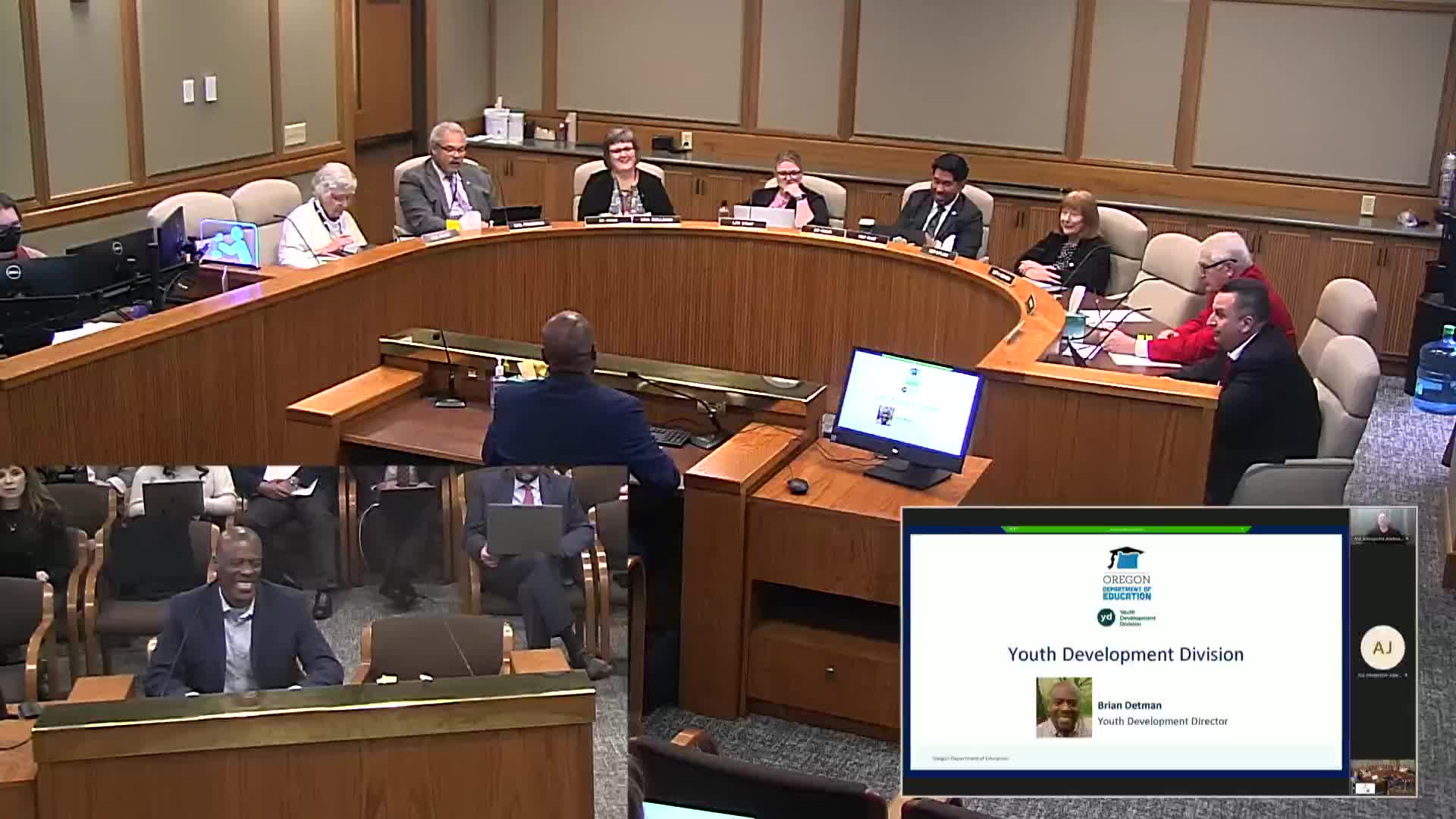
Brian Detman, director of Youth Development Oregon, told the Joint Ways and Means Subcommittee on March 12 that the division’s mission is "all Oregon's youth have the opportunity to thrive and achieve their full potential" and presented program results and budget requests for the coming biennium.
Nut graf: The division reported multi-thousand participant counts across several grant portfolios and said its grant-funded providers operated in all 36 counties and nine federally recognized tribes. Detman asked the committee to consider the governor’s budget package that includes a staff position for community engagement and noted a proposed reduction of about $2.1 million in grant programs.
What the division reported: Detman summarized the 2021–23 biennium results: community investment grants supported more than 10,000 youth ages 6–24 through 88 grants to 69 unique organizations; reengagement grants contacted about 7,500 youth and enrolled about 3,300 in programs that reported 740 credentials earned (493 high school diplomas and 247 GEDs); and juvenile crime-prevention (county and tribal formula) programs served roughly 1,620 youth and—according to third-party evaluation data presented—showed that most youth avoided subsequent juvenile-system involvement in the 12 months after services.
Program details and examples: Detman highlighted grant-funded work in rural areas and named Project Youth Plus (Medford/Jackson and Josephine counties) and Central Oregon Intergovernmental Council’s Compass program (Central Oregon) as examples where outreach, job coaching and employer partnerships helped young people reengage with school and earn credits. He said reengagement grantees perform active outreach (working with districts on students on attendance lists, door-to-door outreach and other engagement) and that the division is moving to collect more participant-level data in the coming biennium to enable longitudinal matching with Oregon Department of Education records.
Budget and staffing: Detman summarized the governor’s 2025–27 grant funding request: total grant programs at about $33.8 million in the governor’s package, with roughly $18.5 million for community investment grants, about $9 million for reengagement system grants, juvenile crime-prevention formula grants near $6.9 million at current service level, and other federal or small grant lines (for example, about $1.3 million in federal DOJ juvenile delinquency funds). He said administration and operations total about $5.1 million with 13 FTE for the division.
Questions and follow-up: Committee members asked where grant dollars are deployed; Detman pointed to a map in the slides showing grants or grantee addresses in every county and tribal nation but said not all grant types are present in every county. Members also asked about outcome measures; Detman said the division will ask grantees in the coming biennium for more identifiable (secure/confidential) data to enable matching with education outcomes such as reading/math scores, promotion to ninth grade, and graduation outcomes.
Ending: Detman closed by thanking committee members and asking for continued support of local partners that implement reengagement, prevention and workforce supports for youth across the state. There were no formal votes on the presentation.