Get Full Government Meeting Transcripts, Videos, & Alerts Forever!
Get email alerts on the State School Fund topic
No spam. Unsubscribe anytime.
Oregon education officials review state school fund formula, explain weights and charter funding differences
Summary
State education officials told the Joint Ways and Means Subcommittee on Education on March 12 that the State School Fund distributes a base per-student amount plus additional "weights" for students and district needs, and explained why some charter schools are funded at 80%.
State education officials told the Joint Committee on Ways and Means Subcommittee on Education on March 12 that the State School Fund distributes a base per-student amount and additional weights to account for special needs and district characteristics.
Vanessa Clark, State School Fund Program Manager at the Oregon Department of Education, told the committee that "ADM is how we refer to student enrollment in the state school fund formula" and explained the related terms ADMR (resident ADM), ADMW (weighted ADM) and extended ADMW, which the formula uses as the higher of the current or prior year.
The nut graf: The State School Fund is a revenue-distribution formula that the department said is designed to balance local resources and statewide equity. Clark and other presenters described how the formula converts the statewide appropriation into a per-ADMW rate, and how weights are intended to target additional resources to students with higher needs.
Most important facts first: Clark said about 82% of ADMW is the enrollment component and roughly 18% represents the additional weights for things such as special education, poverty and other district characteristics. She gave the current per-ADMW distribution figure shown in the presentation: about $10,084 per ADMW for the 2023–24 year, and said the 2023–25 biennial State School Fund appropriation was presented as roughly $10.2 billion and split between the two fiscal years (49%/51%).
How weights work: Clark described common weights, including the IEP weight for students receiving special education services (which she said is capped in law at 11% of a district’s ADMR) and a poverty weight that provides extra dollars to higher-poverty communities. She summarized the fund’s policy principles as equalization (leveling resources across districts) and adequacy (the rate per ADMW over time).
Charter school funding: Representatives asked why some charter schools receive 80% of district funding. Clark and other committee members said the 80% rate reflects a legislative compromise and an intent to leave some funding with the resident district to cover centralized administrative functions and services that districts provide to charter schools (for example, counseling, behavioral health, or special-education services). Clark described that some charter schools operate with varying degrees of autonomy; she said, "we treat them the same [for student-level weights] — they're public schools, if you will" while acknowledging some district-level weights (for example, poverty) are not student-specific and create nuance in allocation.
Local option and carve-outs: Clark said about 20 to 21 districts typically use a local option feature that is paired with a local-option equalization grant to encourage lower-assessed-value districts to ask voters for additional local revenue. She listed a number of carve-outs that sit outside the equalization formula, including a $500,000 charter school transition set-aside and a $5,000,000 per-biennium small high-school supplement.
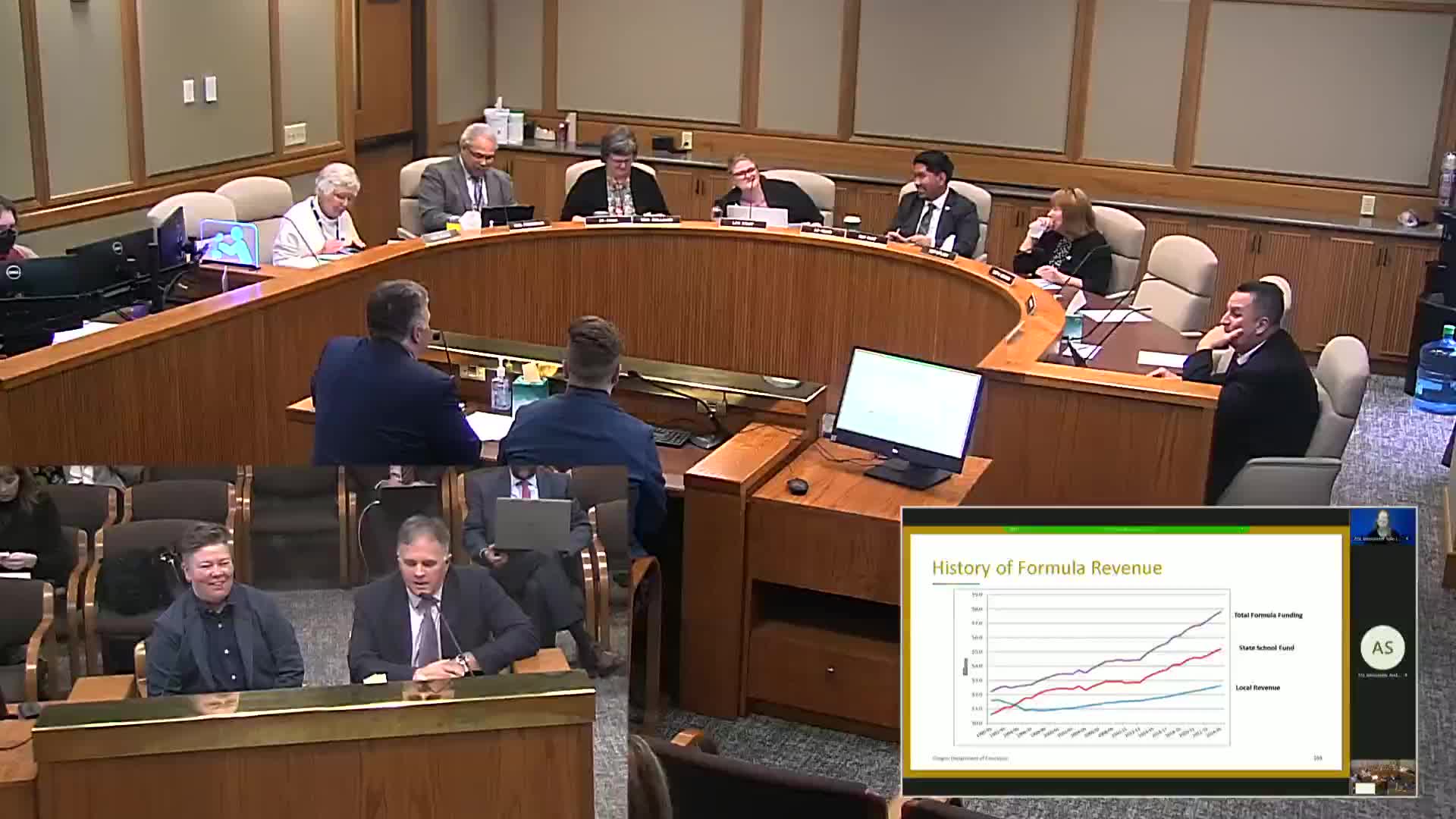
Context and limits: Clark emphasized the State School Fund is currently a revenue formula used to allocate general-purpose grants, the transportation grant and a high-cost disability grant; she said it is not a block grant, reimbursement grant or outcomes-based grant. The presentation compared the nominal ADMW rate across decades and an inflation-adjusted version to show that, adjusted for education inflation, the per-ADMW rate has been relatively flat.
What was not decided: Committee discussion clarified implementation questions but did not produce any motions or votes. Committee members asked for additional detail on how districts provide services to charter-school students and how certain funds are phased out or adjusted in the governor’s budget; presenters said staff would follow up with written detail.
Ending: Presenters paused for additional questions and moved on to the next agenda topic after about 20 minutes of discussion.