Get Full Government Meeting Transcripts, Videos, & Alerts Forever!
Get email alerts on the Healthcare Finance topic
No spam. Unsubscribe anytime.
Senate committee advances provider-assessment bill after debate over insurer fee’s effect on premiums
Summary
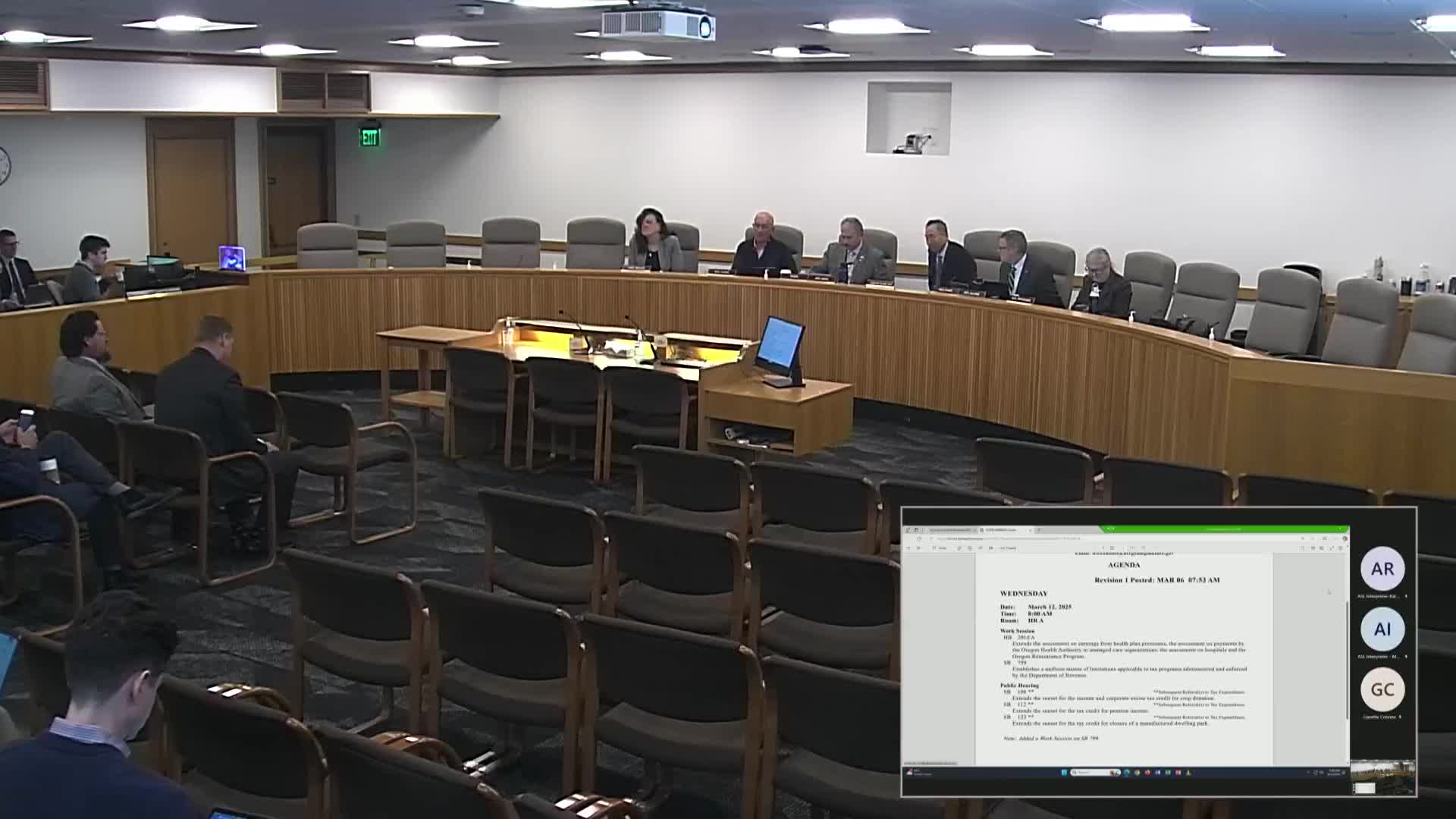
The Senate Committee on Finance and Revenue on March 12 voted to move House Bill 2010A to the floor with a due-pass recommendation after hours of debate over how extending insurer and hospital assessments affects premiums, payer mix and schools. Lawmakers agreed to pursue separate legislation to study exemptions and alternatives.
The Senate Committee on Finance and Revenue voted March 12 to move House Bill 2010A to the Senate floor with a due-pass recommendation after an extended work session focused on the state’s provider-assessment program and a proposed amendment to exempt certain payers.
Supporters and critics sparred over whether extending a 2% insurer assessment and a statewide hospital assessment would push individuals and small employers out of commercial coverage and into ERISA plans or the Medicaid program. Senator Caden, who led the amendment drive, said the assessment has driven a substantial payer shift and urged more study: “If you decrease a pool by 20 or 30% in premium to pick up 50 or a hundred million dollars you have really hurt the provider networks,” he told the committee.
The bill as drafted extends two assessments used to draw federal matching funds: an insurer assessment (currently proposed at 2% of certain premiums) and a hospital assessment (a revenue-based assessment sent to CMS as part of an intergovernmental transfer). Legislative Revenue Office materials in the packet estimate the insurer assessment would add roughly $150 million in biennial revenue from the individual and small-group markets and roughly $43 million from school districts, though committee members said some of those estimates remain uncertain.
Senator Daniel Bonham, citing hospital testimony from his district, pressed the committee on the consequences for rural hospitals if commercial payer revenue declines. “A commercially insured birth, the hospital makes about $31,000; a Medicaid birth, they lose $17,000,” Bonham said, arguing that losing commercially insured patients can force service reductions.
Proponents of an amendment labeled A3 (introduced by Senator Caden in committee) asked the committee to exempt individually insured people, small-group plans and school districts from the insurer assessment. They argued the exemption would stop a market shift that has reduced the individual market by about 25–30 percent since the assessment was implemented and would remove roughly $146 million from the bill’s projected biennial revenue, creating a funding gap proponents said could be backfilled by including ERISA-covered plans or by other revenue sources.
Opponents and several committee members warned that carving out groups now could imperil the package before the Legislature and that some of the largest potential offsets — notably a pending or proposed intergovernmental transfer (IGT) tied to a possible Legacy–Oregon Health & Science University alignment — remain uncertain. Senator Caden and others argued that if Legacy were folded into OHSU’s IGT, it could generate roughly $440 million in additional provider assessment revenue over a biennium, a number proponents said would more than cover the exemption.
Committee chair Meek and other members agreed to advance the base bill to provide budget certainty while pledging to draft separate, follow-up legislation for the policy questions raised in the hearing. Representative Rob Nosse, present from the House, said the separate work should focus on policy options rather than immediate revenue changes. The committee kept the record open for additional work and discussion before final floor action.
The committee’s action sends HB 2010A forward while creating a path for additional committee or committee-carried legislation to study ERISA inclusion, alternative assessment mechanisms and potential hold-harmless provisions for schools and small employers.