Get Full Government Meeting Transcripts, Videos, & Alerts Forever!
Get email alerts on the Officer Certification topic
No spam. Unsubscribe anytime.
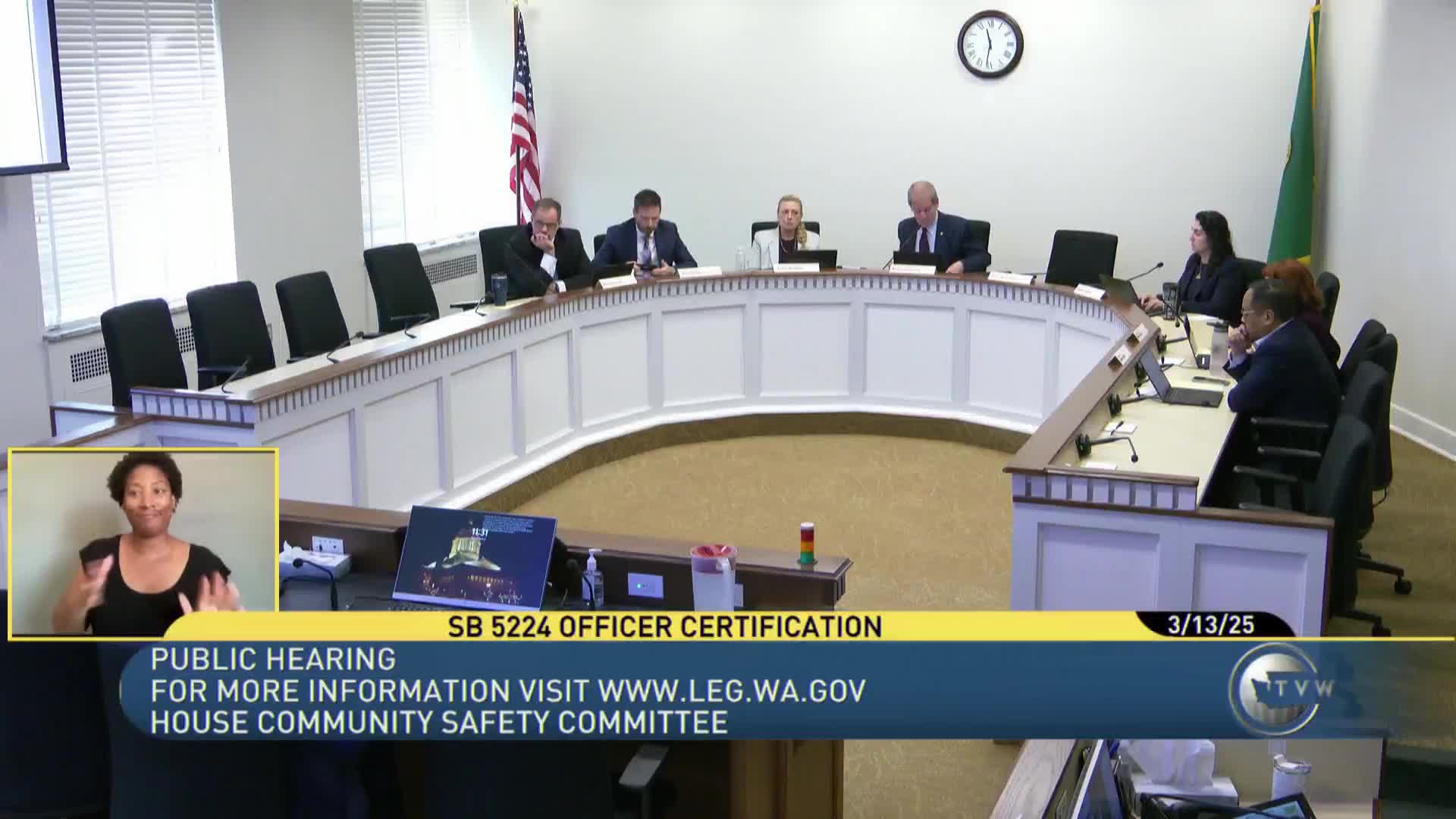
Committee reviews technical changes to officer certification, background checks and hearings
Summary
Senate Bill 52-24 would clarify certification and commissioning language at the Criminal Justice Training Commission, require background checks on certain transfers between officer types, and remove a statutory requirement that the administrative law judge issue a proposed recommendation before a five-member panel issues a final decision.
Senate Bill 52-24, a companion to legislation previously heard in the House, would align definitions and processes used by the Criminal Justice Training Commission (CJTC) for certifying peace officers, corrections officers and limited-authority officers.
Staff explained the bill narrows and clarifies terms such as “certified” and “commissioned,” establishes that applicants moving between certified positions must meet background-investigation requirements, and removes a statutory step requiring an administrative law judge (ALJ) to issue a proposed recommendation before a five-member CJTC hearing panel issues a final decision.
James McMahon of the Association of Sheriffs and Police Chiefs supported the bill and explained that the background-investigation requirement is intended to apply to applicants moving into a new certified position, not to temporary or emergency shift reassignments within a department. “If I worked as a corrections officer and I wanted to go be a sheriff's deputy… I do need to go apply to be a peace officer, get my peace officer certification,” McMahon said. But he and others clarified that short-term reassignments to cover staffing shortages do not trigger the applicant certification process.
Kimberly Bliss, assistant director for certification at CJTC, explained the provision about administrative law judges is intended to reduce duplication and shorten the time to a final order. She said CJTC typically pays for both the ALJ's work and Attorney General representation for the hearing panel; removing the statutory requirement that the ALJ draft a proposed order will shorten timelines and reduce duplicate work. Bliss said the ALJ would still preside over hearings and rule on evidentiary matters.
Committee members asked for clarification about temporary reassignments, training requirements, and when a full certification process is required. Witnesses confirmed current law requires certification for transfers between officer types and that the bill is intended to clear up ambiguity and speed administrative timelines rather than expand authority.
No committee vote was taken.