Get Full Government Meeting Transcripts, Videos, & Alerts Forever!
Get email alerts on the Judiciary Administration topic
No spam. Unsubscribe anytime.
Bill to remove city-residency requirement for pro tem municipal judges debated
Summary
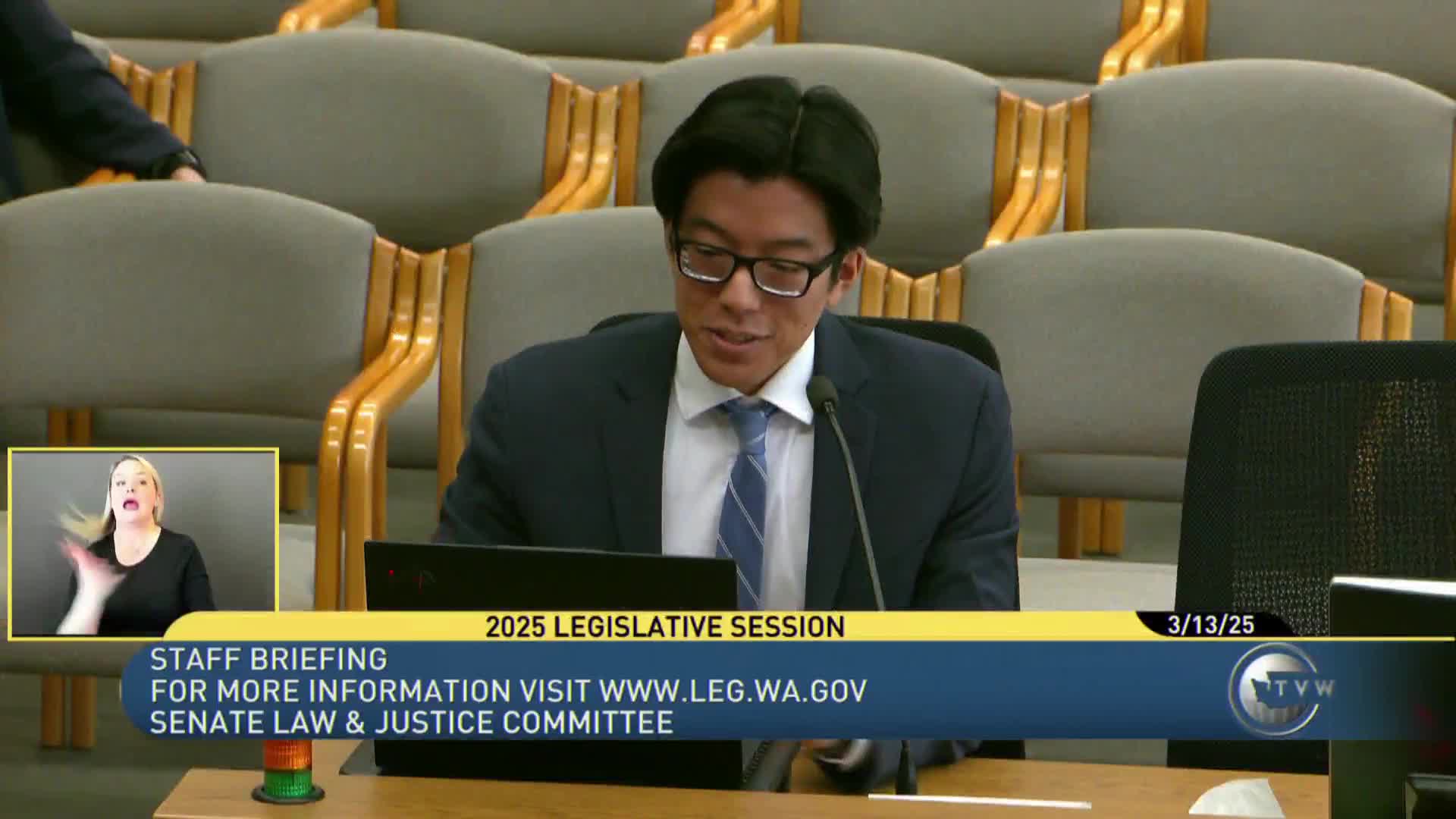
The Law & Justice Committee on March 13 heard public testimony on House Bill 1112, which would repeal a requirement that judges pro tem in cities with more than 400,000 residents live inside the appointing city.
The Law & Justice Committee heard public testimony on House Bill 1112 on March 13. The bill, introduced by Representative Daria Farvar, would remove the requirement that judges pro tem in municipalities with populations over 400,000 must reside in the appointing city.
Staff counsel Ryan Giannini explained that municipal courts have authority to appoint judges pro tem with the same powers as sitting judges, but current law requires those pro tem judges to reside in the city for jurisdictions above the 400,000-population threshold. Giannini said the bill would retain licensure and state-elector qualifications while eliminating the city-residency requirement.
Representative Farvar said the change would expand the pool of available pro tem judges, helping overburdened court systems in large cities to fill temporary vacancies: “When judges need to take a moment to step away from the bench, we need to make sure that we've got enough people who can step into their stead to make sure that justice is served quickly,” Farvar told the committee.
Judge Chess of Seattle Municipal Court testified in support, saying Seattle struggles to recruit pro tem judges because of the city’s high cost of living and that many experienced attorneys willing to serve do not live inside Seattle city limits. “Most of the pro temps are in the jurisdictions around us and they'll tell us all the time we would…love to come over in Pro Tem but I don't live in the city of Seattle,” the judge said.
A fiscal note was requested during the briefing. No committee action or vote was taken at the hearing; the item remains at the public hearing stage.