Get Full Government Meeting Transcripts, Videos, & Alerts Forever!
Get email alerts on the Reentry Transportation topic
No spam. Unsubscribe anytime.
Committee hears bill to lift $100 cap on DOC release transportation, require coordination with reentry providers
Summary
A bill before the House Community Safety Committee would remove an outdated $100 cap and the “cheapest method” requirement on transportation for people leaving Department of Corrections custody and require DOC to coordinate releases with nonprofit reentry partners to reduce late-night, unsafe arrivals.
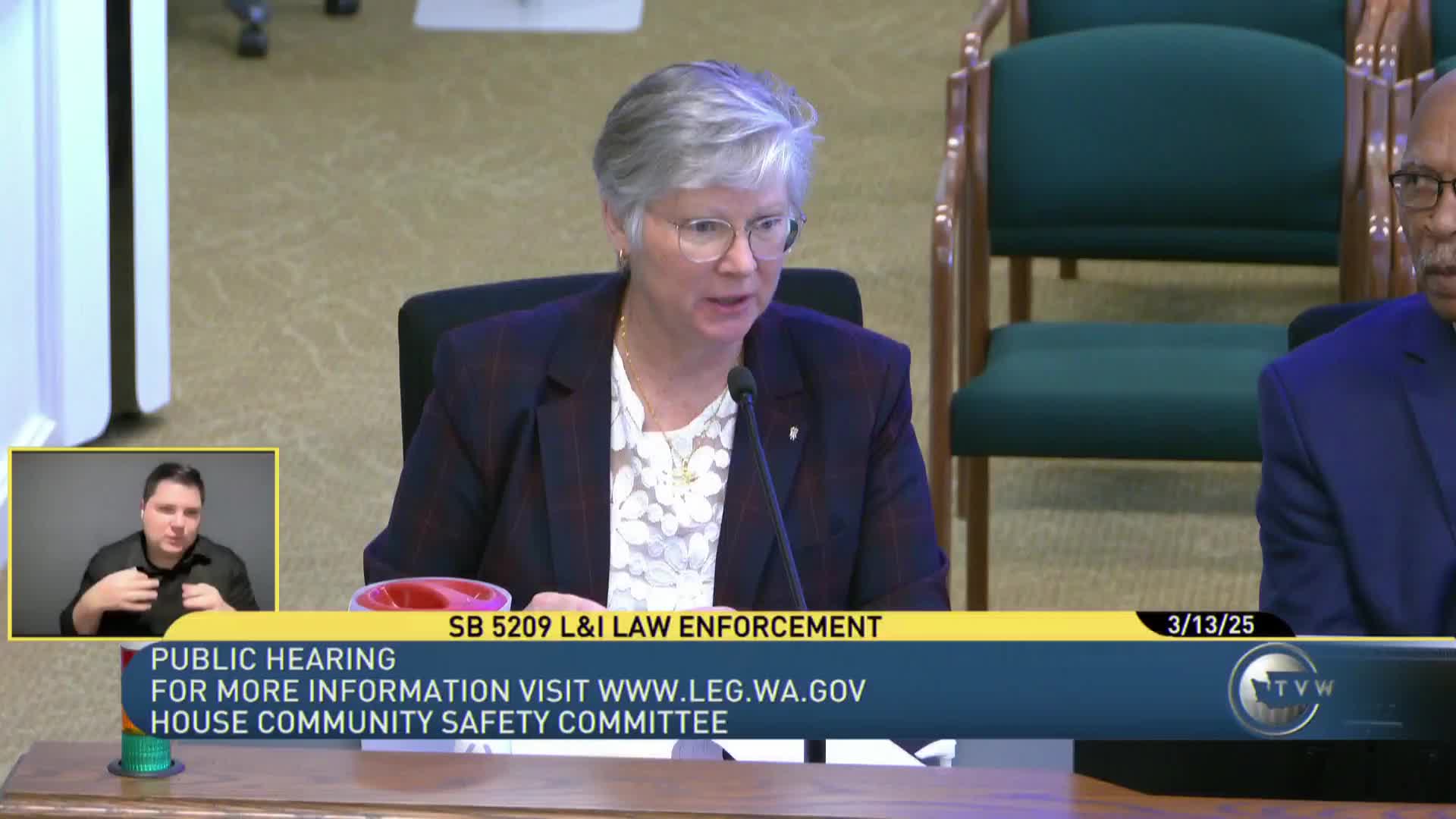
Senator Claire Wilson on Thursday told the House Community Safety Committee she brought Engrossed Substitute Senate Bill 50-29 to remove an outdated $100 cap and a requirement that the Department of Corrections use the least expensive public transportation when arranging travel for people being released from state custody.
“Currently, DOC…has to release an individual using the least expensive method of public transportation, which often means putting people on a bus at 3 a.m.,” Senator Claire Wilson said. “The $100 limit was established in state law in 1971.”
The bill would require DOC to provide transportation to a person’s residence, the location in their reentry plan, or the place from which they were committed. DOC would no longer be limited to selecting only the least expensive public-transportation option not to exceed $100, though the bill keeps other limits such as in-state travel and interstate-compact rules when applicable. The superintendent would continue to have authority to review, approve, or deny transportation expenses.
Lina Langer, counsel to the committee, summarized the current statute: people discharged from custody must be supplied with suitable clothing, at least $40 for subsistence, and transportation by the least expensive public transportation not to exceed $100 unless the superintendent determines the person has ample funds. Langer also noted that the interstate compact for adult offender supervision continues to govern transfers to other states.
Kristen Morgan, senior administrator in DOC’s reentry division, said the department supports the bill and explained why the existing statutory cap creates consequences for reentry. “The unintended consequence of this requirement often forces individuals to rely on less efficient transportation involving multiple transfers, stops, and potential delays, particularly for individuals who are releasing to rural areas,” Morgan said. She added those delays can “result in violations or other sanctions” when people miss required appointments.
Senators, representatives and witnesses described operational problems tied to the $100 cap and the “cheapest” mandate: people arriving late at night to bus terminals, long waits, missed pickups by reentry organizations, and difficulties for individuals who have spent long periods incarcerated. Percy Levy, public outreach specialist with the Washington Defender Association and formerly incarcerated, recounted being dropped at a bus station and unable to contact reentry supports immediately after release.
DOC staff told the committee the agency normally schedules releases in the morning but that long inter-county transports on low-cost routes can cause late arrivals under the current rule. DOC said in fiscal year 2024 the system released just over 5,000 individuals and that transportation allotments for those releases were about $90,000 in total. The department’s fiscal note to the committee listed the anticipated fiscal impact as indeterminate but less than $50,000.
Committee members asked whether the bill would allow DOC to coordinate with nonprofit vans or reentry organizations; Wilson and Morgan said the bill requires reasonable efforts to coordinate with nonprofits and community partners when appropriate. The bill does not create a new entitlement to out-of-state travel except under the interstate compact or other legal agreements.
No formal action or vote occurred; testimony concluded and the committee moved to the next agenda item.