Get Full Government Meeting Transcripts, Videos, & Alerts Forever!
Get email alerts on the Creative Economy topic
No spam. Unsubscribe anytime.
Commerce official outlines Washington’s creative economy growth, strategy and workforce plans
Summary
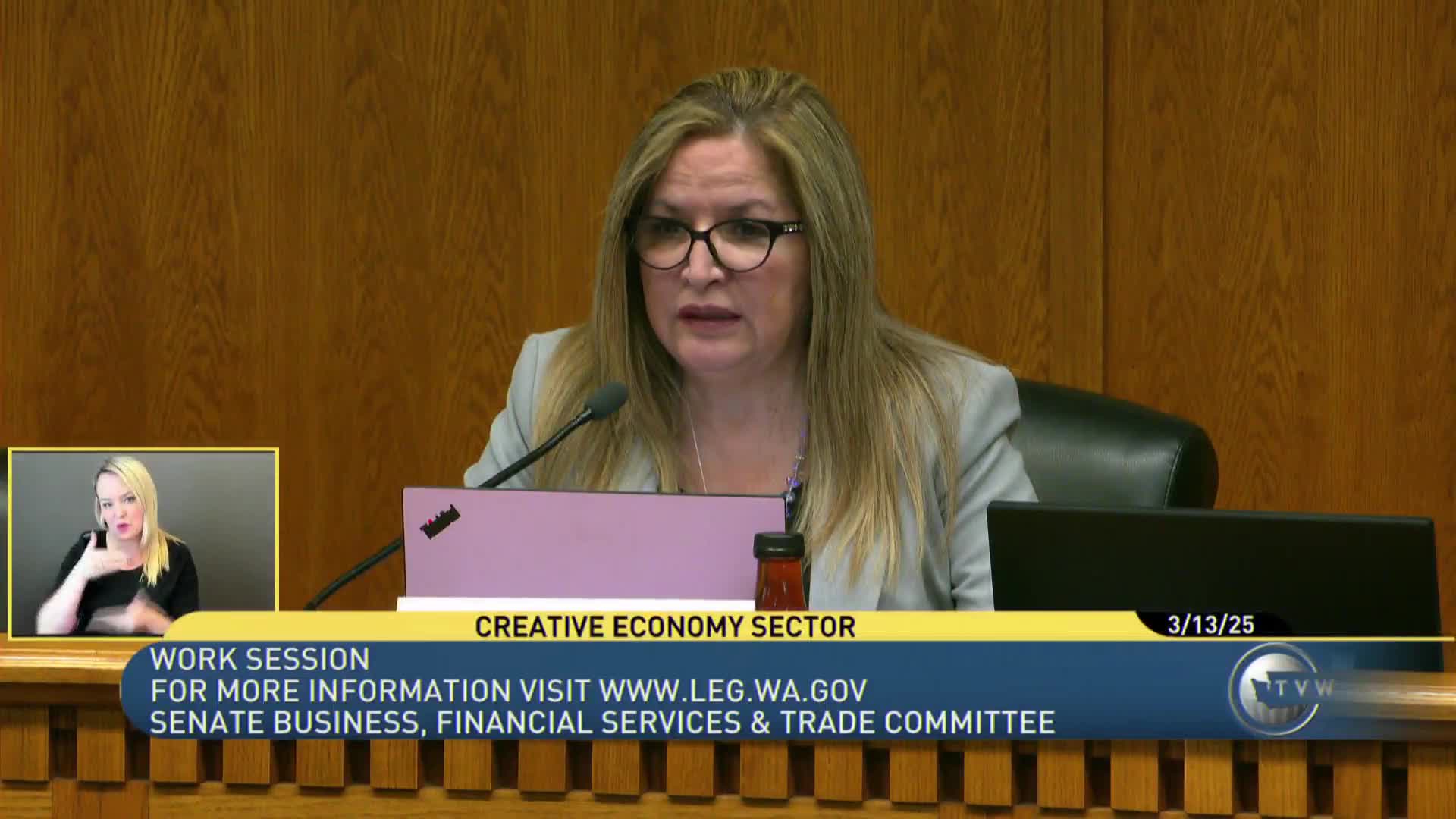
Shannon Roach Halberstadt of the Washington State Department of Commerce told the Senate Business, Financial Services, Gaming & Trade Committee that the state’s creative economy supports tens of thousands of jobs and is guided by a strategic plan emphasizing equity, investment, skills and sector development.
Shannon Roach Halberstadt, creative economy industry sector lead for the Washington State Department of Commerce, told the Senate Business, Financial Services, Gaming & Trade Committee on March 13 that Washington’s creative economy employs more than 91,000 people and accounts for roughly $70.2 billion in economic value.
Halberstadt said the creative economy “means jobs and it means businesses right here in Washington state,” and described the sector as including architecture, culinary arts, cultural institutions, creative technology, design and advertising, fashion, film and television, music, performing and visual arts, and publishing. She cited United Nations estimates that put the global creative economy at about $2.3 trillion and nearly 50 million jobs worldwide.
The department presented key data showing Washington’s creative industries generate 5.1% of state employment and 7.6% of compensation, with creative activity accounting for 9.5% of state GDP — a rate Halberstadt described as “the densest” in the nation. She highlighted creative technology and digital entertainment, noting Washington’s video game market produces roughly $13.9 billion in statewide impact and that the sector supports high-paying jobs.
Halberstadt described the state’s 2022 authorization of a creative-economy strategic plan developed with a 34-person work group and more than 400 stakeholders. She summarized four strategic priorities in that plan: equity and access; infrastructure and investment; learning and skills; and sector and workforce development. The plan itemizes roughly 30 implementation tactics the department is pursuing or planning.
Examples of recent initiatives she cited include: Commerce’s Innovation Accelerator Cluster Program (ICAP) work with the music industry and Washington Music and Nightlife Association; support for a Cascadia music corridor consortium; participation at Gamescom (Cologne) and other international trade events to promote Washington game studios; assistance with a solar-feasibility study at Harbor Island Studios; and support for the Motion Picture Competitiveness Program implemented by Washington Film Works.
Halberstadt said Commerce is working on strengthening career pathways between K–12 education and creative industry entry roles, with plans for creative apprenticeships targeted for implementation at two high schools by 2026 and meetings planned with state workforce board leaders. She also said the department supports aligning creative-industry recognition within partner networks such as the Employment Security Department (ESD), Department of Revenue (DOR), Career Connect Washington and Skills Centers.
Committee members asked about Commerce staff capacity and funding. Halberstadt said she is currently the sole dedicated creative-economy industry sector lead in Commerce but that the department coordinates across industry-sector leads and with external partners. She said the program operates largely through partnerships and stakeholder networks and that Commerce is pursuing budget discussions with the governor’s office and legislature to secure additional resources for business development, incubation hubs and workforce pipeline work.
Halberstadt invited committee members to follow implementation items that include the April 2025 release of a Washington Music Census at the National Music Policy Forum and the continued development of industry clusters, association support and apprenticeship and pipeline efforts.
Halberstadt concluded by saying success will be visible in increased creative-cluster development, clearer career pipelines and improved economic outcomes for underinvested individuals and communities.