Get Full Government Meeting Transcripts, Videos, & Alerts Forever!
Get email alerts on the Benchmark Process topic
No spam. Unsubscribe anytime.
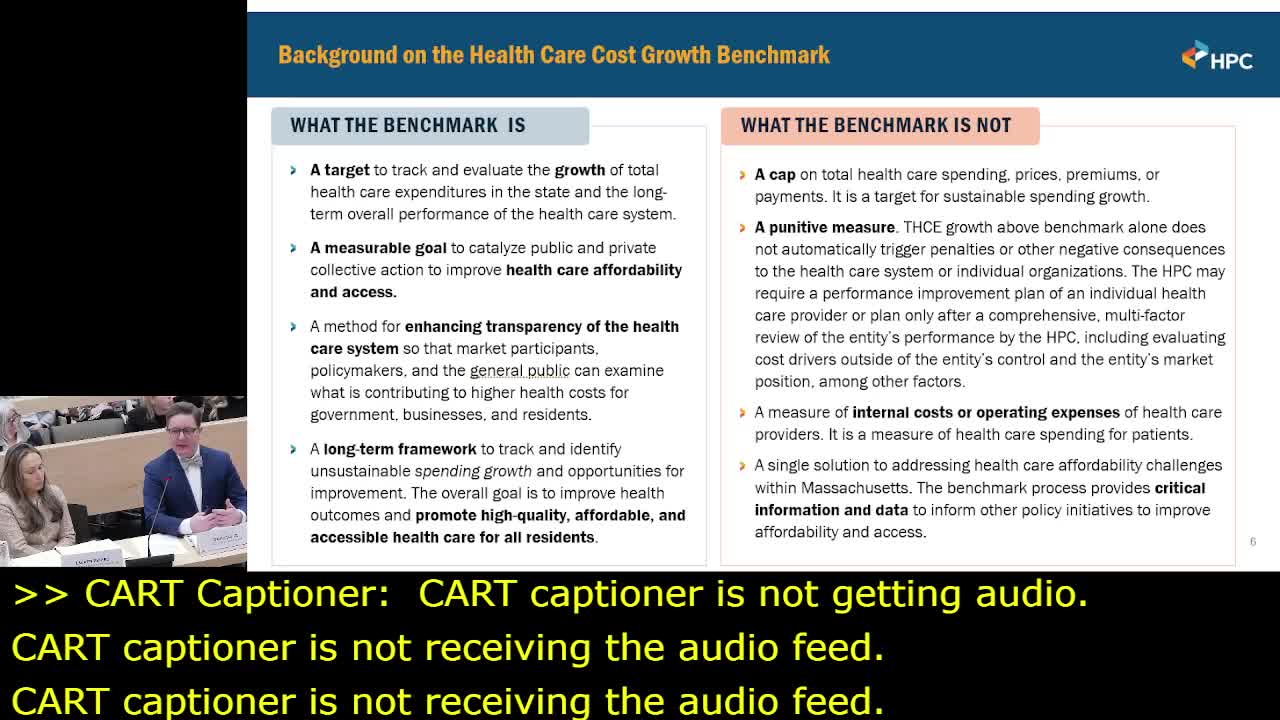
HPC outlines legal process and oversight for setting Massachusetts health cost benchmark; performance plans remain available tool
Summary
The Health Policy Commission explained the statutory framework for setting the annual health care cost growth benchmark and the commission’s process for reviewing providers and payers whose spending exceeds the benchmark.
Health Policy Commission executive director David Seltz told the commission and the joint legislative committee that the benchmark is set under state law and the HPC has discretion — within statutory limits — to modify it each year after a public hearing and consultation with the Joint Committee on Health Care Financing.
Seltz reviewed the law’s phased approach: in the statute’s first five years the benchmark was a fixed PGSP‑based rate of 3.6%, then the law tied the benchmark to potential gross state product minus 0.5 percentage points for the next five years while permitting limited modification. After the 10‑year mark, the statute preserves the benchmark’s tie to long‑term economic growth but gives the HPC broader discretion to raise or lower the benchmark if warranted.
“Now after year 10, we are in a new phase as prescribed by the law where, again, the default rate for the benchmark to be set every year is still tied to that long term economic growth rate, but it does allow broad discretion to the HPC board to either raise or lower the benchmark if it feels that it is warranted to do so,” Seltz said.
Seltz described the multi‑step accountability and referral process that can follow a benchmark decision: CHIA compiles health plan and provider spending and refers confidentially to the HPC a list of providers and payers whose growth exceeds the benchmark; the HPC conducts a comprehensive review (pricing, payer mix, populations served and any external factors) and then may vote in public to require a performance improvement plan (PIP) if it determines such a plan is warranted. Seltz noted the commission has required a single PIP in its history — for Mass General Brigham — which the commission said yielded an estimated $170 million in near‑term savings through care management and other measures.
Seltz emphasized the board would not vote on the benchmark at the hearing and that the HPC’s board vote to establish the 2026 benchmark was scheduled for a later meeting (announced at the hearing as April 17). He also noted that if the board decides to modify the benchmark upward or downward, additional legislative oversight by the Joint Committee on Health Care Financing would be required under the statute.
Seltz and other HPC staff explained that CHIA’s annual report is a central input but “not the sole piece of information” used to consider a modification; the commission also examines price trends, patient acuity, capacity and affordability measures, and the economic outlook. Staff said they review the most recent data available to determine whether a modification would be appropriate and to identify which providers or payers might need closer review.
During discussion commissioners and legislators asked about changes proposed in the legislature — including multiyear benchmarks — and staff cited other states' approaches (California, Oregon, Rhode Island, Connecticut) that set targets or sector‑specific goals. Staff said sector‑specific benchmarks are one policy option to address price variation among hospitals and allow targeted expectations for high‑value areas such as primary care.
Seltz also acknowledged that the referral list the commission receives from CHIA is currently confidential and said the commission was considering whether more of that process should be public; he recommended greater public disclosure in future refinements of the process.
No formal board action on the benchmark occurred at the hearing; the HPC board will meet later to vote and any board modification would trigger statutory legislative review and potential follow‑up actions such as referrals for performance improvement plans.