Get Full Government Meeting Transcripts, Videos, & Alerts Forever!
Get email alerts on the State Revenue Forecast topic
No spam. Unsubscribe anytime.
OMB revises North Dakota revenue outlook downward as oil-price and extraction-tax effects cut receipts
Summary
The Office of Management and Budget told the Joint Appropriations Committee that lower oil-price assumptions and a falling effective oil-extraction tax rate driven by stripper-well exemptions reduce next-biennium revenue projections by about $591 million versus the January forecast.
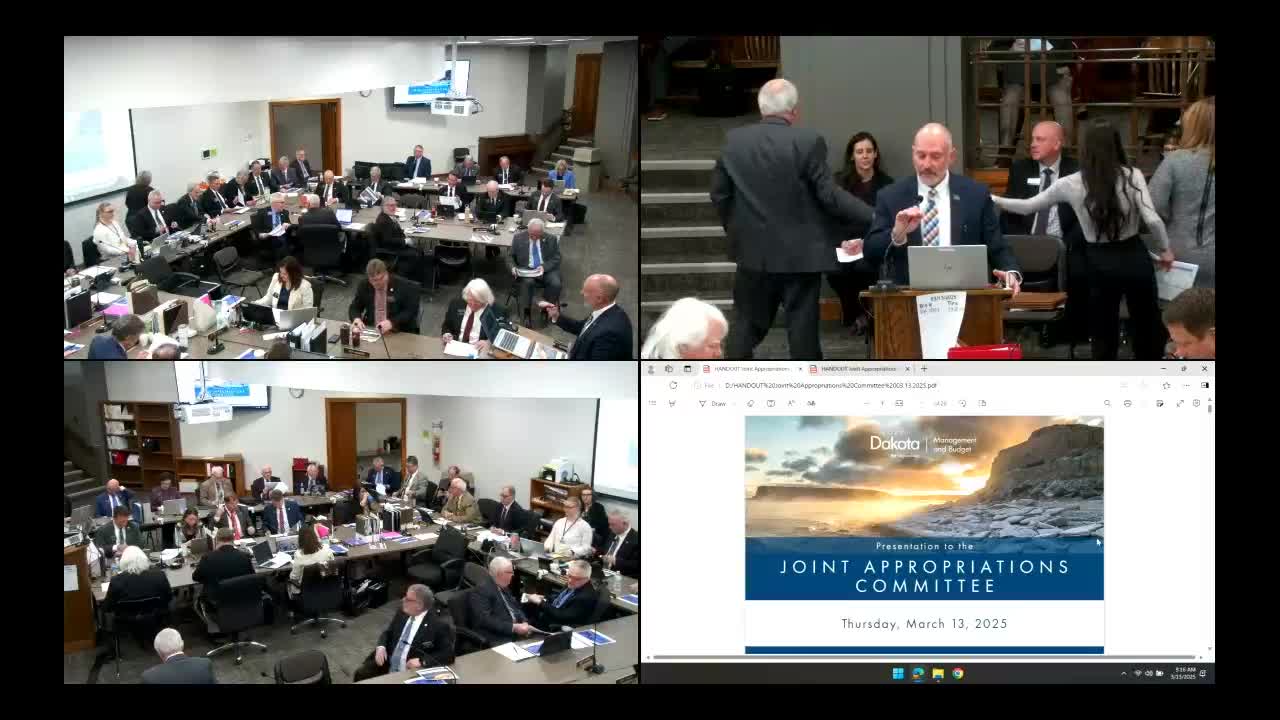
Joe Morrison of the Office of Management and Budget told the Joint Appropriations Committee the department’s March revenue update lowers the state’s 2025–27 outlook owing mainly to lower assumed oil prices and an adjustment to the effective extraction tax rate as more wells qualify for the stripper-well exemption.
Morrison said North Dakota had collected about $4.65 billion in oil-related taxes through Feb. 28 and that, to reflect recent futures markets, OMB trimmed its oil-price assumptions for the next biennium to about $59 per barrel in the first year and $57 in the second year. Those trimmed price assumptions account for roughly $200 million of a roughly $591 million reduction between the January and March forecasts, Morrison said.
The forecast revision also reflects a change to the effective oil-extraction tax rate caused by an increase in wells qualifying for the stripper-well exemption. Morrison said the tax department’s current data show about 48 percent of producing wells now meet the exemption rule, reducing the effective extraction tax rate from the roughly 4.8 percent used in prior forecasts to about 4.3 percent in the current biennium; OMB used an average 4.0 percent effective rate for the 2025–27 biennium. Morrison said the model change tied to stripper-well status explains most of the remaining $370–$380 million of the forecast revision.
Morrison walked committee members through the distribution formulas that flow oil collections to the legacy fund and to a series of infrastructure buckets. He noted the legacy fund is 30 percent of collections and that, under the revised forecast, some downstream infrastructure buckets that had previously been projected to fill fully would fall short. Morrison said the municipal, county-township and airport infrastructure buckets would each receive about $61 million under the revised outlook — a shortfall compared with prior expectations — and that certain bottom‑tier State Investment Fund (SIF) allocations would not be available under the reduced projection.
Morrison also summarized biennium-to-biennium totals and balances: the state’s current biennium collections and the preliminary beginning balance flow into the next biennium as one-time resources, he said. He told members the revised forecast still shows overall biennial growth between the two biennia but that the downward revisions are material for mid- and lower-tier distributions.
Why it matters: Oil-related taxes are a large driver of North Dakota general fund receipts; the combination of lower price assumptions and more wells qualifying for the extraction exemption materially reduces projected receipts and affects which infrastructure and grant buckets will receive funds.
Morrison took questions from members about stripper-well rules, secondary recovery and how future enhanced-recovery investments interact with exemption status. He said once a well meets the exemption definition it remains exempt even if production increases later.