Get Full Government Meeting Transcripts, Videos, & Alerts Forever!
Get email alerts on the Economic Outlook topic
No spam. Unsubscribe anytime.
Moody’s, S&P Global tell appropriations committee tariffs and slower hiring could damp growth
Summary
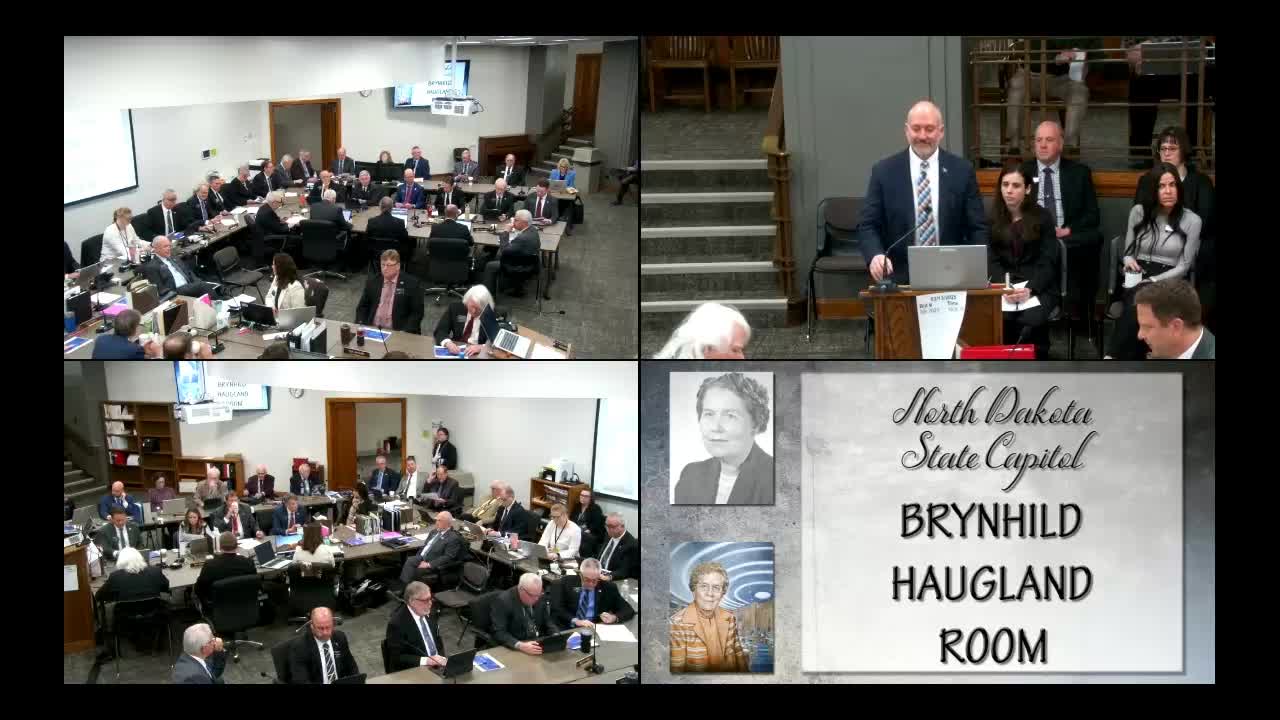
Moody’s economist Emily Mandel and consultants from S&P Global told the Joint Appropriations Committee that the U.S. economy and North Dakota should keep expanding but at a slower pace, and that new tariff plans and other risks could slow hiring, consumer spending and state revenues.
Moody's economist Emily Mandel and consultants from S&P Global presented separate but largely consistent outlooks to the Joint Appropriations Committee, saying the U.S. and North Dakota economies are still expanding but that new tariffs, higher prices in some sectors and slower job growth will likely trim momentum over the next two years.
Mandel, identified as an economist who works with the state forecast team, said the U.S. “is still expanding. It’s still on track. We’re still growing, although a little bit more slowly.” She told lawmakers that while consumer spending remains solid — about 3 percent year over year in her presentation — much of that growth has come from services rather than goods, which has implications for sales-tax receipts.
The Moody’s baseline included two key risks: higher effective tariffs and restrained business investment. “Our baseline outlook calls for a 10% effective tariff rate in the near term,” Mandel said, and she added that the combination of tariffs and higher input costs could push inflation modestly higher before easing. Mandel also said Moody’s expects the Federal Reserve to pause on rate cuts and to start cutting “beginning in September,” a timing she said reflects a cautious policy response to inflation and labor-market strength.
Dan McLaughlin of S&P Global’s Applied Economics Consulting Group presented S&P’s revenue-driver estimates for North Dakota and highlighted largely parallel themes. S&P expects sales-and-use-tax collections to grow about 3.3 percent in the current fiscal year but said vehicle excise collections have declined and are projected to remain soft in the short term. “Motor vehicle excise tax has declined by 8% through the first half of fiscal year 2025 compared to the previous year,” McLaughlin said, and S&P’s model implies a roughly 6.5 percent decline for the fiscal year.
S&P’s presenters also flagged trade-policy uncertainty as a material downside risk for commodity markets and state revenues. Nathan Carson, S&P’s commodity specialist, said the recent tariff actions and the potential for reciprocal tariffs are altering export patterns for soybeans, corn and other crops and that those developments have already reduced soybean and corn price forecasts. Steven Adams, S&P’s energy director, said global spare capacity in OPEC and U.S. production trends are also pressuring oil prices.
Both Moody’s and S&P emphasized uncertainty. Mandel said consumer delinquency measures in North Dakota look better than the U.S. average and that credit-card delinquencies have stabilized, but she cautioned that “there is a lot of uncertainty” from trade policy that could affect investment and hiring. S&P’s scenarios showed a wider range of outcomes in the 2025–27 biennium as the time horizon lengthens, with deviations driven primarily by oil-price paths and the scale of trade-policy escalations.
Why it matters: The presentations supply the outside-economist inputs the committee uses to revise the state’s revenue forecast. Stronger service-sector spending helps sales-tax collections, while lower vehicle purchases, commodity-price declines and new tariffs can reduce receipts that fund state programs.
The committee heard both briefings in the morning session and will use the presentations as inputs to upcoming budget and revenue decisions.