Get Full Government Meeting Transcripts, Videos, & Alerts Forever!
Get email alerts on the Rural Catalyst Grants topic
No spam. Unsubscribe anytime.
Rural catalyst grant bill pressed as means to fund small-town quality-of-life projects
Summary
Senate Bill 23‑90 would create a Rural Catalyst Fund and committee to distribute grants for small‑town quality‑of‑life projects, and regional councils urged larger funding and flexible matching rules so meaningful projects can move forward.
Senate Bill 23-90, introduced as a rural catalyst grant program, received testimony from regional planning councils, economic development organizations and agricultural groups urging the House Political Subdivisions Committee to support flexible state grants for small-town quality‑of‑life projects.
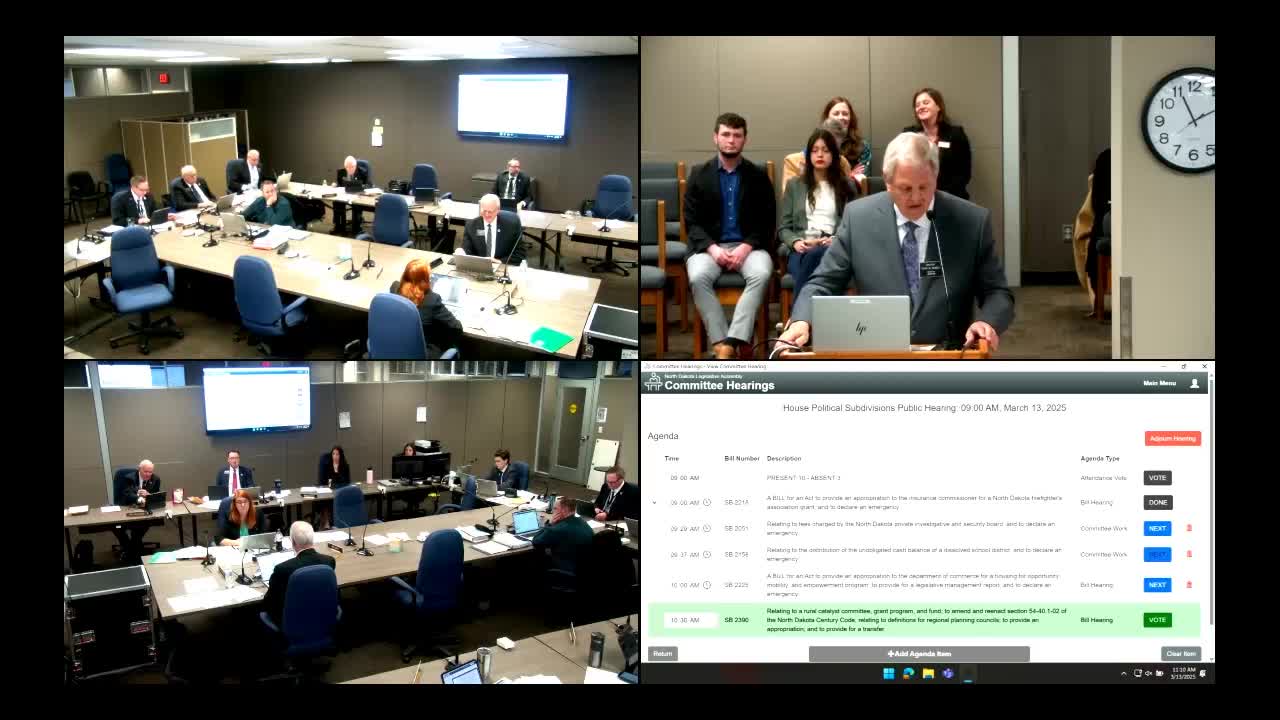
Senator Terry Wanzik, sponsor of the bill, told the committee the program would create a Rural Catalyst Committee and a grant fund administered by the Department of Commerce to support projects in arts and culture, community and economic development, education, health and wellness, and to help reopen rural grocery stores. Wanzik said the program’s design would require local matches and direct half of available appropriations for communities below a population threshold. “I see this catalyst committee as a potential resource for our rural communities to go to and try to spark an idea or innovate a solution,” he said.
John Mant, executive director of the Red River Regional Council, and several other regional-council directors described the backlog of small capital projects and said existing federal programs are often too heavy in administrative requirements for small towns. Mant said his regional survey documented 193 projects from 81 communities totaling more than $300 million in request amounts and supported a larger appropriation than the $5 million the Senate approved; proponents said $30 million would be a better initial appropriation to make meaningful grants.
The bill as drafted requires non‑state matching funds; testimony described the match as intended to be two non‑state dollars for each state dollar in one formulation, and supporters stressed the bill’s template allows in‑kind match (donated labor or equipment) and looked-for waivers in hardship cases. Regional council witnesses asked the committee to increase a specified under‑1,000 population allocation threshold to 1,500, which would add roughly 20 additional eligible communities to the focused small‑town pool.
Stakeholders who testified in favor included regional planning councils, the North Dakota Association of Rural Electric Cooperatives, North Dakota Farmers Union, commodity groups and local economic development authorities. They urged the committee to either increase the Senate’s $5 million appropriation or combine the bill with an endowment approach to draw private philanthropy into a complementary fund.
No committee vote was recorded during the hearing; committee members were told the bill’s discretionary framework would link regional planning expertise with Commerce administration and that the matching requirement will be used to ensure local buy‑in.