Get Full Government Meeting Transcripts, Videos, & Alerts Forever!
Get email alerts on the Corrections topic
No spam. Unsubscribe anytime.
Lawmakers back study of county jails and regional correctional centers amid capacity concerns
Summary
House Bill 11 97, revised into a legislative-management study, would examine county jails, regional correction centers and the impact of housing state-sentenced inmates locally. Witnesses said North Dakota counties face capacity constraints and sharply rising costs for new jail construction.
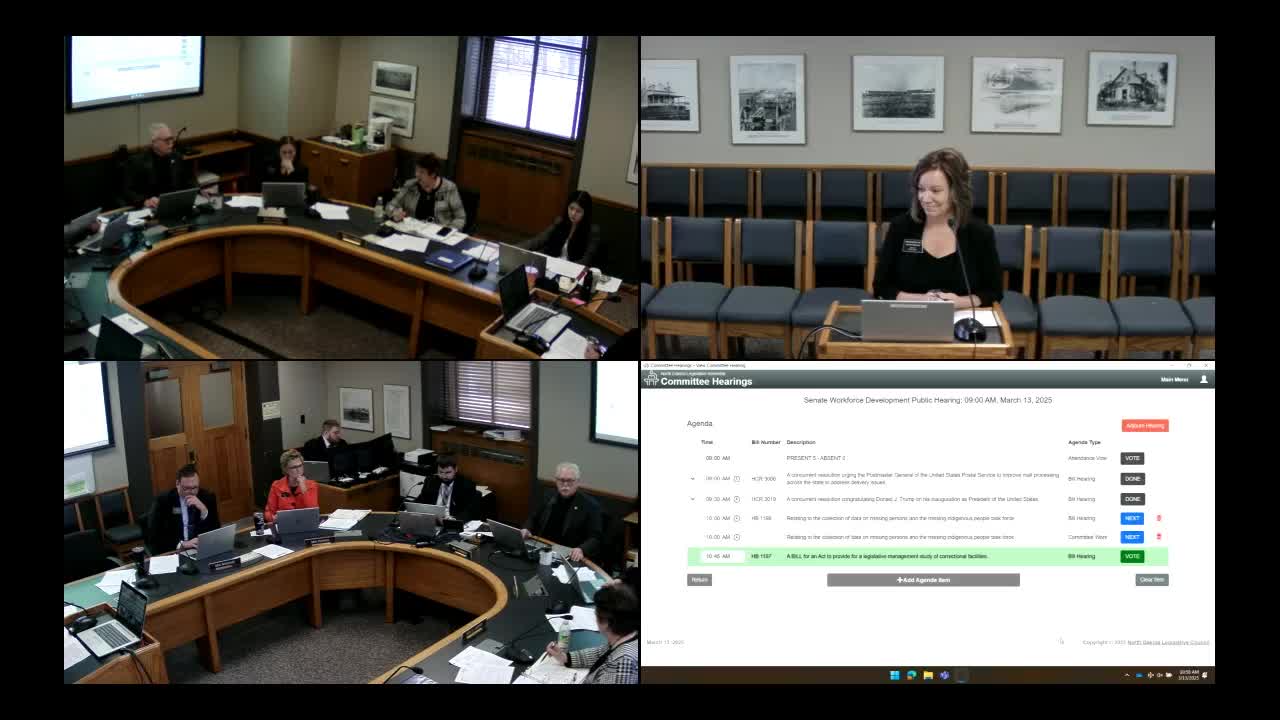
Representative Kathy Freilich told the Workforce Development Committee that House Bill 11 97, now a legislative-management study, was prompted by county jail capacity problems and the cost pressures of building and operating correctional facilities.
Freilich said the bill originally proposed grant funding for jail construction but was revised into a study after limited appetite for appropriations. "We are in a crisis," she said, urging the Legislature to examine county jails, regional correction centers and deferred-admission impacts to craft longer-term solutions.
Danelle Presky of the North Dakota Association of Counties, who also serves as executive director for the North Dakota Sheriffs and Deputies Association, said counties are housing state-sentenced inmates and that five local projects in development would add about 434 beds at an estimated total cost of $250 million. "Counties' primary funding source is property taxes," she said, urging state support and noting that a $50 million grant program had been discussed previously to offset local costs.
Witnesses asked the committee to consider regional approaches and the fiscal challenges counties face if the Legislature moves toward spending caps for political subdivisions. Panelists said local capacity constraints create statewide consequences when county jails are full and the state system is overcapacity.
Committee members asked whether agencies expected to participate in the study were willing; Freilich said she had consulted the attorney general's office before the initial bill and that the stakeholder list mirrored existing courthouse grant committees. No final committee action was recorded in the hearing excerpt; the sponsor indicated she expects further conversation with the appropriations committee.
The hearing closed with committee members noting the issue's urgency and the need to reconcile local needs with statewide fiscal policy.