Get Full Government Meeting Transcripts, Videos, & Alerts Forever!
Get email alerts on the Missing Indigenous Persons topic
No spam. Unsubscribe anytime.
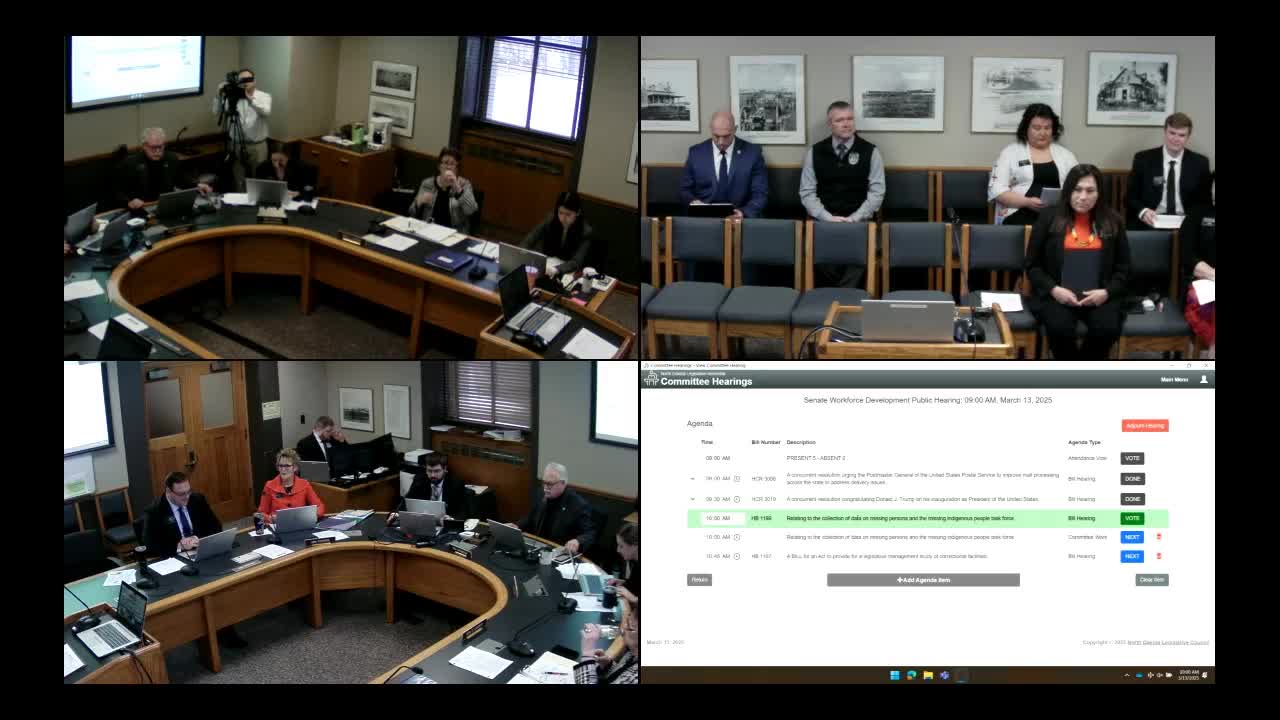
Lawmakers weigh task force, data system and funding to address missing and murdered Indigenous people
Summary
House Bill 1199, proposing a Missing and Murdered Indigenous Persons task force and centralized data, drew broad support in committee hearings and neutral technical comment from the attorney general’s office; witnesses and tribal leaders urged action and the bill includes a $250,000 tribal-support provision for the next biennium.
Lawmakers heard extensive testimony on House Bill 11 99 proposing a Missing and Murdered Indigenous Persons (MMIP) task force, a centralized data system and measures to improve interagency coordination for cases involving Indigenous people in North Dakota.
Representative Dawson Holly (sometimes recorded as Dawson Hawley in the hearing) introduced the bill and said the task force would create a unified data repository, improve cross-jurisdictional collaboration and include Indigenous leaders in policy design. "The first step in solving any problem is to understand it," he said, describing the bill’s centralized data component and calls for culturally informed investigations.
Multiple witnesses described the problem as severe and urgent. Representative Davis recounted a recent search in Turtle Mountain that she said required bringing additional state resources and coordination; she reported that, as of that morning, there were 20 Indigenous people listed as missing from North Dakota, 11 of whom had gone missing since Jan. 1 of that year and seven were under 18. "There's a lot of great work being done, but if we don't know how to communicate... we will continue to have missing and murdered indigenous peoples numbers rise," she told the committee.
Colette Brown, representing two of North Dakota's tribes, supported the bill and highlighted the bill provision that would provide $250,000 in funding for the next biennium for tribal support efforts related to identifying and locating missing Indigenous persons. Senator Richard Marshall (testifying as a former or current state senator) and several tribal representatives urged establishment of Amber Alert capability in Indian country, permanent law-enforcement resources and stronger interagency coordination.
The attorney general's office offered neutral testimony. Heidi Smith, an AG office official, said an amendment added in the House that altered membership of the Criminal Justice Information Services (CJIS) advisory board appeared to place new members in the wrong section of the bill and would have operational consequences if left unchanged. "Adding 6 new members to the CJIS advisory board ... would increase the number of members required for a quorum from 7 members to 10," Smith warned, saying that could make it difficult for the CJIS board to meet and could delay law enforcement access to critical data.
Steve Harstad of the Bureau of Criminal Investigation explained that the attorney general’s public-facing missing-persons database is a nightly copy of the National Crime Information Center (NCIC) entries and that photographs must be uploaded to NCIC by the reporting agency. He also said the BCI has been assigned three agents to work with reservation task forces and that jurisdictional issues remain: "That database is completely off the NCIC database... the information that's in NCIC is exactly what's in our database," Harstad said.
Committee members discussed technical fixes to the bill language—specifically moving several named tribal-chairman entries from the CJIS advisory-board section into the task-force membership section so that sensitive CJIS governance provisions are not changed inadvertently. Representative Holly said designees could represent busy tribal chairs if needed. No final committee vote was recorded in the hearing excerpt; the committee closed the hearing and asked sponsors to review and confirm placement of membership language and other technical edits.
Supporters urged passage as a step toward addressing a long-standing crisis in Indigenous communities; neutral witnesses asked for language fixes to avoid unintended impacts on law-enforcement information systems.