Get Full Government Meeting Transcripts, Videos, & Alerts Forever!
Get email alerts on the Landscape Native Prairie topic
No spam. Unsubscribe anytime.
Senate committee declines study of replacing sterile monocultures with native prairie plantings
Summary
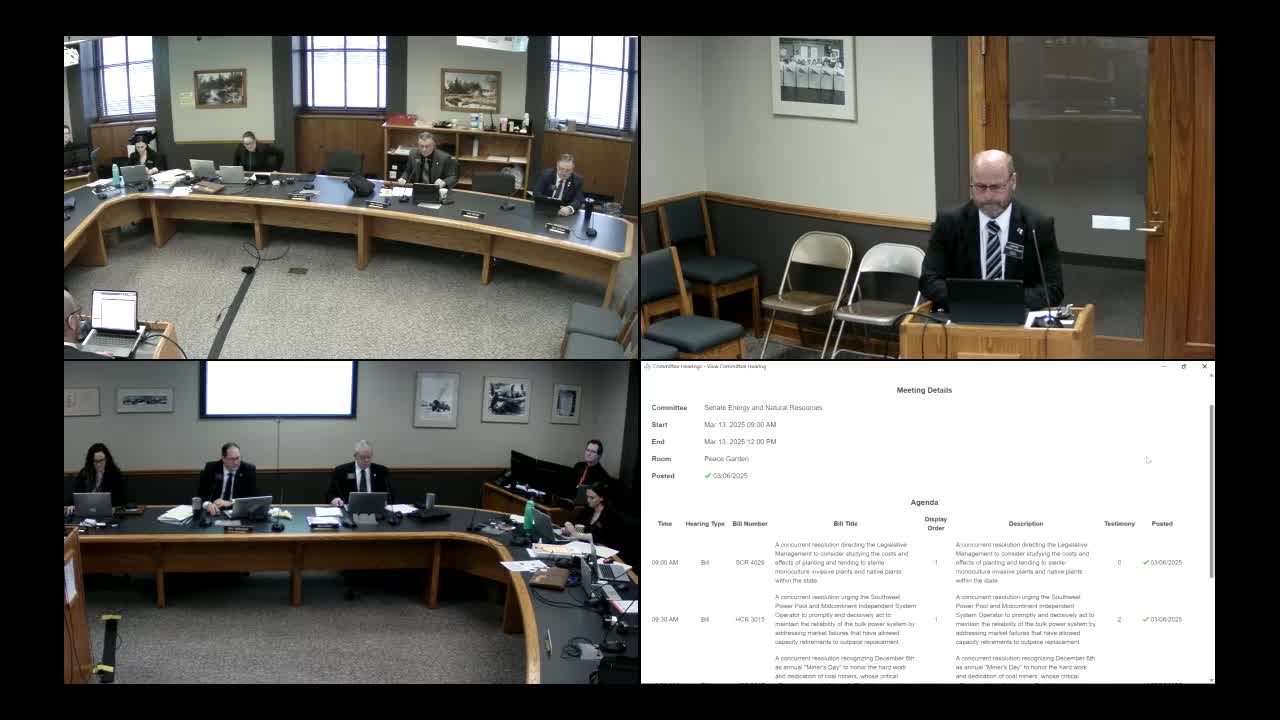
The Senate Energy and Natural Resources Committee heard testimony for and against a resolution to study costs and ecological effects of sterile monoculture plantings versus native prairie and pollinator plantings, then voted to recommend 'do not pass.'
The Senate Energy and Natural Resources Committee on March 7 declined to advance Senate Concurrent Resolution 40‑29, a proposal to direct legislative management to study the costs and effects of planting sterile monoculture "invasive" plantings versus native prairie and pollinator plantings across North Dakota.
Senator Jeff Magnum, sponsor of SCR 40‑29, told the committee the resolution would ask legislative management to "consider studying the cost and effects of planting, intending to sterile monoculture, invasive plants, and native plants within the state." He said the study would compare mowing, seeding, herbicide and pesticide application practices, and other costs associated with each approach.
The request grew out of constituent Carol 2 Eagles' advocacy, and Eagles spoke by phone from a hospital bed to urge lawmakers to back the study. "SCR 40 29 is landmark legislation," Eagles said, describing a small private plot where she has substituted native prairie plugs for invasive plantings and saying the approach reduced maintenance while supporting pollinators. She described a non‑toxic method using cardboard and shallow boxes of soil and asked the committee for a "resounding unanimous due pass recommendation."
Supporters and some senators framed the resolution as an information‑gathering step rather than a mandate. Senator Magnum said the study could show whether native plantings would reduce mowing, watering and weed‑control costs for political subdivisions and state projects such as flood‑control excavations. Committee members also discussed existing programs at North Dakota State University, the Natural Resources Conservation Service and the state Game and Fish Department that already work on native grasses and prairie restoration.
Opponents and several senators questioned the value of a legislative study given existing expertise. During final committee action Senator Castle moved a "do not pass" recommendation. The motion to recommend do not pass was seconded and carried on a 6‑1 roll call, effectively blocking the resolution from advancing from committee.
Committee members emphasized that many agencies and university programs already study and promote native species, and some senators said they were not convinced a legislative study would produce new, actionable results. The committee did not adopt any changes to state law during the hearing and provided no direction for a substitute study scope or new reporting requirement.
The committee record contains written testimony from Carol 2 Eagles and references to the Game and Fish Meadowlark Initiative; Senator Magnum said he had consulted Jeb Williams at Game and Fish during bill development. The committee's recommendation is recorded as a "do not pass" on SCR 40‑29.
The resolution text requested a comparison of mowing, seeding, chemical applications and ecosystem effects between sterile monocultures and native prairie plantings, and asked the legislative management to report findings to the 70th Legislative Assembly if a study were authorized. The committee did not refer the resolution for further study.
Votes and next steps: Committee members approved the motion recommending "do not pass" on SCR 40‑29 by a 6‑1 vote; no additional committee referrals or amendments were adopted.