Get Full Government Meeting Transcripts, Videos, & Alerts Forever!
Get email alerts on the Child Welfare topic
No spam. Unsubscribe anytime.
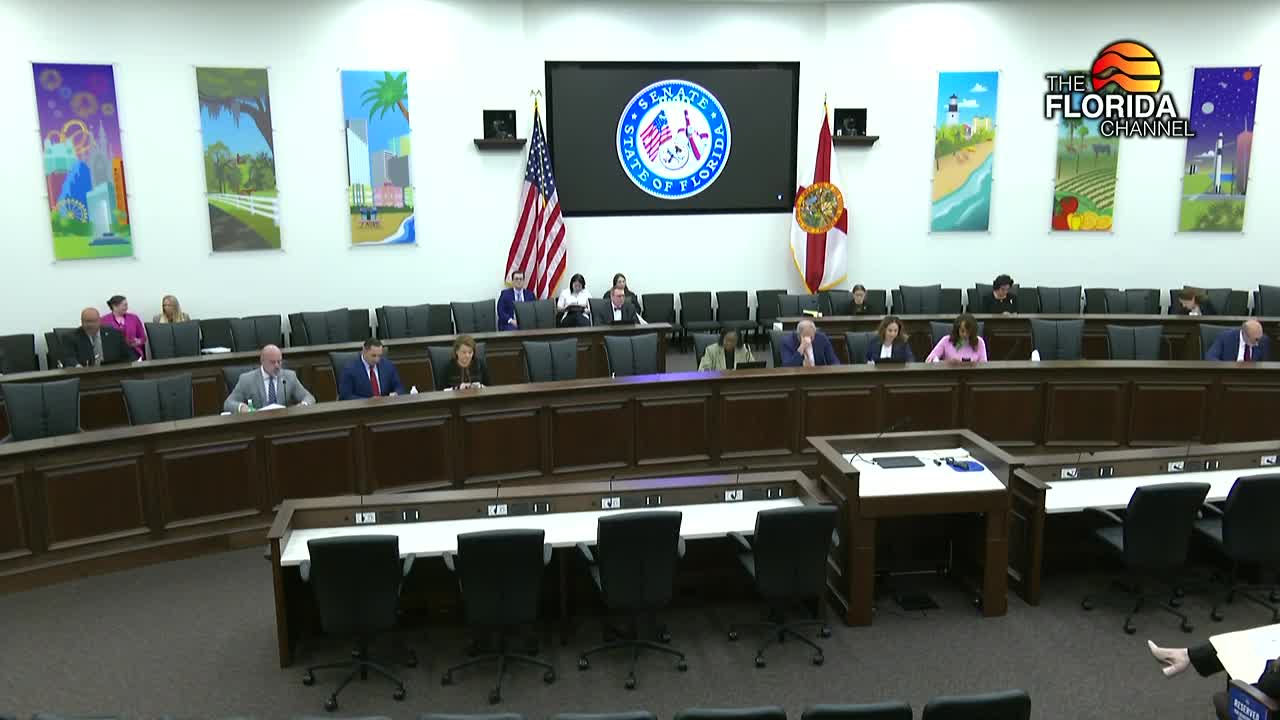
Committee backs SB 7012 to pilot treatment foster care, boost child-welfare data and recruitment
Summary
The Senate Committee on Fiscal Policy reported SB 7012 favorably after adopting amendments to fund a four‑year treatment foster care pilot, require DCF to improve extractable data on commercially exploited children, commission a bed‑capacity study and launch targeted recruitment for child protective investigators and case managers.
The Senate Committee on Fiscal Policy voted to report SB 7012 favorably after senators adopted two amendments that attach funding and limit legislative access to certain redacted case documents. Senator Grahl, sponsor of the bill, told the committee the measure addresses workforce strain, a shortage of family‑like placements for children with high behavioral needs and gaps in data on children commercially exploited.
Why it matters: Supporters said the bill aims to reduce turnover among child protective investigators and case managers, expand family‑style treatment foster care for higher‑acuity children and give the Legislature better, analyzable data to plan services for victims of commercial sexual exploitation.
Key provisions and context
Senator Grahl said the bill “deals with three distinct areas: child welfare workforce issues, increased acuity of the children and [the] child welfare placement array and commercial exploitation of children and how we protect them.” The bill requires the Department of Children and Families (DCF) to run a recruitment program targeted at individuals who previously served in public‑safety and service roles, such as law enforcement officers and first responders, to recruit child protective investigators (CPIs) and case managers.
On placement, the bill creates a treatment foster care pilot to increase the number of family‑like placements for children with high behavioral needs. The pilot is structured to run for four years; at the end of that period DCF must submit a final report to the Legislature assessing feasibility of statewide expansion. Treatment foster care, as described to the committee, places children in family‑like homes where foster parents receive specialized training and higher compensation and participate in care coordination.
On data and capacity for victims of commercial exploitation, Grahl said DCF must move from scanned, hard‑to‑analyze documents to a child‑level format that is extractable and analyzable by the Legislature. The bill also requires DCF to contract for a bed capacity study for residential treatment and a gap analysis for nonresidential services, with policy recommendations to ensure sufficient beds and services for victims.
Amendments and clarifications
The committee adopted two amendments. One (barcode 91217) narrowed legislative access to copies of certain redacted assessments by requiring DCF to maintain copies of the documents and provide them to the Legislature upon request, rather than including them in routine reports. A second amendment attached an appropriation to the bill (barcode 119236).
Senator Osgood asked whether the two judicial circuits identified for the treatment foster care pilot would be chosen because they had the highest numbers of removals. Senator Butler responded that the bill’s language directs the department to “use relevant removal and placement data to identify areas with the greatest need for such a program,” which should guide selection of the two circuits.
Support and procedure
The record shows several supporters waving in, including Georgia McCown and Victoria Zeep, who did not take extended floor time but registered support on appearance forms. After debate closed, the committee voted by roll call to report SB 7012 as amended favorably to the full Senate. The clerk completed a roll call; the committee reported the bill favorably by your vote.
Votes at a glance
- Action: Reported favorably as amended (SB 7012) - Outcome: Reported favorably to the full Senate - Roll-call (recorded as saying “Yes” during the committee roll call): Senator Arrington; Senator Avila; Senator Bernard; Senator Boyd; Senator Bridal; Senator Burton; Senator Kalatiued; Senator Davis; Senator Gates; Senator Angolia; Senator Jones; Senator Leake; Senator Pasadoma; Senator Rodriguez; Senator Simon; Senator Trudeau; Senator Yarbrough; Vice Chair Osgood; Chair Gruters.
What’s next
Because the committee reported the bill favorably, SB 7012 proceeds to the full Senate for further consideration. The bill requires DCF to run the pilot, convene a case‑management workforce work group and deliver the required report to the Legislature at the end of the pilot period.
Ending: The committee adopted the amendments and reported SB 7012 favorably; the bill will advance to the Senate for subsequent consideration.