Get Full Government Meeting Transcripts, Videos, & Alerts Forever!
Get email alerts on the Broadband topic
No spam. Unsubscribe anytime.
NDIT tells appropriations panel North Dakota is on track on broadband but federal timelines strain spending
Summary
NDIT officials told the Appropriations — Government Operations Division that North Dakota has used Capital Projects Fund grants to close many gaps, is preparing BEAD proposals for NTIA review and is watching a 2026 Treasury deadline for CPF construction completion.
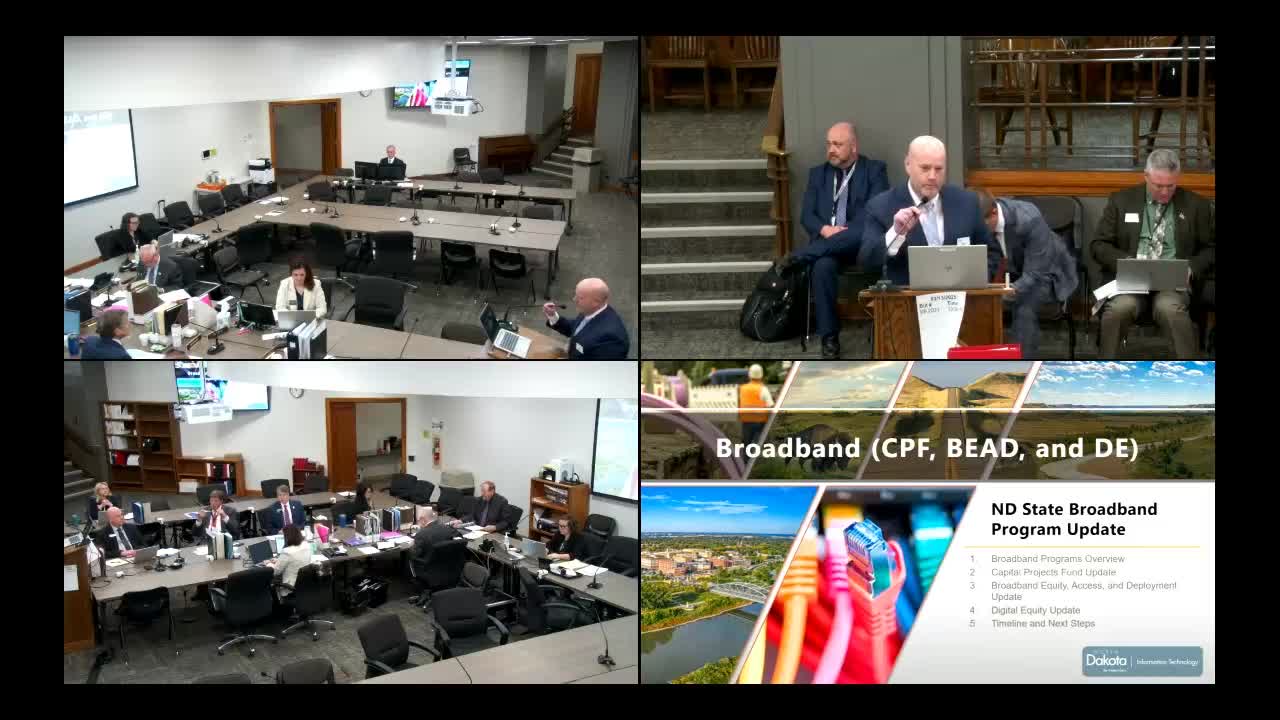
BROADBAND PROGRAMS — North Dakota Information Technology broadband staff briefed the Appropriations — Government Operations Division on federal broadband grants and timelines, saying work funded by the Capital Projects Fund (CPF) has reduced the number of unserved locations and that the state is preparing Broadband Equity, Access and Deployment (BEAD) applications for NTIA review.
The update focused on three federal programs: the CPF (about $37.3 million allocated to the state), BEAD (roughly $130 million in the state’s allocation) and a digital equity authorization of about $4.54 million. "This is probably the least of the things you need to worry about in terms of the budget because we are federally funded," said Brian Newby, broadband program director for NDIT.
NDIT said CPF-funded projects have closed many coverage gaps and that the number of eligible unserved or underserved locations has fallen from thousands in 2023 to roughly 2,000 in 2025. The agency cautioned that CPF projects must be "completed or materially completed by the end of 2026," a Treasury standard it said remains undefined. Newby said the department has asked Treasury for flexibility and is tracking the possibility of an extension, but that states should plan for close oversight of invoices and construction timelines.
NUT GRAF: The briefing gave lawmakers a status check ahead of budget decisions: CPF work is under way, BEAD remains in proposal and review stages with NTIA, and digital-equity programs are still being defined at the federal level. Committee members pressed NDIT on timelines, unused balances and the state's strategy to avoid forfeiting federal funds.
NDIT officials described the state's immediate steps to protect CPF dollars. Of CPF allocations, the department said roughly $8 million that had not been awarded was transferred to CTE-related purposes in an earlier legislative decision, and some closed CPF projects have come in under budget, leaving an estimated $2 million currently unspent. To avoid letting small remaining balances lapse, NDIT plans a targeted "line extension" program to allow carriers to bid on small additions to existing projects that can be finished before the 2026 deadline; fiber construction would remain the stated priority.
Committee members asked how the state would respond if carriers cannot meet the Treasury timeline. Newby said carriers generally must submit invoices and the state will not pay large advances; invoices are paid as work is documented. He said NDIT has been communicating with Treasury monthly and has asked Treasury to recognize unforeseen circumstances such as natural disasters when assessing material completion.
On BEAD, Newby said the department has spent more than two years preparing a final proposal and expects the department of commerce/NTIA review to extend into winter; he estimated a likely approval timeframe of around January of the following year, after which subgrantee selections and award negotiations would begin. Newby also said BEAD guidance from Washington has emphasized that deployment to locations is the highest priority, and that digital-adoption and other "non-deployment" uses remain under scrutiny at the federal level.
Lawmakers pressed NDIT for details about map accuracy and how federal maps affect eligibility. Newby explained that map data come from the Federal Communications Commission and are updated periodically; carriers can submit evidence to the FCC to remove locations they already serve, but the appeals process can be slow. He cited an example in which local carriers provided evidence to show locations were already served and said NDIT will include that evidence in its BEAD proposal.
Several lawmakers raised technology and equity questions. Newby said NDIT and local carriers prefer fiber because of long-term reliability and argued North Dakota is well positioned relative to many states, but he acknowledged ongoing political debate about cost per location and speed targets. He said the state has met deadlines to this point and is continuing to refine its BEAD selections and pricing structure before sending the proposal to NTIA.
ENDING: NDIT staff asked the committee to consider further questions about BEAD and future uses of non-deployment funds at the next biennium. Newby summarized the timeline and reiterated that most deadlines and federal rules still need clarification from Treasury and NTIA, and that the state’s immediate priority is ensuring CPF-funded construction is supported with invoiced evidence so federal funds remain available.