Get Full Government Meeting Transcripts, Videos, & Alerts Forever!
Get email alerts on the Library Referendum topic
No spam. Unsubscribe anytime.
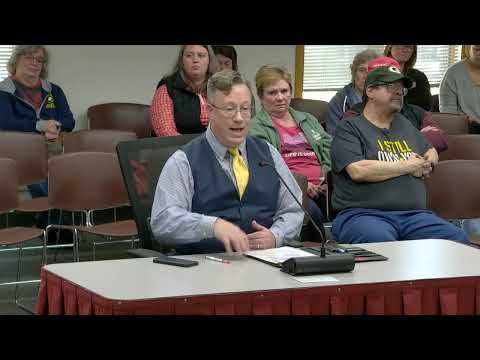
Cottage Grove holds public information session on library referendum, answers questions on cost, site and tax impact
Summary
Village officials and residents discussed a referendum that would allow up to $1.3 million in additional annual levy to build and operate a library at the Learning Ladder site; officials said the village is not advocating a vote and answered questions on costs, timelines, grants and debt implications.
Village of Cottage Grove staff held a public information session to explain a referendum on the April 1 ballot that would authorize up to $1,300,000 in annual property-tax levy to acquire, build and operate a public library at the Learning Ladder site at 312 West Cottage Grove Road.
The session, led by Village Administrator Mack Eze, reviewed the project estimate, the referendum wording and likely tax impacts, and allowed residents to ask questions about site size, parking, soil and engineering studies, timing, debt and grants. "We as staff and the village in general are not advocating for a yes or no vote on the referendum," Eze said, describing the meeting as informational.
Why this matters: A yes vote would authorize the village to exercise an option to purchase the privately owned Learning Ladder site and to levy the additional funds; a no vote would preclude construction at that address. Village officials said the referendum question combines capital and operating costs so voters can evaluate the full projected cost of delivering a library service within village limits.
Presentation and estimates: The village summarized a consultant study by Engberg Anderson that recommended razing the existing Learning Ladder structures and building a new single-story library if that site is chosen. The consultant estimated total project costs (acquisition, construction, soft costs) at about $8.2 million; the village has an option to purchase the property for $40,000 and a stated purchase price of $1,400,000. The $1.3 million levy shown on the ballot blends estimated capital recovery and operating costs; officials said the capital campaign and grants could reduce the levy impact.
Ehlers, the village's municipal advisor, presented two financial scenarios during prior planning: one that included the library and one that did not. Officials said village debt would rise in the near term under the option that includes both the library and a planned police station, peaking in the 2026 plan at roughly $60.8 million (about 78% of the village's borrowing limit under the village's current equalized value) and then declining in later years as other debt is retired. "That peaks at that one year and then is planned to come down," a village official said.
Local concerns and staff responses: Residents pressed staff on several recurring concerns: - Site size and alternatives: The Learning Ladder site is about 1.9 acres; an alternative parcel owned by the Friends of the Cottage Grove Community Library is roughly five acres. Cindy Kelm Nelson, a village trustee and library board president, said the Learning Ladder location is "bikeable, walkable, near senior housing, links neighborhoods, and backs up to 11 acres of the village's community park." Nelson also said the village's capital campaign had raised more than $530,000 in pledges contingent on referendum approval. - Construction risks and site work: Residents asked whether soil, drainage or groundwater studies had been done. Officials said Engberg Anderson performed a site evaluation and included contingencies in its cost estimate but that detailed engineering, soil borings and design work would require additional expenditures that typically wait until after a successful referendum. "...it takes spending resources to get answers to some of those questions and it's a balancing act for a Village Board to decide how much to spend to get enough information for people to make the decision," an official said. - Tax impact and timing: Staff provided projected tax impacts per $100,000 of equalized value and explained they used equalized value rather than assessed value to project future tax impact. Officials said the levy increase shown on the ballot would be applied only to the village portion of property taxes (not county, school or technical college levies). The village also noted a Dane County library tax (about $34 per $100,000 of equalized value) that could be removed over time if the village meets Dane County library standards and the county phase-out occurs. - Capital campaign and grants: The village has an active $1,000,000 capital campaign goal and reported roughly $530,000 in pledges contingent on referendum approval; staff said they have also applied for a $1,000,000 Community Development Block Grant (CDBG) that would require a $500,000 match and have submitted other grant applications. - Debt and bond rating concerns: Residents asked whether the combined projects would harm the village's bond rating. Officials said bond-rating outcomes depend on the credit review by the rating agency and that the village has a high management score for planning and capital prioritization; a definitive rating impact cannot be known until a bond-rating review is requested.
Process notes and limits: Officials reiterated that the referendum language is set by law, the village does not yet own the Learning Ladder site (it holds an option), and the board would have to take affirmative action to buy the property even if voters approve the referendum. Village Attorney Larry Konopaki clarified legal limits: the referendum authorizes an "up to" levy amount but future boards could decide how and when to levy funds within statutory limits; capital borrowing and debt-service choices may require separate financial decisions.
Public comments: Proponents, including Cindy Kelm Nelson and Robin Smeckel (president of the Friends of the Cottage Grove Community Library), urged voters to support the Learning Ladder site and said a library would create a central community hub. Opponents and questioners, including residents who obtained village records via open-records requests, urged more study of alternatives, raised concerns about timing given other capital needs, and argued the village should not increase long-term debt during uncertain economic conditions. "This is not a now or never question," resident Pete Dahl said, arguing for further due diligence.
Timeline: Staff estimated roughly one year of architectural and engineering work followed by about one year of construction if the referendum and subsequent village decisions move forward; staff said the opening is currently projected in 2027 under the timeline shown at the session.
What was decided: The Village Board previously voted to place the referendum on the April 1 ballot; no new formal board votes were taken during this information session. The meeting produced no binding site approvals, only informational responses and guidance on next steps (grant applications, continued design if authorized by future boards and exercise of the purchase option if voters approve).