Get Full Government Meeting Transcripts, Videos, & Alerts Forever!
Get email alerts on the Labor topic
No spam. Unsubscribe anytime.
Minnesota labor panel advances governor's Department of Labor budget with fee, apprenticeship and misclassification provisions
Summary
The Minnesota Senate Labor Committee on March 13 recommended passage of Senate File 2,373, the governor's Department of Labor and Industry budget and policy bill, after adopting an amendment and hearing hours of testimony on fee changes, worker protections and a proposal to fund a statewide registered teacher apprenticeship program.
The Minnesota Senate Labor Committee on March 13 recommended passage of Senate File 2,373, the governor's Department of Labor and Industry budget and policy bill, after adopting an amendment and hearing hours of testimony on fee changes, worker protections and a proposal to fund a statewide registered teacher apprenticeship program.
Nicole Lisonbee, commissioner of the Minnesota Department of Labor and Industry, told the committee the proposal "maintains base funding and adds modest operating adjustments" while adding targeted new investments, including funding for misclassification enforcement, a statewide teacher apprenticeship sponsor and construction code fee adjustments.
The bill would: fund 2.5 full-time equivalent positions in the labor standards division to enforce worker misclassification laws (281,000 in fiscal 2026 and 286,000 in fiscal 2027 as presented); direct 5,000,000 from the Workforce Development Fund in fiscal 2026 and 2,000,000 in fiscal 2027 to establish a statewide registered teacher apprenticeship sponsor and joint apprenticeship training committee; and align construction code permit, inspection and plan-review fees in the construction codes and licensing division to better reflect the cost of providing those services.
Committee witnesses from labor and industry gave contrasting perspectives. Melissa Heising, legislative director for the Minnesota AFL-CIO, said the misclassification funding is needed: "This funding will help ensure DLI has the resources to handle increased complaints, to conduct complex investigations and enforcement, to protect workers, employers, and taxpayers." Alex Liuzzi, apprenticeship coordinator at Education Minnesota, and several school-district speakers urged approval of the apprenticeship funding, describing plans to use a union-sponsored statewide model to help paraprofessionals become licensed teachers.
Contractor and trades groups supported the fee alignment to address what they called a funding gap that has led to service delays. Ryan Saint Cartier, government affairs director for the Minnesota NECA and Minnesota Mechanical Contractors Association, told the committee that underfunding "has led to an operational deficit in the construction code and licensing division" and that updated fees would speed plan review and inspections.
Manufactured and modular home industry representatives objected to several proposed provisions. Mark Bruner of the Manufactured Modular Home Association of Minnesota said the bill would create new costs and requirements for resale and transport of manufactured homes, and described a proposed $1,200 state inspection fee for homes in areas without local code enforcement as "problematic." He warned the changes could raise prices for first-time buyers and said some resale requirements could effectively block sales unless costly upgrades are made.
Department staff explained the proposal would create a new resale-decal process and a shipment/transport label to fund auditing and on-site reviews of used manufactured-home sales and new installations in areas that lack local building officials. State building official Gregory Metz told the committee, "Plumbing plan review is currently sitting at 6 weeks for plan review," and described how review times stop while applicants correct plan deficiencies.
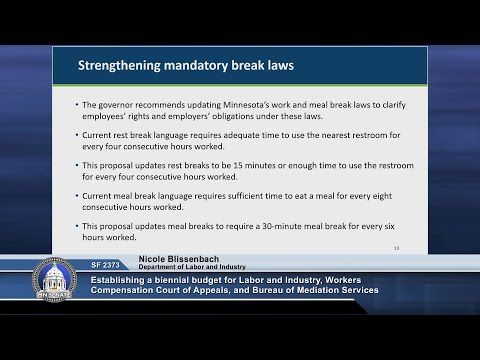
The bill also would clarify break-time rules, proposing a minimum 15-minute rest break for each four consecutive hours worked and a minimum 30-minute meal break for every six consecutive hours worked; the department said the changes are intended to clarify existing law and align practice with federal case law on compensated short meal periods.
Committee action and next steps: Chair McEwen moved and the committee adopted the A2 amendment to add language from a related policy bill; the committee then voted to recommend the bill pass and be re-referred to the Judiciary and Public Safety Committee. Both votes were taken by voice in committee and recorded as passing. The bill must still proceed through Judiciary review and further floor action before becoming law.
Committee members and stakeholders told the committee they expect follow-up negotiations on the manufactured-home provisions, fee schedules and apprenticeship implementation details as the bill moves forward.