Get Full Government Meeting Transcripts, Videos, & Alerts Forever!
Get email alerts on the Cultural Burning Tribal Stewardship topic
No spam. Unsubscribe anytime.
UC Cooperative Extension names beneficial-burning adviser to work with tribes in Lake, Mendocino counties
Summary
UC Cooperative Extension introduced Ally Zangdresik as its new beneficial burning and tribal land stewardship adviser, a role intended to support tribal communities and build fire-resilient ecosystems in Lake and Mendocino counties.
UC Cooperative Extension introduced Ally Zangdresik as its new beneficial burning and tribal land stewardship adviser, a role intended to support tribal communities and build fire-resilient ecosystems in Lake and Mendocino counties.
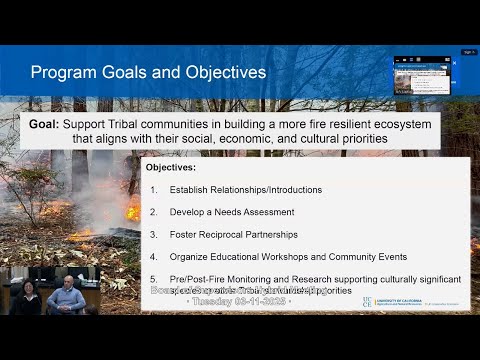
"The overarching goal for this position is supporting tribal communities and building a more fire resilient ecosystem that aligns with their social, economic, and cultural priorities, and a lot of that will be determined by the tribes," said Ally Zangdresik, beneficial burning and tribal land stewardship adviser, UC Cooperative Extension.
The appointment is part of a three-position statewide initiative at the University of California to engage tribal nations on cultural and beneficial burning practices. Matthew Barnes, area director for UC Cooperative Extension, introduced Zangdresik and said her post is the first of three created to support tribal engagement across the state.
Zangdresik, who has been with UC Cooperative Extension for about five months, described her academic background and prior work and said the first year will focus on relationship-building and a needs assessment that will shape the program. She said potential activities include organizing educational workshops, pre- and post-fire ecological monitoring, and support for culturally significant species and tribal stewardship priorities.
Zangdresik described regulatory support as part of her responsibilities: "One of the reasons I think I was hired for this position was for regulatory support for the tribes with CEQA and NEPA planning, as well as potentially biological monitoring." CEQA refers to the California Environmental Quality Act; NEPA refers to the National Environmental Policy Act.
Supervisors at the meeting welcomed the new adviser. "It's very exciting to have even more resources to help bring the good fire back to the land," Supervisor Pyska said, and invited UC Cooperative Extension to participate in the county's Risk Reduction Authority meetings, held on the third Monday of each month.
Supervisor Sabatier asked whether tribal projects developed through UC Extension could be added to the county's recently adopted Community Wildfire Protection Plan (CWPP) so local projects and tribal actions align. Zangdresik said that could be explored but the process for adding exhibits to the CWPP was not specified; county staff advised Zangdresik to connect with Terry Logsdon, the county's climate resiliency officer, to follow up.
Presenters and supervisors repeatedly emphasized that tribal partners should lead the direction of stewardship activities. Zangdresik said she plans to use community-based participatory research and tribal partnerships to determine program priorities and stressed reciprocity and listening as central methods.
There were no formal votes or binding actions recorded during the presentation. Next steps identified at the meeting include Zangdresik conducting a needs assessment and UC Cooperative Extension coordinating with the county's Risk Reduction Authority and climate resiliency staff to explore possible inclusion of tribal stewardship work in local planning documents.