Get Full Government Meeting Transcripts, Videos, & Alerts Forever!
Get email alerts on the Air Quality topic
No spam. Unsubscribe anytime.
Lake County air district reports steady attainment, details permitting, burn-permit and monitoring work
Summary
The Lake County Air Quality Management District updated the board on staffing, monitoring, permitting and burn-permit operations and responded to public questions about enforcement of major-use permit recommendations and cannabis odor regulation.
Doug Gerhardt, the Lake County Air Pollution Control Officer, told the Lake County Board of Supervisors sitting as the Lake County Air Quality Management District Board of Directors on Oct. 12 that the district has met state and federal air-quality standards for 35 years and is running ‘‘in the 60 to 90% range of air quality standards’’ as it monitors for changing standards.
Gerhardt said the district has hired a new employee who started the day before the meeting and another staffer scheduled to begin the following Monday. He summarized monitoring and permitting activity and described several operational requirements the district enforces under state and federal law.
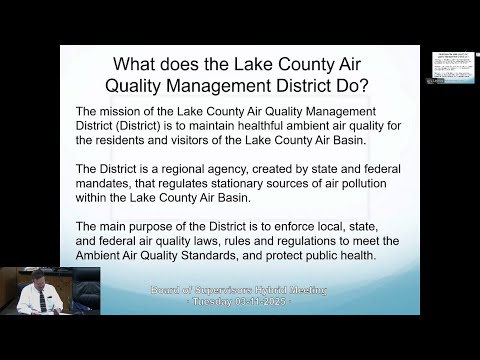
The update matters because changes in state or federal standards, major wildfires or noncompliant stationary sources can trigger a nonattainment designation that would require new rules, loss of some burn-program flexibility and additional mitigation. Gerhardt described the district’s role as enforcing local, state and federal air-quality laws ‘‘to meet the ambient air quality standards and protect public health.’’
Gerhardt said the district maintains a main monitoring station in Lakeport and additional monitors in the Geysers area for hydrogen sulfide and meteorology. He described mobile and portable particulate monitors used after wildfires and said the district has installed low-cost sensors at every school campus in the county so school officials can see real‑time data during wildfire events. He said the district has reduced particulate monitoring costs by using lower-cost methods for some sites while keeping PM monitoring in place.
On permitting, Gerhardt described the authority-to-construct and annual renewal process the district follows. He said the district currently reviews about 670 permits every year during the renewal cycle and that each permit is issued for a maximum of one year and must be evaluated for compliance at renewal. He advised applicants to submit complete project and equipment descriptions to speed sign-offs and avoid delays.
Gerhardt noted specific permitting rules and thresholds. He said the district’s permitting review looks at every emission point, fugitive emissions and health risks for nearby populations. As an example, he said a commercial-size propane engine proposed next to a school produced carbon monoxide and nitrogen-oxide levels that pushed the modeled cancer-risk numbers well above the district’s review thresholds; ‘‘our permitting threshold is 10 in a million for high risk,’’ he said, and the example project would have exceeded that by a large margin.
The district also now operates an online burn-permit system developed with CAL FIRE and South Lake County Fire. Gerhardt said since the burn season began the district has issued more than 1,400 online permits for pile burns up to 10-foot diameter; piles larger than 10 feet require a smoke-management plan and in-person review. He said parcels generally must be one acre or larger to qualify for a standard burn permit but the district retains some options for smaller parcels. He estimated the office issues roughly 100–150 in-person permits each season for applicants who cannot use the online system.
Gerhardt described public service details: regular office hours are Monday through Thursday from 9 a.m. to noon and staff take appointments 8:30 a.m. to 4:30 p.m. Monday through Friday; he asked people seeking smoke‑plan approval to call by 3 p.m. the day before a proposed burn and by 3 p.m. on Friday for weekend burns so staff have time to check forecasts. He gave the district phone number, 263-7000, and an email address, lcaqmd@lcaqmd.net.
Public commenters praised the district’s long attainment record and raised two concerns. Tom Lasik, a resident, urged that agency sign‑offs on county major‑use permits be worded so recommendations are carried into conditions for projects. ‘‘I would recommend … that they use the, you know, must include or shall include instead of, well, it ought to have this,’’ Lasik said, urging firmer language to prevent recommendations from being omitted in permit conditions.
Margo Kambara, another resident, thanked the district and asked whether the agency should re-engage with the county’s commercial cannabis permitting process because outdoor cannabis cultivation can create noticeable odor issues. Kambara said the county’s current setbacks were under discussion and asked whether Lake County Air Quality Management District expertise on odor could be applied to permitting. Supervisor Owen echoed the point, saying: ‘‘The odor is real.’’
Gerhardt said that in the past the district was not involved in commercial cannabis permit applications but acknowledged that odor and related public complaints are an issue counties and other jurisdictions have faced. He described the district’s monitoring and permitting authorities and noted that some problems are outside local control, such as changes to federal or state standards and natural events like wildfires.
The board thanked Gerhardt for the report and for restoring staff capacity after recent vacancies. The presentation did not include new formal actions or votes; members and the public requested follow-up discussion on how the district’s technical expertise could intersect with county permitting for cannabis odor and how to make interagency recommendations less likely to be omitted from major‑use permit conditions.