Get Full Government Meeting Transcripts, Videos, & Alerts Forever!
Get email alerts on the Housing Capacity topic
No spam. Unsubscribe anytime.
County staff say Spokane County lacks zoned capacity for projected housing growth; planners outline options
Summary
County staff presented draft land capacity and housing-allocation analyses showing a large shortfall in housing capacity under current zoning and identified zoning changes, incentives and infrastructure planning as possible responses.
Spokane County planning staff told the county Planning Commission that draft land capacity analyses show the county and its urban growth areas do not have enough zoned capacity under current rules to accommodate state population and housing allocations.
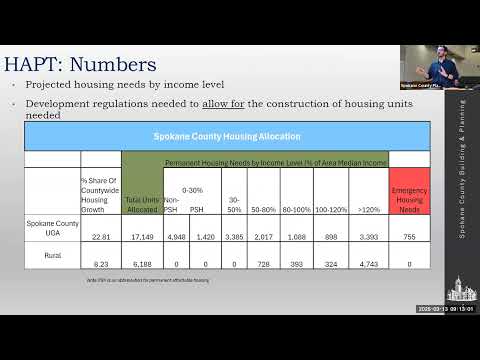
The presentation, led by Graham (staff member) and followed by Tate (county planner) and Director Scott Chesney, compared the Office of Financial Management medium projection allocations with local land-capacity results and with allocations from the state Housing for All planning tool (HAPS) maintained by the Washington State Department of Commerce. "We have capacity for 11,062 units, whereas we are allocated 17,142 units," Graham said when walking commissioners through the draft county figures.
Why it matters: the comparison showed a sizable shortfall in dwelling-unit and population capacity when current zoning and development patterns are held constant. The gap — officials said — will shape the county's alternatives for the comprehensive-plan Environmental Impact Statement and will drive discussion about whether to increase allowable housing types, add mixed-use zoning, or pursue other measures such as incentives or identifying additional developable land.
Most important facts - Staff used the Office of Financial Management medium population projection and Commerce's HAPS tool to translate population allocations into housing-unit shares and income-band allocations. - County figures presented: capacity of 11,062 dwelling units versus an allocation of 17,142 units for Spokane County (staff estimate); population capacity 24,460 versus allocation 30,528, a roughly 6,000-person shortfall in the county figures cited by staff. - At the UGA (urban growth area) scale staff reported capacity for just over 25,000 people compared with an allocation of about 95,000 (staff characterization of the current draft results). - Using the HAPS income bands, staff said the county faces an estimated aggregate deficit of roughly 6,200 housing units across the 0–80% area median income (AMI) brackets; the low‑density residential (LDR) zone shows a surplus of about 1,800 units because a large share of available acreage is LDR.
How staff did the math Graham and Tate described the workflow: adopt the OFM medium projection for countywide population growth; apportion that growth to jurisdictions by historical trends; convert population to housing units using Commerce's HAPS methodology; run each jurisdiction's Land Capacity Analysis (LCA) by zone; assign zones to AMI brackets based on likely housing types permitted by zoning; and subtract zoned capacity from projected need to identify deficits or surpluses. "It assigns overall percentage share of the countywide housing growth to us in every jurisdiction," Tate said of the HAPS tool.
Constraints and caveats Staff emphasized the results are preliminary. "I wanna reiterate that this is a draft," Tate said; the county is still quality‑checking results internally and with Commerce. The LCA figures reflect existing zoning allowances and market factors; for example, commercial zones received a conservative market factor because only a small percentage of past development in those zones converted to residential. Staff also noted that apartments can serve lower AMI bands only when subsidies or vouchers are present — the analysis records land‑use allowance, not guaranteed production of subsidized units.
Policy and next steps Commissioners and staff discussed policy responses: expanding middle‑housing choices in LDR zones, allowing more mixed‑use development, building affordable housing incentives into the development code, and evaluating whether expanding some UGAs or urban reserves is warranted. Director Scott Chesney said the housing allocation work will shape the set of alternatives evaluated in the Environmental Impact Statement and that the county expects to present three or four EIS alternatives for commission direction.
Voices from the meeting Commissioners and attendees raised questions about rural housing, ADUs (accessory dwelling units), and how census and income distributions affect allocations. One attendee asked whether rural populations under county AMI were being overlooked; staff responded that apartments and typical lower‑AMI housing types usually require urban services and therefore are seldom assigned to rural zones, although strategies such as ADUs, vouchers and other measures can help address lower‑income needs in rural areas.
Ending Staff said they will continue quality‑checking the draft LCA and HAPS outputs with Commerce, refine zone‑to‑AMI assignments and bring consolidated alternatives to the Planning Commission as part of the EIS scoping and alternatives process.