Get Full Government Meeting Transcripts, Videos, & Alerts Forever!
Get email alerts on the Affordable Housing Process topic
No spam. Unsubscribe anytime.
Consultants tell Grand Junction to tighten application completeness, project management to meet Prop 123 90‑day deadline
Summary
Christian Vaughn, a manager at Baker Tilly, told the Grand Junction Planning Commission that the firm found opportunities to speed development reviews and improve predictability to meet Prop 123’s 90‑day requirement for qualifying affordable housing projects.
Christian Vaughn, a manager at consulting firm Baker Tilly, told the Grand Junction Planning Commission that the firm found opportunities to speed reviews and improve predictability as the city prepares to comply with Proposition 123 (codified as Article 32 of the Colorado Revised Statutes).
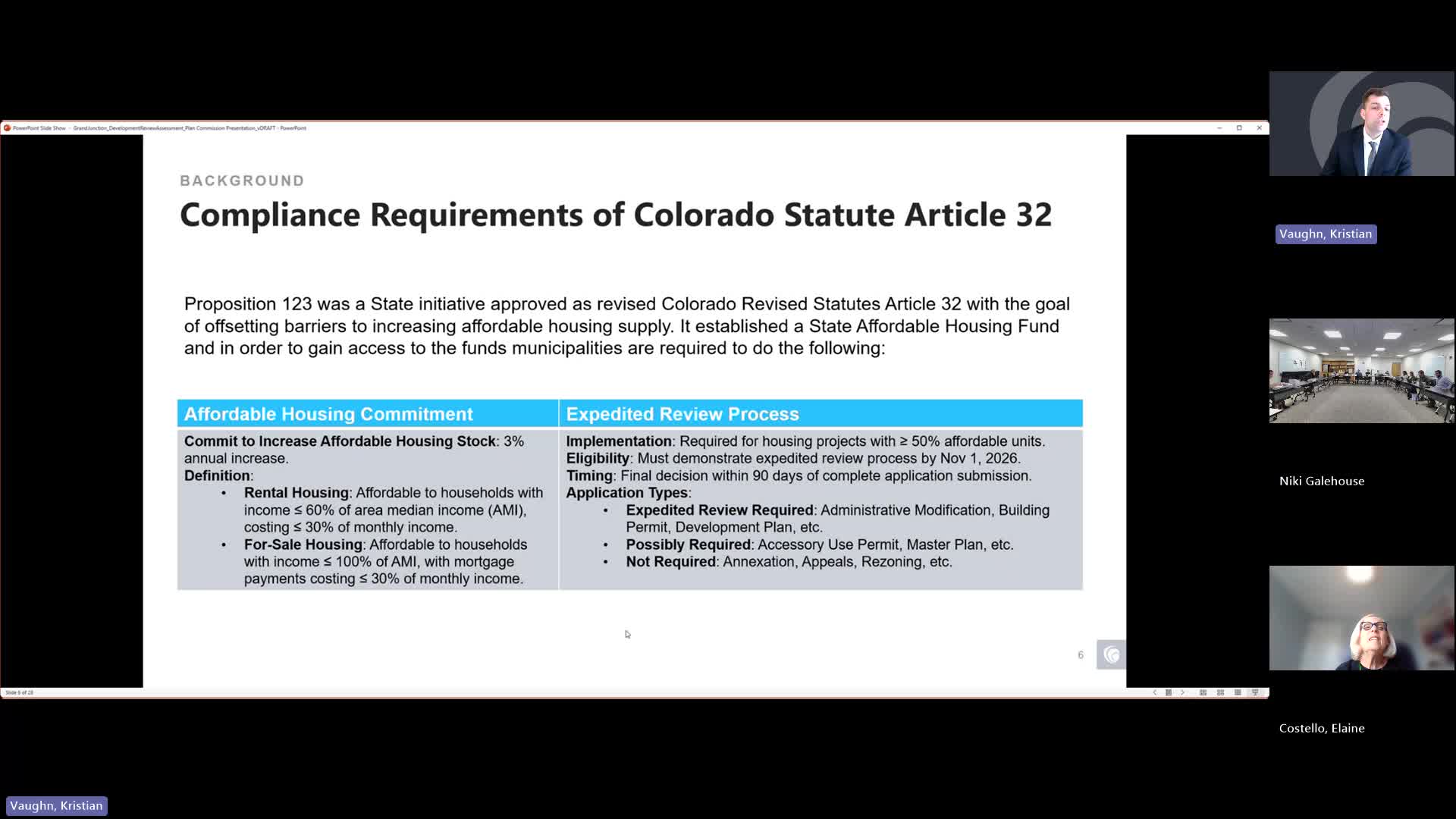
Baker Tilly’s review focused on the law’s expedited‑review provision, which applies to housing projects that contain 50% or more affordable units and requires “a final decision on approval or denial [to] be made within 90 days of a complete application submission,” Vaughn said.
The consultants said their work produced 32 recommendations aimed at moving the city toward that 90‑day standard while improving review for other project types. Elaine Costello, a Baker Tilly consultant, summarized the recommendations as changes to process, people, regulation interpretation and technology: “we came up with 32 recommendations,” Costello said during the presentation.
Why this matters: Article 32 requires municipalities to demonstrate compliance by Nov. 1, 2026 if they want to remain eligible for state incentives tied to affordable housing. Baker Tilly said the city’s existing review flow and practices commonly produce multiple review cycles for the same application, increasing the time to decision and making the 90‑day target unlikely under current practice.
Major findings and recommended changes
- Require a sufficiency check before accepting an application as complete. Baker Tilly urged the city to perform a content review at intake so the first comprehensive review is less likely to spawn repeated resubmittals. The consultants recommended clear checklists and sample submissions to make it easier for applicants to submit a complete package.
- Different turnaround standards by project type. The consultants recommended setting explicit turnaround targets calibrated to project complexity rather than maintaining a single three‑week target for all reviews.
- Train and empower planners as project managers. The report recommends assigning an experienced planner to serve as the main contact and timeline manager for each application, convening reviewers and monitoring progress to reduce handoffs and idle time.
- Create an interdepartmental affordable‑housing team. To administer the Article 32 expedited track, Baker Tilly suggested a standing group with planning, public works, fire, city attorney and other reviewers to determine eligibility, maintain checklists and resolve issues quickly. The consultants noted the state allows limited extensions (a 30‑ and a 60‑day extension), and recommended the city use them sparingly.
- Use technology to increase transparency. Baker Tilly said Grand Junction’s EnerGov system can provide applicants more visibility into application status and that analytics could flag stalled files for follow up.
What presenters and staff said about timing and scope
Baker Tilly told the commission the draft implementation action plan would be delivered “in about 2 to 3 weeks,” and that the city could aim to have the expedited program operational in roughly 6 to 12 months so it is tested before the November 2026 compliance date. City staff noted the local volume of Article 32‑eligible projects has historically been low, but said preparing the broader review process will benefit other housing and nonhousing projects as well.
Questions from commissioners focused on whether prioritizing affordable projects by location (for example downtown) is consistent with state rules; Baker Tilly and staff said eligibility is driven by the Article 32 affordability threshold and local eligibility criteria the city may adopt, and that the 90‑day rule applies regardless of project location.
No formal action requested
The presentation was informational. Baker Tilly and staff said further outreach to the development community and additional internal work will follow, including the implementation action plan and incremental operational changes. Commissioners asked follow‑up questions about staffing, the risk of rushing review items, and how the expedited track would affect other applicants.
Ending: Next steps
Staff and Baker Tilly said they will circulate the draft implementation action plan to city leadership and stakeholders, begin targeted operational changes, and schedule follow‑up briefings. The consultants recommended testing procedural changes on a small number of projects before full implementation to reduce rollout risk.