Get Full Government Meeting Transcripts, Videos, & Alerts Forever!
Get email alerts on the Public Safety Fire Rescue topic
No spam. Unsubscribe anytime.
Fire chief reports staffing gains, new ambulance transport and warns of tax-increment financing impact
Summary
Chief John Noor told the La Center City Council that Clark County Fire & Rescue has increased staffing and begun high-priority ambulance transports, improved response times, and faces budget pressure from tax-increment financing designations that can freeze property tax revenue for fire districts.
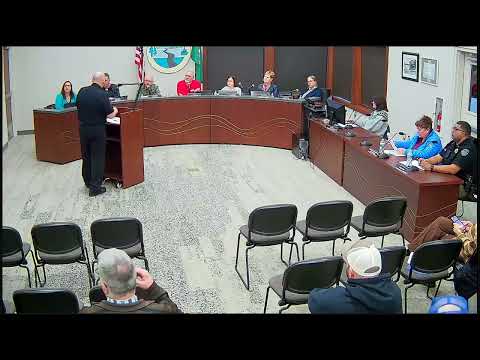
Chief John Noor, chief of Clark County Fire & Rescue, told the La Center City Council on March 12 that the district has increased staffing and begun providing ambulance transport for high-priority calls, producing faster response times — but warned that tax-increment financing programs could reduce the district’s property-tax revenue even as demand rises.
Noor said Clark County Fire & Rescue now employs “80 full time firefighters,” works six stations across the district and handled 5,682 emergency incidents in the past year, “about a 7.1% increase from last year.” He said the district moved this year to provide ambulance transport for high-priority medical incidents beginning Jan. 1 to shorten delays caused by system-wide busyness.
The chief said the district negotiated with the prior contract holder to allow district ambulances to transport high-priority patients — “cardiac arrest, cardiac chest pain, breathing difficulties, traumatic injury where somebody risks bleeding out” — and that the change reduced average response times on those calls. “In February, our average response time on those calls was down to 15:48,” he said.
Noor described operational details for the La Center station and district-wide resources: daily minimum staffing of three firefighters per staffed engine, at least one paramedic on duty each day, shared mutual-aid arrangements with neighboring districts, a rescue raft, rescue boat and a brush/UTV capability for off-road incidents. The district also runs a co-response mental-health team and a referral/follow-up team that visits recently discharged hospital patients to check home safety and link them to services.
On funding, the chief urged the council to note the fiscal risk posed by tax-increment financing (TIF) programs. He described a local example in which a property’s “frozen” TIF value would substantially reduce tax revenue to the fire district compared with the property’s current assessed value. Using figures from his presentation, he said a frozen value example of $1,000,000 would generate about $1,500 at a $1.50 per $1,000 fire levy, while the property’s current full value — he cited a Costco at $21,000,000 in his example — would produce far larger tax receipts for the district absent a TIF designation.
Noor urged public education about the trade-offs of TIF, saying the district’s operations rely largely on property tax and that frozen TIF values can create a mismatch between service demand and available revenue. He said the commission would discuss whether to hold an informational public meeting on the matter.
Council members praised the district’s staffing and service improvements during the presentation. Councilmember Fox said the district’s services are “unmatched,” and others noted the hiring of roughly 30 people over two years and ongoing training.
Noor also reviewed capital and equipment needs: two engines expected in 2026 with an estimated cost of $1.1 million each and a ladder truck priced at about $2 million; he said typical front-line service life goals are 15 years front-line and five years in reserve. He cautioned that vehicle procurement times have lengthened: recent quotes ranged from 30 to 37 months for some apparatus.
No formal action was taken by the council on the presentation. The council thanked Noor for the report and agreed to pass along the district’s concerns to the community.
Ending: The council did not vote on any ordinance or budget item tied to the presentation; Noor said the district will continue outreach about TIF and other fiscal pressures and return with more details as needed.