Get Full Government Meeting Transcripts, Videos, & Alerts Forever!
Get email alerts on the Regulatory Reform topic
No spam. Unsubscribe anytime.
Supporters tell committee REINS Act would shift approval of high-cost rules to legislature
Summary
Witnesses from Americans for Prosperity, Pacific Legal Foundation and FGA Action testified in favor of House Bill 11 (the REINS Act), which would require legislative approval for agency rules meeting specified fiscal thresholds; witnesses cited examples from other states and said the measure restores legislative authority over major regulations.
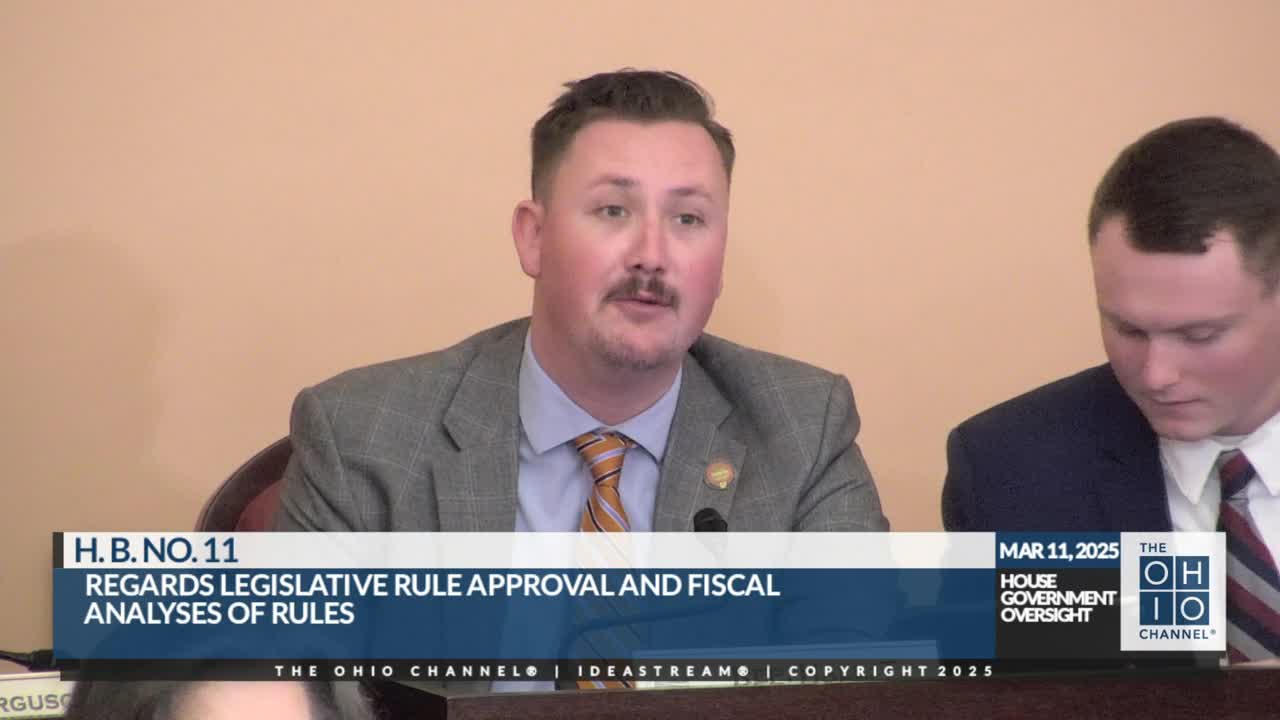
Witnesses for proponents told the House Government Oversight Committee that House Bill 11, a REINS-style measure, would require the General Assembly to approve agency rules that exceed specified fiscal thresholds before those rules could take effect.
Hannah Cubbins, legislative director for Americans for Prosperity Ohio, told the committee the bill would trigger full legislative approval where a proposed rule exceeds $100,000 in agency costs or compliance costs or $1,000,000 in economic impact over a biennium, and argued the measure would restore legislative accountability for high-impact regulation. "The REINS Act aims to restore accountability by ensuring that elected officials have the final say on major regulations," Cubbins said.
Jamie Kavanaugh of Pacific Legal Foundation said the measure protects separation of powers and that other states with similar laws have seen agencies promulgate fewer sweeping rules: "What we often see in states that have enacted these laws is a propensity for the agencies to promulgate smaller rules that are going to have less economic or social effects." Emma Gerlick of FGA Action cited Florida, Indiana, Kansas and other states as part of a broader national trend and said the bill would strengthen legislative oversight while preserving emergency rulemaking carve-outs.
Committee discussion and clarifications - Thresholds: Witnesses noted other states use different numeric thresholds; Florida and Kansas use $1 million over five years, Indiana uses $1 million over two years. HB 11’s $100,000 threshold for some categories is lower than several peer states. - Scope and emergency rules: Witnesses said emergency carve-outs would remain to allow agencies to act in public-health or disaster situations, and that emergency rules would expire (witnesses referenced standard temporary-rule expiration periods). - Retroactivity and workload: Witnesses and members discussed that the bill is not retroactive; one witness cited an LSC query that suggested a past two‑year period would have produced roughly 83 rules meeting a REINS-style threshold (witnesses said they would provide the LSC data to the committee). - Local impacts: Members asked whether state-level REINS measures address regulatory requirements that operate at the local level (for example, federally driven water/sewer mandates); witnesses said the bill focuses on statewide agency rulemaking and would not directly change local or federally driven mandates.
No committee vote occurred; the hearing concluded after proponent testimony and committee questions. Supporters said they would provide additional LSC data and are open to technical changes.