Get Full Government Meeting Transcripts, Videos, & Alerts Forever!
Get email alerts on the Criminal Justice Transparency topic
No spam. Unsubscribe anytime.
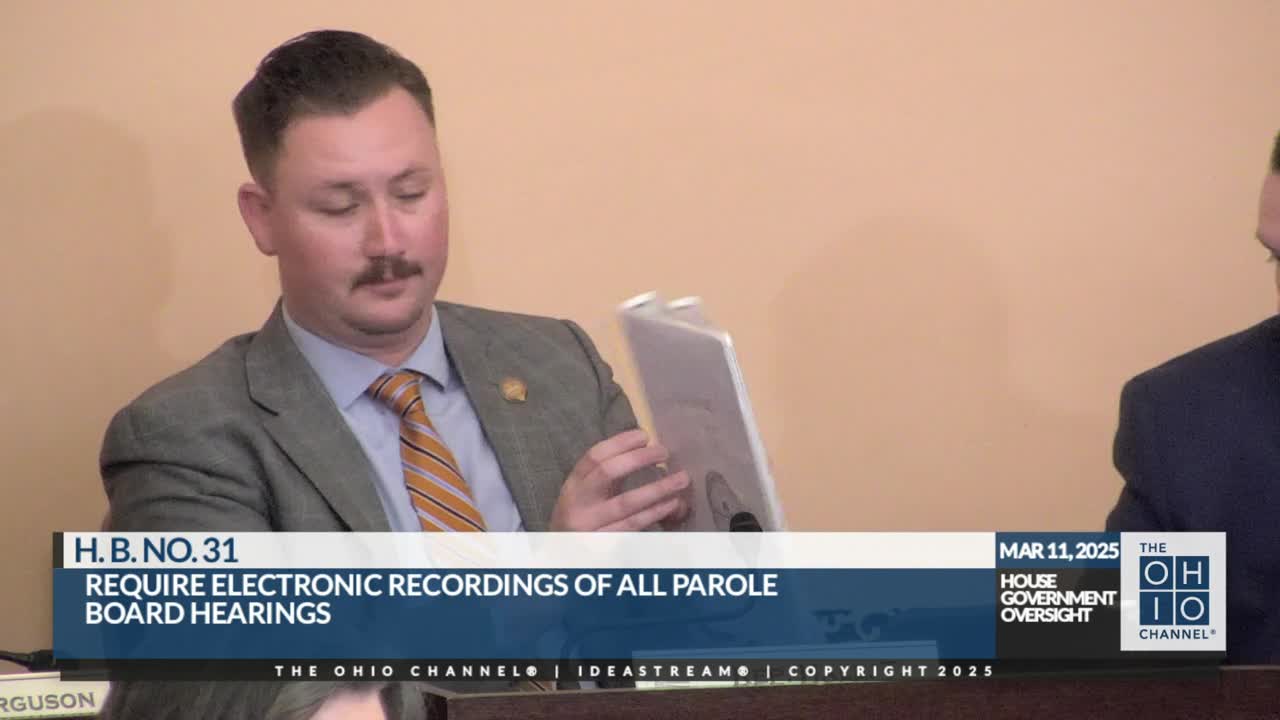
Bill to require recordings of full parole board hearings gets committee airing
Summary
Sponsors said House Bill 31 would mandate electronic recording of full parole board hearings and classify them as public records, with other institutional hearings recorded but access limited to entitled parties; committee members pressed sponsors on costs, retention, victim privacy and enforcement.
Representative Merissa Humphrey (sponsor) told the Government Oversight Committee that House Bill 31 would require full board parole hearings to be electronically recorded and classified as public records under Ohio public-records law, and that victims and involved parties would be entitled to request access.
In sponsor testimony the bill author said current parole hearings are not transcribed or fully recorded in the way court proceedings are: "Under current law, parole board hearings are not required to be recorded or transcribed. Unlike official court proceedings ... the parole board currently only provides a summary digest of its hearings." The bill would make full-board hearings publicly accessible recordings, while institutional parole panels, revocation hearings and similar proceedings would be recorded but access limited to the victim, the individual subject to the hearing and attorneys.
Why it matters: sponsors and supporters said recordings would create a durable record of how parole decisions are made for victims, families and the public. They highlighted that recording full-board hearings is already streamed in some form and that the proposal would preserve recordings rather than create a new public-stream requirement.
Committee questions and clarifications - Scope: Sponsors said the bill covers full board hearings (public) and preserves recordings of other hearing types but limits access to entitled parties to protect sensitive information. - Who may access: For full board hearings the recording would be available by public-records request; for institutional hearings and revocation hearings access would be limited to the parties and their attorneys; sponsors said victims' information would be protected under public-records law. - Cost and storage: Committee members asked about appropriations and storage costs. Sponsors and supporters argued that most hearings are already streamed and that the primary added cost would be file retention, which they characterized as minimal; they opposed a new appropriation in testimony but said they would accept further technical work. - Retention and sanctions: The bill text does not specify detailed retention policies or progressive sanctions for failing to record. Sponsors said the measure relies on standard public-records obligations and the legislature's oversight rather than creating new enforcement penalties in statute. - Usage limits: Supporters said recordings of sensitive institutional hearings should not be published on the internet by third parties and that access language would be crafted to limit public dissemination of victim-sensitive material.
Sponsors cited two figures to underscore the scope of the system: "We have 22,000 Ohioans on parole. A 91,000 Ohioans on probation," one sponsor said during testimony.
No formal committee vote was taken; the hearing concluded as the committee's first hearing on HB 31 and sponsors said they are open to amendments to refine retention, access and cost language.