Get Full Government Meeting Transcripts, Videos, & Alerts Forever!
Get email alerts on the Immigration And Citizenship Data topic
No spam. Unsubscribe anytime.
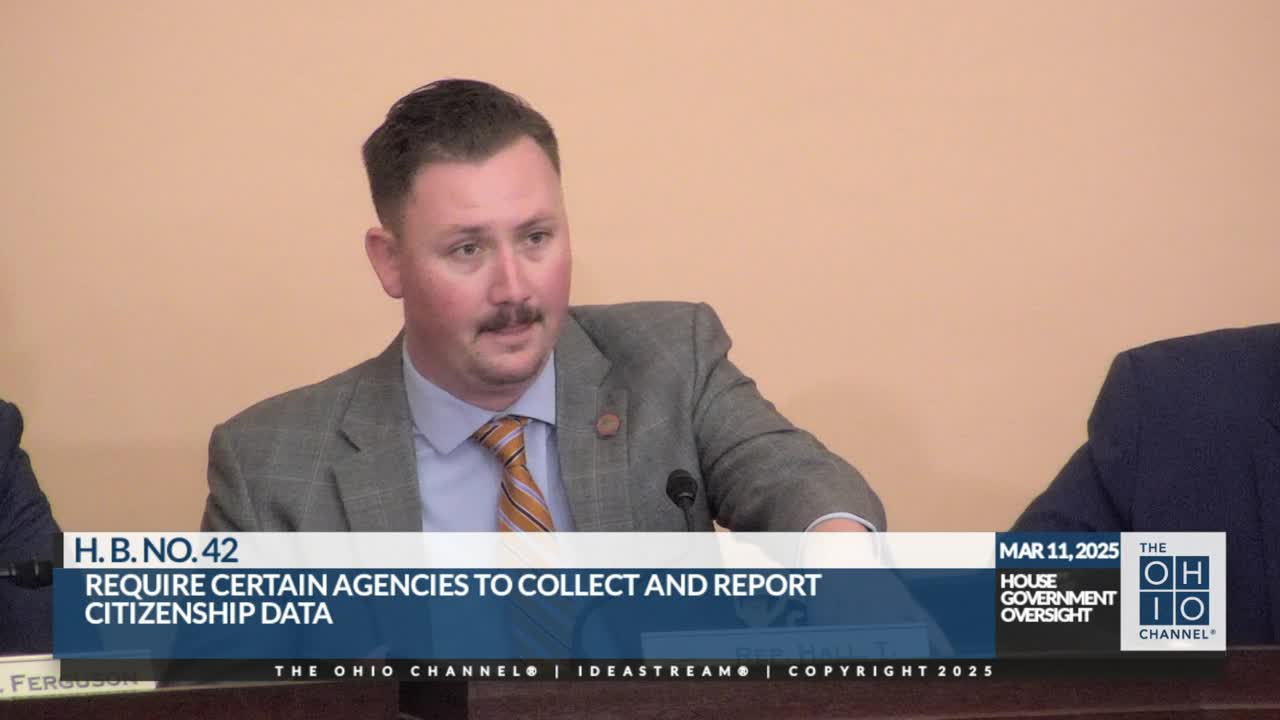
Ohio bill would require state agencies to report citizenship status to governor
Summary
Sponsor testimony for House Bill 42 would require state agencies including schools, corrections, Medicaid and job services to collect and report citizenship categories annually to the governor; committee discussion raised questions about costs, enforcement and data privacy.
Representative John Fisher (sponsor) told the House Government Oversight Committee that House Bill 42 would require state agencies to add citizenship status to existing demographic forms and send annual totals to the governor.
The bill would direct law enforcement and the Department of Rehabilitation and Correction to collect citizenship status for people who are arrested and report totals to the governor by Feb. 28 each year; public school enrollment forms would collect citizenship at enrollment; the Department of Jobs and Family Services and Department of Medicaid would report citizenship categories for households receiving benefits. "To be clear, this legislation will place no restriction on any Ohioan who is currently enrolled in any of these programs or receives these benefits," Fisher said.
Why it matters: supporters said the data would let legislators quantify taxpayer exposure and evaluate program spending. Representative Williams, a joint sponsor, framed the bill as a tool for tracking fiscal effects he connects to illegal immigration and said the annual reports would "assist the General Assembly in lawmaking and policy efforts." Committee members pressed sponsors on whether the data exist now, the fiscal impact of adding collection fields, how agencies would secure sensitive information, and what mechanisms would enforce agency compliance.
Committee discussion and clarifications - Data scope: Sponsors described three reporting categories: U.S. citizens or nationals; noncitizens lawfully present; and noncitizens unlawfully present. They said the reports would include counts only (not names, social security numbers, birth dates or addresses). - Reporting cadence: Sponsors said agencies would compile and forward the report each year, with an example deadline of Feb. 28 for the governor's office submission. - Agencies named: Department of Rehabilitation and Correction (DRC), Department of Jobs and Family Services (JFS), Department of Medicaid, public school systems, and law enforcement agencies. - Costs: Sponsors argued the financial impact should be "negligible" because many agencies already collect demographic data and adding a checkbox is a small operational change; they invited agencies to submit cost concerns to Legislative Service Commission (LSC). Committee members asked whether a fiscal note existed and whether appropriations might be needed. - Enforcement: Sponsors did not place explicit penalties or enforcement mechanisms in the bill. They said legislative power over budgets and committee subpoena power would be the primary means to compel compliance. - Privacy and data protection: Sponsors and members said the bill is intended to collect aggregate counts rather than identifiable records and that sensitive identifiers would not be requested in the reports.
Questions from the committee included whether charter schools (community/charter schools) and county agencies are included, and staff said community schools are expected to be included but they would confirm statutory text. Members also asked whether hospitals and general hospital admission data would be covered; sponsors said hospital admissions were not included and the bill instead focuses on Medicaid to capture health-related taxpayer spending.
No formal vote or committee action occurred; the item concluded as a first hearing and sponsors said they would work with members on clarifying amendments.
Ending: Sponsors said they intend the bill to be a starting point for legislative oversight of public spending and welcomed follow-up with affected agencies and the committee on technical fixes and cost questions.