Get Full Government Meeting Transcripts, Videos, & Alerts Forever!
Get email alerts on the Regulatory Oversight topic
No spam. Unsubscribe anytime.
Committee hears sponsor testimony on bill to require legislative approval, fiscal review for major rules
Summary
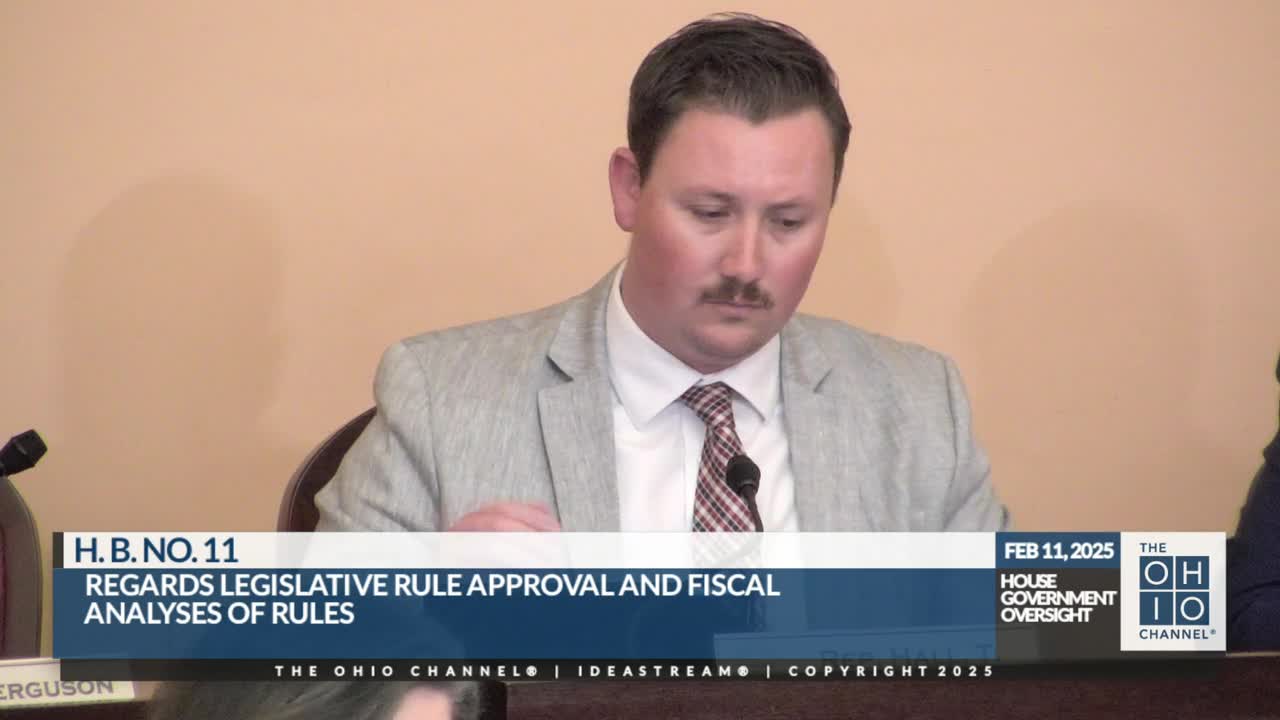
The House Government Oversight Committee heard sponsor testimony on House Bill 11, a proposal to require legislative approval and an independent fiscal analysis for major administrative rules, at a committee meeting of the House Government Oversight Committee (date not specified).
The House Government Oversight Committee heard sponsor testimony on House Bill 11, a proposal to require legislative approval and an independent fiscal analysis for major administrative rules, at a committee meeting of the House Government Oversight Committee (date not specified).
The bill, as presented by Vice Chair Representative Ferguson and sponsor Representative Lorenz, would require that any administrative rule with an estimated administrative cost of $100,000 or more, or a $100,000-plus impact on any individually affected person, come before the full General Assembly for review and approval rather than proceed solely through the Joint Committee on Agency Rule Review (JCAR). "HB 11 is designed to accomplish 3 main objectives, restore legislative control, increase transparency, and empower the people of Ohio," Vice Chair Representative Ferguson said in sponsor testimony. Representative Lorenz added, "House bill 11 is not about stopping necessary regulations. It's about making sure they are justified, transparent, and accountable."
Why it matters: Sponsors said the bill is intended to shift major regulatory decisions that now take effect automatically into a process requiring affirmative legislative approval and more rigorous economic review. Supporters argued that would give more Ohioans and their elected representatives a voice on rules that affect jobs, costs, and local economies and would create an incentive for agencies to propose cost-effective rules. The sponsors cited an estimate from the Legislative Service Commission (LSC) that, had this bill been law in the 2023–2024 biennium, roughly 83 rules would have met the threshold and required legislative review.
Key provisions and process described in the hearing: Under the version discussed, an agency would submit an economic analysis on a form prescribed by JCAR. If either JCAR chair (house or senate) requests an independent analysis, that request would be put to a vote of the requesting chair's chamber; a majority vote would authorize the chair to contract for a third-party economic analysis. Committee members were told that costs for such contracted analyses would come from existing agency budgets and that the bill does not create a general appropriation for new expenditures. Sponsors said agencies could avoid exceeding their administrative allotment either by offsetting new regulatory costs through removing or modifying existing regulations or by remaining within the biennial allotment for administrative costs.
Questions from committee members focused on practical effects and scope. Representative Gross asked how many rules are produced after legislation is passed; the sponsors and LSC staff responded with the estimate of roughly 83 rules over the 2023–2024 period that would have met the draft bill's threshold. Representative King and others pressed on how the offset requirement would work; sponsors described an initial allotment for agency administrative costs each biennium and said activities beyond that allotment would trigger legislative review unless an agency offset reduced costs. Representative Raider and others asked for clarity on who would pay for an independent analysis and how the contracting would be authorized; sponsors said a chamber majority would authorize the contracting and that agency budgets would cover the contracted cost.
Several members raised questions about JCAR's existing role and whether moving more rules to full-chamber review would create lengthy legislative sessions. Sponsors said the intent is not to require review of every rule but to set a threshold (the $100,000 figure discussed at the hearing) that targets rules with broader fiscal or individual impact and to leave lower-cost rules under JCAR's current process. Emergency rules would still be allowed and would expire after 180 days if not acted on, sponsors said.
Supporters framed the bill as restoring "legislative control" and adding transparency; members asked for examples where JCAR or an agency had exceeded legislative intent but sponsors said specific instances were not offered in the hearing and invited members to share examples with the bill chairs for distribution to the committee. Representatives noted other states have enacted similar measures (sponsors cited Florida, Wisconsin and Kansas as recent examples) and agreed to supply comparative outcomes to the committee if requested.
Administrative business and next steps: At the start of the session, the committee adopted standing committee rules (the ROMA rules referenced by the chair), including a five-minute testimony limit at the chair's discretion, by unanimous consent. The committee also appointed Ranking Member Humphrey as committee secretary by unanimous consent. The committee concluded the first hearing on House Bill 11 and the chair said no committee would be held next week and that the next meeting would be held in two weeks; staff from the Legislative Service Commission remained available to provide data to members.
The hearing record contains sponsor testimony and multiple member questions but no formal committee votes on House Bill 11 at this meeting.