Get Full Government Meeting Transcripts, Videos, & Alerts Forever!
Get email alerts on the Corrections Health And Dignity topic
No spam. Unsubscribe anytime.
Committee re-hears bill to require free menstrual products for incarcerated women
Summary
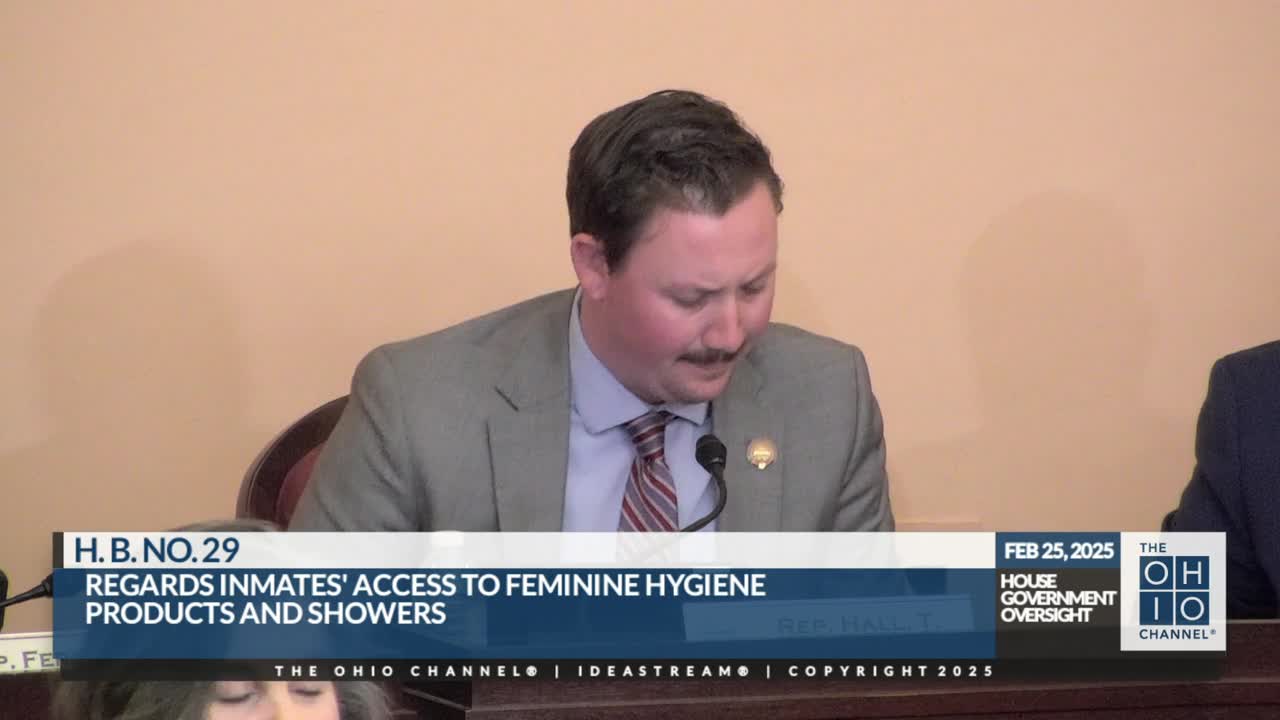
Representative Humphrey and Representative Marilyn John presented sponsor testimony in a first hearing on House Bill 29, which would require correctional facilities in Ohio to provide feminine hygiene products at no cost to incarcerated women and to allow at least one shower per day.
Representative Humphrey and Representative Marilyn John presented sponsor testimony in a first hearing on House Bill 29, which would require correctional facilities in Ohio to provide feminine hygiene products at no cost to incarcerated women and to allow at least one shower per day.
Humphrey told the committee the bill had passed the Ohio House unanimously in the prior session—both as a standalone measure and later as part of another bill—but stalled before final enactment. She said the Ohio Department of Rehabilitation and Correction (ODRC) issued a variance in November 2022 that mirrors many of the bill’s protections, and she argued the variance is not a permanent legal guarantee: “A variance is not a law. It is not permanent, and it can be rescinded at any given time,” Humphrey said.
The sponsors described the bill’s key provisions: mandate free feminine hygiene products in state, county and local correctional facilities; prohibit denying products to inmates; require formal policies for distribution and disposal; permit at least one daily shower for women, including in segregation unless an emergency requires temporary restriction; and include an emergency clause for lockdowns or other critical situations. Representative Humphrey said the bill seeks to “remove the arbitrary discretion” of staff-level decisions about access to hygiene products and to “safeguard the dignity and health of incarcerated women.”
Committee members asked about abuse or misuse of products and about operational details. Humphrey acknowledged ODRC concerns about rare incidents—in one example an offender swallowed a tampon to harm herself—and said the draft includes emergency provisions that permit temporary restrictions in cases where safety requires it. Humphrey and other sponsors pointed to the CIIC (Correctional Institution Inspection Committee) role in inspections to verify facility compliance with the variance and with policy.
Sponsors also said the bill had been refined through bipartisan work and stakeholder outreach, including discussions with ODRC and CIIC. No vote was taken at the committee hearing; sponsors invited follow‑up questions and indicated willingness to provide the variance and other supporting documents to members.
Ending: The committee closed the first hearing on House Bill 29 after sponsor testimony and member questions; sponsors said they would provide the ODRC variance and other materials for members’ review.