Get Full Government Meeting Transcripts, Videos, & Alerts Forever!
Get email alerts on the Historic Recognition topic
No spam. Unsubscribe anytime.
House committee holds first hearing on bill to designate John Rankin Day and commission statue
Summary
The House Government Oversight Committee heard sponsor testimony on House Bill 53 to designate Feb. 4 as John Rankin Day and commission a statue on Statehouse grounds; sponsors said the move would recognize Rankin’s role in the Underground Railroad. No vote was taken; the measure received questions about funding, placement and community outreach.
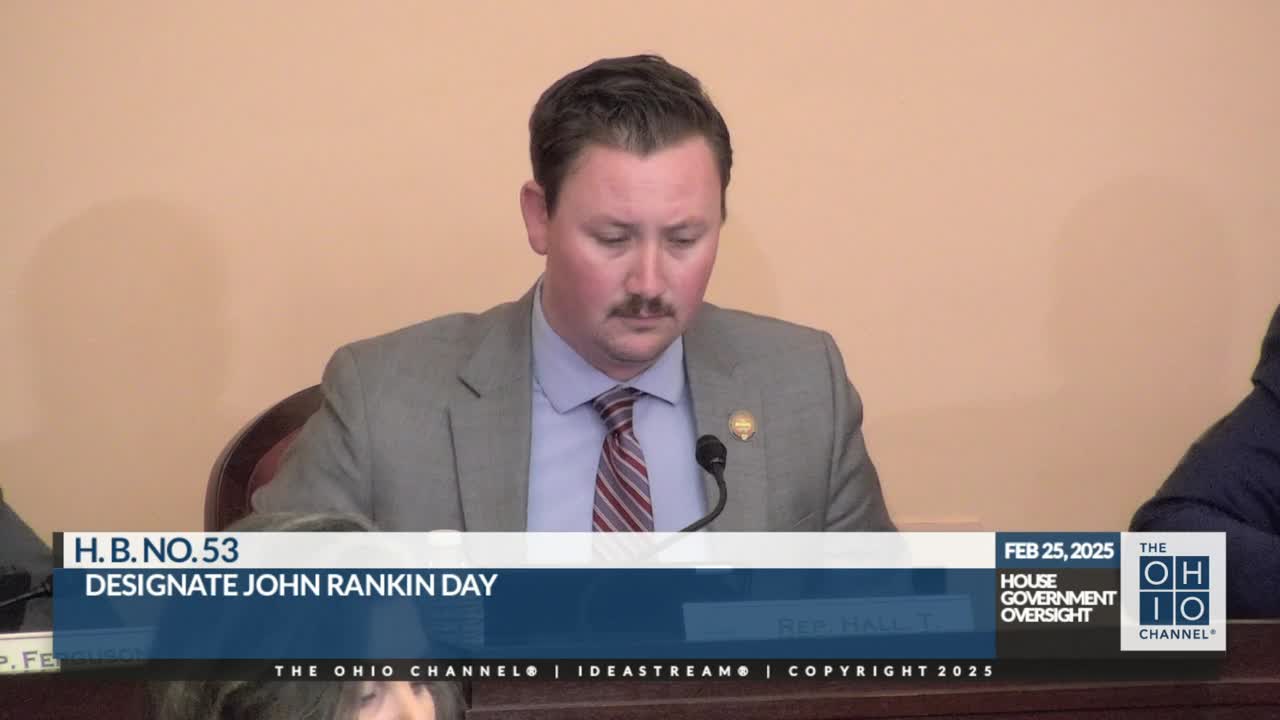
House Government Oversight Committee Chair Gregory Hall on Wednesday opened a first hearing on House Bill 53, which would designate Feb. 4 as John Rankin Day and authorize a commissioned statue of the 19th‑century abolitionist for placement on Statehouse grounds.
Sponsors Representative Pizzoli, who said he represents Ripley, Ohio, and Representative Fisher told the committee that Rankin’s work as an Underground Railroad conductor and his abolitionist writings warrant formal recognition. “Designating a day to honor John Rankin would just be an affirmation of the values he championed. Freedom, equality, and moral courage,” Pizzoli said in sponsor testimony.
The bill’s sponsors told the committee they expect the statue to be placed on the Statehouse grounds after review by the Capitol Square Advisory Board and that private fundraising would cover the cost of commissioning the sculpture. Representative Fisher said the intention is to “make sure that whatever ends up happening fits in with the beautiful State House grounds that we have” and that the Capitol Square Advisory Board typically handles siting and fundraising.
Members asked about consulting historical organizations and families with connections to the Underground Railroad. Fisher said the bill is “more than happy to partner with any type of historical society,” listing the Ohio History Connection and the John P. Parker House in Ripley as potential partners. Representative Simms and others suggested outreach to local historical societies and community groups, including those with family histories tied to people who passed through Rankin’s house.
Committee members also asked for details on financing and placement. Sponsors said the bill anticipates private fundraising for the statue and state coordination for site preparation; specific funding amounts and a precise placement on the grounds were not specified at the hearing. The sponsors acknowledged a local biography of Rankin by Caleb Franz and said they would work with community groups to incorporate broader local histories.
The committee did not take a vote. Chair Hall closed the hearing after members’ questions and sponsor answers.
Ending: The first hearing on House Bill 53 concluded with sponsors committed to partnering with historical groups and the Capitol Square Advisory Board on fundraising and siting; no formal action or vote was recorded at the committee hearing.