Get Full Government Meeting Transcripts, Videos, & Alerts Forever!
Get email alerts on the Water Conservation topic
No spam. Unsubscribe anytime.
Fort Collins updates water‑efficiency plan: staff propose a 3% treated‑water demand target and city landscape goal
Summary
Fort Collins Utilities staff briefed council on a draft water efficiency plan that emphasizes equity, engagement and measurable conservation. Staff proposed a new utility‑wide treated water goal — a 3% reduction in annual treated demand by 2040 — and a second goal to improve outdoor water efficiency on city‑owned landscapes.
Fort Collins Utilities presented an update to the city’s Water Efficiency Plan (WEP), describing community outreach, equity analysis and a proposed set of goals and strategies for reducing treated‑water demand over the coming decades.
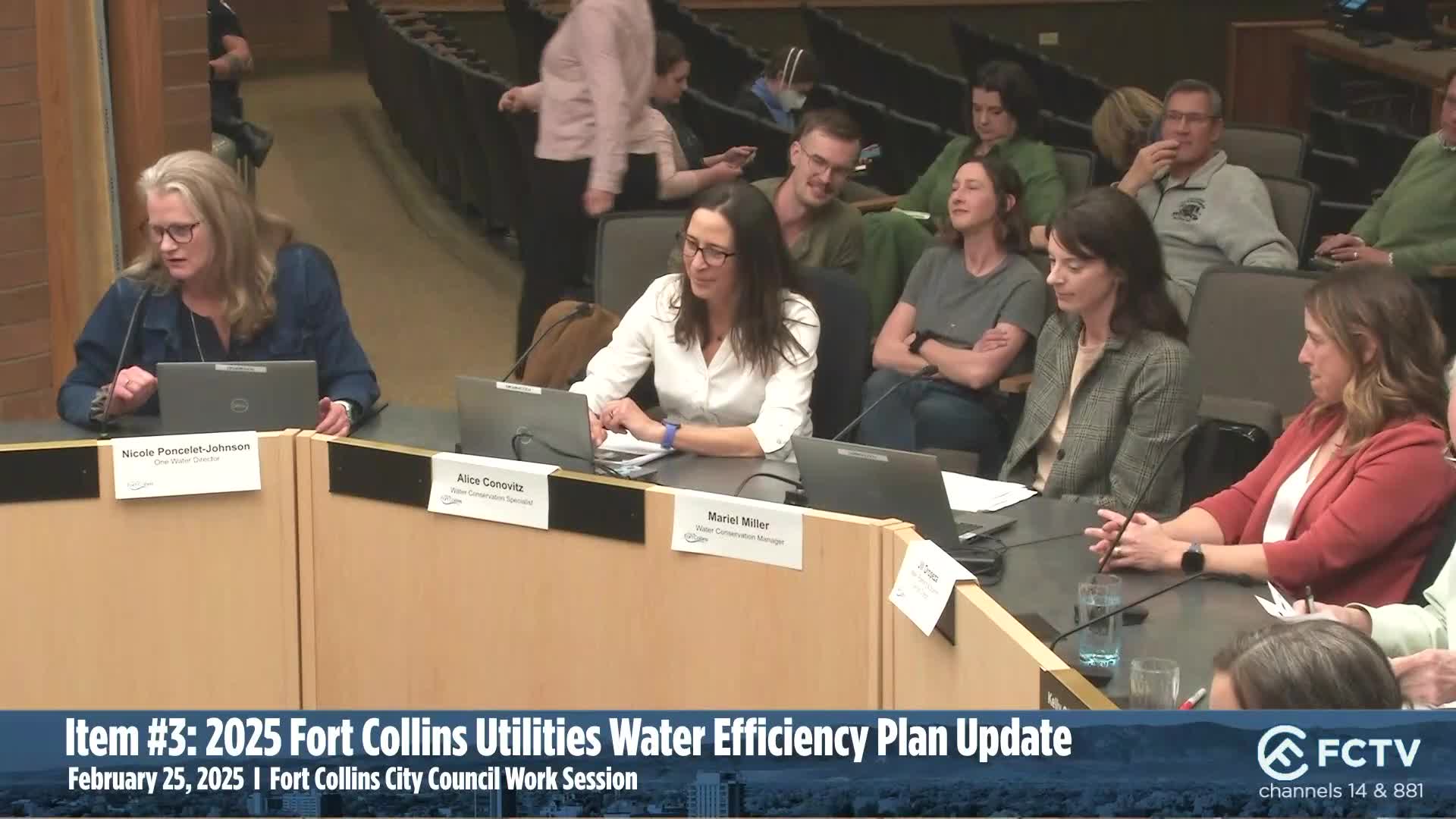
Nicole Poncelet Johnson, 1 Water Executive Director, introduced the presentation and said the WEP is a state‑required plan. Alice Konovitz, Water Conservation Specialist, summarized engagement and modeling work and put forward two core goals: a utility‑wide treated water target and a city landscape target. “Goal 1: all customers contribute to lowering annual water demand by 3% by 02/1940 to reduce our risk of shortages,” Konovitz said. She added that the plan proposes a second goal to upgrade irrigation and outdoor water efficiency on city‑owned landscapes to build resilience.
Why this matters
Fort Collins faces demand pressure from growth and warming temperatures. Staff said conservation in Fort Collins already yields measurable savings (about 135 million gallons per year, roughly the annual use of 1,500 single‑family households) and that coordinated action can reduce the city’s exposure to shortages while prioritizing equitable access to programs and assistance.
What staff proposed
Staff summarized analytic work and engagement. They reported more than 5,000 public “touch points,” including a survey with over 1,300 respondents and targeted outreach to disproportionately impacted groups: renters, non‑English speakers and new residents. Modeling and screening of strategies informed the recommendations.
Proposed goals discussed at the meeting:
- Goal 1 (utility treated water): “All customers contribute to lowering annual water demand by 3% by 02/1940,” with interim targets and sector‑specific tracking. Staff estimated that 3% of treated use by 2040 would equate to roughly 21–26 million gallons per year under their scenarios and would require roughly a 40% increase in current programmatic savings by volume.
- Goal 2 (city landscapes): The city will “improve outdoor water efficiency across city‑owned landscapes,” with a suggested target of completing at least one prioritized irrigation or turf‑to‑xeric project per budgeting cycle (about seven projects by 2040). Staff proposed tracking irrigation upgrades and replaced turf square footage.
Strategies and equity
Staff grouped strategies by policy, behavior, operations and economic levers. They said community feedback favors incentives and wants the city to lead by example on public landscapes. Staff emphasized equity screening — identifying barriers that would keep lower‑income or non‑English households from participating — and recommended targeted outreach and adaptation of programs for renters, HOAs and high‑use customers.
Council questions and follow‑up asks
Councilmembers sought clarifications about metrics, who pays and how the plan accounts for growth. Mayor and council asked staff to break down usage and conservation metrics by customer sector (residential vs. commercial; indoor vs. outdoor) rather than relying solely on a single gallons‑per‑capita‑per‑day figure. Several members asked for worked examples showing how the 3% goal would be applied and how it will scale with population growth.
Other follow‑ups included requests for: a clearer, quantifiable city‑owned water‑use target; cost estimates and funding options for prioritized projects (staff suggested reallocating conservation funds and leveraging other landscape program funding); documentation of how conservation programs affect disproportionately impacted households; and a review of the city’s “frowny face” over‑use notification program and its measured effectiveness.
Ending
Staff said they will publish a public comment draft, open a 60‑day public comment period, brief relevant boards and commissions, and return to council to seek adoption of the finalized WEP in summer. No formal decision was taken at the meeting.