Get Full Government Meeting Transcripts, Videos, & Alerts Forever!
Get email alerts on the Coastal Management topic
No spam. Unsubscribe anytime.
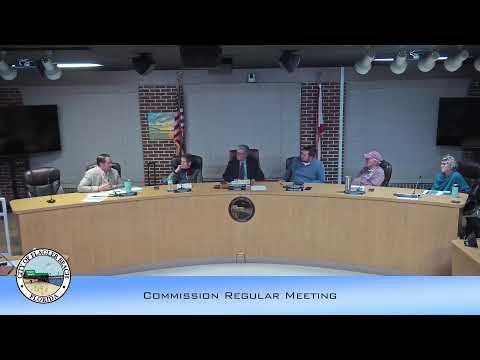
Flagler Beach commissioners express general support for county beach-management funding plan, ask for detail on fees and oversight
Summary
At a March 6 workshop, the Flagler Beach City Commission voiced broad, conditional support for Flagler County’s proposed beach-management plan — which relies on a half-cent county sales tax and a $1.60 annual per-parcel fee — while asking county staff for clearer cost breakdowns, exemptions for low-income residents, and oversight mechanisms.
The Flagler Beach City Commission on March 6 signaled general support for Flagler County’s proposed beach-management plan, which would fund shoreline renourishment with a half-cent county sales tax and a proposed $1.60 annual per-parcel fee, but commissioners pressed county staff for more detail on costs, timing and protections for low-income residents.
Commissioner Cooley said he was broadly supportive of the county’s approach, adding, “I am all in.” That view was echoed by other commissioners, including Mayor Mary King, who said, “I’m bought in on this,” while noting remaining questions about logistics such as walkovers and maintenance.
The workshop, convened as a discussion-focused meeting rather than a formal vote, brought Flagler County Administrator Heidi Petito to the dais to take questions. Petito described how the county developed estimates and funding options, said the county recently qualified for additional grant funding and emphasized that the plan is not final: “I’m enjoying the conversation, actually, and I’m really glad to hear the comments and the feedback,” Petito told the commission.
Why it matters: Commissioners and public commenters framed the coastline as Flagler County’s primary economic asset and said a coordinated, countywide funding approach could avoid piecemeal work that leaves some reaches eroded. Commissioners repeatedly said the plan’s intent is to pool multiple revenue sources — sales tax, a per-parcel fee, state and federal grants and contributions from municipalities — so renourishment can be done more often and more predictably than relying on emergency responses alone.
Key details discussed
- Proposal components: County staff presented a funding model that pairs a half-cent county sales tax with an annual per-parcel fee proposed at $1.60. The county estimates tourism-generated sales tax and a dedicated bed tax penny will meaningfully contribute to the revenue stream.
- Cost estimates and schedule: Commissioners asked for the source of island- and jurisdiction-level cost estimates. Petito said a coastal engineer produced the jurisdictional costs that underlie the $2.4 million (reported in county materials as a jurisdictional annual figure) and related estimates and that the Army Corps of Engineers’ periodic nourishment interval may be shorter than originally projected — county staff now expect intervals closer to six to eight years in some areas rather than 10 years.
- Grants and matching funds: Petito said the county qualified for an $8.8 million project with a 50% match requirement (roughly $4.4 million local match), and that pursuing additional federal hazard-mitigation and other grants is part of the plan to reduce the local funding burden.
- Municipal shares and concerns: Commissioners raised concerns about Palm Coast and Bunnell receiving a share of revenues returned to municipalities, and about how the per-parcel fee would be applied across different property types (single-family parcels, multi-unit parcels, undeveloped lots). Several commissioners described the $1.60 figure as nominal but asked for options to reduce burden on fixed-income residents; Petito said the county has discussed grant or waiver programs to address affordability and could consider a graduated approach tied to property valuation or zones.
- Oversight and governance: Commissioners requested clearer oversight language. Petito said the county envisions restricted funds held in a separate account and suggested an oversight/steering group with representatives from participating jurisdictions meeting periodically to review revenues and expenditures.
- FDOT, Army Corps and other partners: The commission asked about Florida Department of Transportation (FDOT) commitments at seawalls and whether FDOT’s role would limit beach-building in some sections. Petito said FDOT has historically prioritized protecting A1A and seawalls, not beach renourishment, but that FDOT and the county have discussed amending earlier agreements and that FDOT has been a committed partner on some funding.
Public comment: Speakers at the meeting ranged from residents seeking clearer math and limits on revenue use to those endorsing a countywide approach. Resident Steve Dally asked for clearer parcel and revenue calculations: “I don’t understand the $1.60 and we’re not doing it on the other side,” and urged explicit spending limits and transparency. RJ Santore and other residents said the beach benefits the whole county and argued for a regional solution that preserves quality of life.
Next steps and constraints
County staff and commissioners agreed the plan remains a work in progress. Petito urged municipal representatives at an upcoming intergovernmental meeting to provide specific feedback — for example, whether the cities want the county to assume maintenance responsibilities, or prefer to retain local control of walkovers and parking. Commissioners asked staff to return with clearer cost breakdowns, proposed exemptions or hardship programs for the flat fee, and draft language for an oversight arrangement.
No formal funding decision or ordinance was adopted at the workshop. The meeting closed after public comment and a brief procedural motion to adjourn was approved.