Get Full Government Meeting Transcripts, Videos, & Alerts Forever!
Get email alerts on the Student Finance topic
No spam. Unsubscribe anytime.
PHEAA advisers outline steps families can take to narrow college financial-aid gaps
Summary
PA Forward account executives at the Pennsylvania Higher Education Assistance Agency described how students and families can reduce the difference between college cost of attendance and gift aid, emphasizing early preparation, careful review of offer letters, scholarship searches and cautious borrowing.
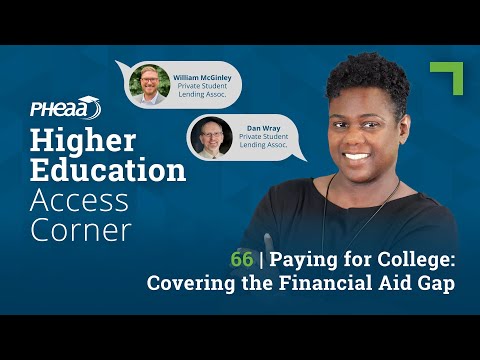
Tiffany DeVane, host of PHEAA’s Higher Education Access Corner, moderated a roughly hour-long discussion about covering the financial-aid gap with PA Forward account executives Dan Ray and Will McGinley.
The guests urged families to begin planning years before college, use net-price calculators and compare school offer letters, and to treat loans as a last resort after maximizing grants, scholarships and work-based aid. “Don’t borrow more than your starting salary,” said Dan Ray, describing a guideline he and colleagues recommend when judging affordability.
The conversation focused on the practical steps that reduce a remaining gap after gift aid: (1) front-load the process (scholarship searches, career exploration and documentation of accomplishments), (2) carefully read and compare financial-aid offer letters, and (3) weigh options for covering any shortfall, including payment plans, student work, federal loans (including the Parent PLUS loan) and private education loans. Ray and McGinley emphasized that offer letters vary by school and that some institutions list “work study” or Parent PLUS amounts that are not automatic reductions to a bill.
Ray and McGinley explained basic differences among financing choices without recommending a single lender. They noted that federal Direct Loans have annual and aggregate limits and that Parent PLUS loans carry an origination fee; McGinley said the Parent PLUS process screens for adverse credit but does not evaluate a borrower’s capacity to repay. “The PLUS loan credit check is not going to stop you from burying yourself in too much debt,” Ray said, urging parents to consider whether borrowing more than current income is prudent.
Both advisers encouraged shopping among options. McGinley highlighted private education loans as an alternative that can offer competitive interest rates for borrowers with strong credit or a cosigner, and he recommended comparing fees, fixed versus variable rates and repayment terms. Ray pointed listeners to the FIA/PA Forward application system as one place to evaluate eligibility for particular private programs and to MySmartBorrowing.org as a tool for families new to borrowing.
Panelists also discussed strategies for families who cannot fully cover costs the first year: commuting or attending community college for transferable credits, seeking school endowments and professional-judgment or special-circumstance reviews (for recent job loss, divorce or high medical expenses), and continuing scholarship searches every year. “This is a year-to-year thing,” McGinley said, noting that financial aid and family circumstances can change annually.
The episode concluded with practical resource recommendations cited by the guests: StudentAid.gov for federal information, EducationPlanner.org and MyNextMove.org for career and school matching, MySmartBorrowing.org for loan decision tools, feea.org (FIA/PA Forward) for program webinars and scholarship-search tools. DeVane reminded listeners that an official offer letter generally appears only after a student has been admitted and the school is listed on the FAFSA.
The advisers urged families to document achievements early (an academic or scholarship resume), apply widely for small and large scholarships, and to set a realistic household budget that guides any borrowing. “You are worth that investment,” Will McGinley said, framing postsecondary education as a long-term investment in earning potential while reiterating the need to borrow prudently.
The discussion was presented as guidance and information; no new PHEAA policies or regulatory changes were announced during the podcast.