Get Full Government Meeting Transcripts, Videos, & Alerts Forever!
Get email alerts on the Attainable Housing topic
No spam. Unsubscribe anytime.
Rockport, Aransas County officials hear developer plan and housing‑finance briefing as residents raise tax and traffic concerns
Summary
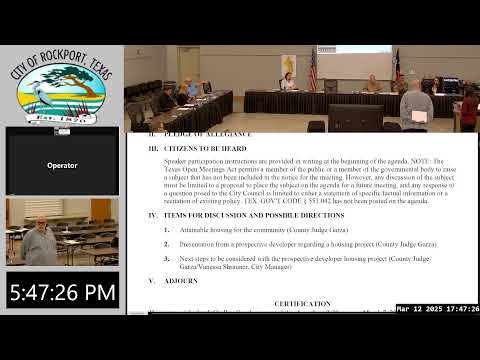
A joint workshop of the City of Rockport and the Aransas County Commissioners Court on the topic of attainable housing featured a developer presentation and a separate briefing on housing‑finance tools, with residents and elected officials sharply questioning the use of public tax relief for private development. No formal action was taken at the meeting.
A joint workshop of the City of Rockport and the Aransas County Commissioners Court on the topic of attainable housing featured a developer presentation and a separate briefing on housing‑finance tools, with residents and elected officials sharply questioning the use of public tax relief for private development. No formal action was taken at the meeting.
The most immediate proposal came from developer Stuart Lynn, who described a conceptual subdivision of roughly 33 acres behind the Dollar Store along Market Street with about 163 lots and houses in the roughly 1,170–1,700 square‑foot range. Lynn said estimated infrastructure costs are about $6.5 million — roughly $40,000–$45,000 per lot — and that his plan would seek a reimbursement mechanism that directs 80% of the property‑tax increase from the new development to pay infrastructure over time.
“I'm not here trying to promote this to make much money. I'm trying to be part of the solution,” Lynn told the workshop. He described a five‑year development window for the project and a graduated reimbursement tied to price per square foot, with a $210/SF baseline (which Lynn said would equal roughly a $247,000 house at the 1,170 SF example). Lynn said he would include contract terms intended to limit investor conversions — occupancy‑first rules, rental caps, HOA controls and other deed‑ or CCR‑based restrictions — and proposed that reimbursement be limited to lots completed and sold within the five‑year build window.
A separate presentation by Hilltop Securities and Chapman legal firm described the housing‑finance‑corporation (HFC) model under state law and the tools it can bring, including private‑activity revenue bonds, tax‑exempt status for property owned by the HFC, and potential access to federal/state tax‑credit programs administered by the Texas Department of Housing and Community Affairs (TDHCA). Megan Ramos of Hilltop said her team represents “about 35 to 40 active HFCs across the state.” Attorney Rachel Jensen told the meeting that HFCs are organized under Texas law (Chapter 394 of the Texas Local Government Code), and described typical program rules and the public‑benefit analyses Hilltop provides for proposed projects.
The HFC presenters and county staff emphasized that bonds issued through an HFC would be revenue bonds secured by project revenues, not a county or city general obligation. Jensen and Hilltop staff outlined common terms used in HFC partnerships: the HFC often takes title to the land underlying a project, the project typically limits a specified share of units to low‑ and moderate‑income households (the presenters noted examples such as 50% of units at under 80% of area median income and policy options to target deeper affordability), and the HFC can negotiate fees, lease payments or other clawbacks to return value to the public.
Residents pressed elected officials on both the specific Lynn proposal and the HFC tool. Andrew Kane, a Rockport resident, urged caution and called the developer reimbursement a de facto subsidy that would create “winners and losers,” saying “This land is not blighted” and asking why taxpayers should effectively provide roughly $40,000 per lot. Patrick Kane, whose written comment was read into the record, urged elected officials to pursue no‑cost options first — higher density zoning, accessory dwellings, divestiture of surplus public land — before offering tax subsidies.
Kristen Underwood, who said she works for the county and lives on Kelly Lane near the proposed entrance, spoke about traffic and property impacts: “At 63 homes, an average of two vehicles per home, that will be at least 326 plus vehicles every day driving past my home,” she said, and urged relocating the main access off Kelly Lane. Other commenters asked for proof‑of‑concept projects and for developers to provide prior contract and market performance data before any tax agreement is considered.
County and city officials asked detailed follow‑up questions. Commissioners and staff pressed Lynn on the $6.5 million infrastructure estimate, the per‑lot reimbursement math, the five‑year development requirement he proposed, and safeguards to keep units owner‑occupied rather than becoming investor rentals. Commissioners also expressed concern that putting project parcels on an HFC’s tax‑exempt rolls would remove ad valorem revenues used for schools and city services, and asked Hilltop and Chapman to quantify the fiscal tradeoffs and sample agreements from other Texas communities.
Presenters said HFC tools can reduce construction costs — sales‑tax exemptions on construction materials, certain recording and licensing savings, and potential companion financing such as 4% low‑income housing tax credits paired with private‑activity bonds — but they acknowledged the tradeoff: property removed from the tax rolls while the HFC is the titled owner. Hilltop said typical HFC fee structures can include an upfront partnership management fee (Hilltop cited $10,000 as a typical administrative item), splits of developer fees, and a small share of sale or refinance proceeds to be returned to the HFC to support community objectives, scholarships, or payments‑in‑lieu to taxing entities.
City and county staff recommended more analysis before any action. Jeff (staff member) and county legal and finance advisers said formation of a county HFC — rather than a city HFC — could cover the whole jurisdiction and keep a single process in place for future projects. Officials asked Hilltop and Chapman to return with sample development‑agreement language, financial‑impact scenarios for schools and general fund revenues, and examples from comparable Texas projects.
The workshop closed with no vote. Judge Garza and council members said the presentations were for information and further study; multiple speakers urged transparency and more data. The workshop did not direct staff to a specific next step, and no development agreement or HFC formation was approved at the meeting.