Get Full Government Meeting Transcripts, Videos, & Alerts Forever!
Pinellas County outlines San Martin Boulevard bridge replacement, schedules construction for 2027–2030
Summary
Pinellas County and consultant HDR presented a design update for the San Martin Boulevard bridge over Riviera Bay, confirming a preferred east-alignment fixed-span replacement, current funding and a construction timeline that begins advertising in spring 2027 and starts in fall 2027 with completion expected by early 2030.
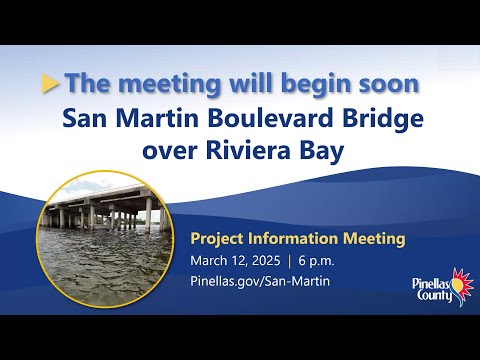
Pinellas County officials and consultants presented updated designs and a construction timetable for the San Martin Boulevard bridge replacement during a virtual project information meeting.
The county and its lead design consultant, Marlon Register of HDR, said the county selected a fixed-span bridge on an alignment east of the existing structure and is advancing design work. "The proposed bridge clearance for the new bridge is approximately 17.8 feet versus the existing 10.5 feet of the current bridge," Register said. He added the horizontal clearance between piers would increase from 22 feet to 70 feet.
The bridge, built in 1962, now carries one lane each way over Riviera Bay and serves motorists, bicyclists, pedestrians and boaters accessing a network of neighborhood canals and the Weeden Island Preserve. County project manager Anne Venables said the project is "fully funded. Currently it's funded with a penny from Pinellas Funds," and the county will pursue additional state and federal sources. Venables said design is about 30 percent complete and is expected to finish in summer 2026.
Why it matters: speakers framed the replacement as a response to aging infrastructure and safety and accessibility gaps. County and consultant presenters said the existing structure is classified as scour-critical, functionally obsolete due to narrow lanes and shoulders, and lacks ADA-compliant sidewalks or designated bike facilities. The design aims to modernize the crossing and keep traffic moving during…
Already have an account? Log in
Subscribe to keep reading
Unlock the rest of this article — and every article on Citizen Portal.
- Unlimited articles
- AI-powered breakdowns of topics, speakers, decisions, and budgets
- Instant alerts when your location has a new meeting
- Follow topics and more locations
- 1,000 AI Insights / month, plus AI Chat