Get Full Government Meeting Transcripts, Videos, & Alerts Forever!
Get email alerts on the San Martin Bridge Replacement topic
No spam. Unsubscribe anytime.
Pinellas County outlines San Martin Boulevard bridge replacement, schedules construction for 2027–2030
Summary
Pinellas County and consultant HDR presented a design update for the San Martin Boulevard bridge over Riviera Bay, confirming a preferred east-alignment fixed-span replacement, current funding and a construction timeline that begins advertising in spring 2027 and starts in fall 2027 with completion expected by early 2030.
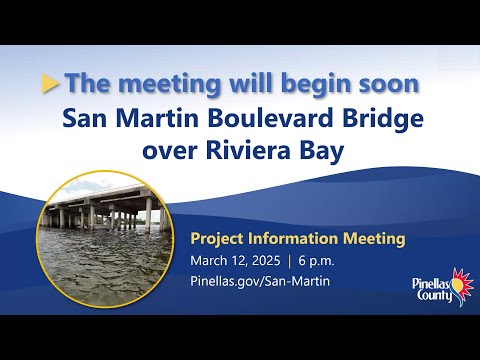
Pinellas County officials and consultants presented updated designs and a construction timetable for the San Martin Boulevard bridge replacement during a virtual project information meeting.
The county and its lead design consultant, Marlon Register of HDR, said the county selected a fixed-span bridge on an alignment east of the existing structure and is advancing design work. "The proposed bridge clearance for the new bridge is approximately 17.8 feet versus the existing 10.5 feet of the current bridge," Register said. He added the horizontal clearance between piers would increase from 22 feet to 70 feet.
The bridge, built in 1962, now carries one lane each way over Riviera Bay and serves motorists, bicyclists, pedestrians and boaters accessing a network of neighborhood canals and the Weeden Island Preserve. County project manager Anne Venables said the project is "fully funded. Currently it's funded with a penny from Pinellas Funds," and the county will pursue additional state and federal sources. Venables said design is about 30 percent complete and is expected to finish in summer 2026.
Why it matters: speakers framed the replacement as a response to aging infrastructure and safety and accessibility gaps. County and consultant presenters said the existing structure is classified as scour-critical, functionally obsolete due to narrow lanes and shoulders, and lacks ADA-compliant sidewalks or designated bike facilities. The design aims to modernize the crossing and keep traffic moving during construction.
Key elements of the design and schedule
- Replacement alignment: fixed-span bridge located to the east of the existing bridge so traffic can be maintained during construction. Minor intersection changes at San Martin Boulevard/Tallahassee Drive and San Martin Boulevard/Wheaton Drive Northeast are included. - Clearances and widths: vertical clearance will increase from 10.5 feet to about 17.8 feet at mean high water; horizontal clearance between piers will increase from roughly 22 feet to 70 feet. The existing bridge is roughly 120 feet long and carries two travel lanes. - Travel and multimodal facilities: the new roadway will include two 11-foot travel lanes, 7-foot bike lanes each direction, a 6-foot sidewalk on the west side and a 12-foot shared-use path on the east side that will tie into the planned Pinellas Trail Loop. - Stormwater and environmental mitigation: the design adds curb and gutter and a stormwater collection system with treatment prior to discharge. Consultants said mechanical treatment devices are planned rather than retention ponds; mitigation strategies for seagrass and mangrove impacts will be developed during design. - Utilities: the city of St. Petersburg is designing relocation of water and sewer lines that currently occupy the existing bridge; those relocations must be completed before bridge construction begins. - Construction phasing and schedule: design began in May 2023. Plans are to advertise for construction in spring 2027, begin construction in fall 2027 and finish in early 2030. Presenters described a four-phase construction sequence intended to maintain traffic in both directions for most of the work; brief lane or intermittent closures that are generally expected to last a day or less were mentioned.
Funding, permitting and risks
Venables said the project is funded through the county's local penny program (Penny for Pinellas) and that county staff will pursue additional state and federal funding. She provided a project cost estimate of about $32,000,000 and noted that county budgeting identifies planned revenues across future years rather than holding the entire multi-year amount in a single account. Presenters said permitting (including Florida Department of Environmental Protection coordination), acquisition of construction easements and utility relocations are among the schedule risks that could delay construction.
Public concerns and county responses
County staff and consultants answered a range of resident questions about fishing access, short-term safety measures, traffic impacts, and noise. Tom Washburn, transportation division director for Pinellas County, said, "Currently, there's no fishing allowed on the bridge," and that the county will coordinate with the city of St. Petersburg on whether fishing access will be permitted on any portion of the new bridge. On short-term safety measures, Washburn said speed bumps are not appropriate for this roadway type but that the county can consider additional speed feedback signs closer to the bridge and study other options with the city.
Residents asked whether the project would include dredging or larger openings for water flow; consultants said no dredging is part of this project and that evaluations concluded opening the channel further could expose waterfront homes to greater wave action. Register said the design "is basically just what we have today" regarding wider openings after evaluating alternatives.
The county said it will post construction updates, lane-closure notices and contact information on the project website and hold another project information meeting prior to construction.
What was not decided or remains to be determined
Presenters repeatedly said some items remain subject to later design decisions or to coordination with the city of St. Petersburg, including: specific utility relocation timing and funding for the city's relocation work; whether fishing will be allowed on parts of the new bridge; precise locations for stormwater treatment facilities; and detailed right-of-way and temporary construction-easement needs, which will be identified as design progresses to 60 percent plans.
Ending
County staff asked residents to submit questions and comments through the project website and said a presentation recording and design materials will be posted online. Venables reiterated the county's schedule expectations: design complete in 2026, construction advertised in spring 2027 and construction beginning in fall 2027 with completion targeted for early 2030.