Get Full Government Meeting Transcripts, Videos, & Alerts Forever!
Get email alerts on the Resort Property Taxes topic
No spam. Unsubscribe anytime.
Taxes committee adds resort property tax changes to early tax bill, advances measure to Senate floor
Summary
The Minnesota Senate Taxes Committee voted March 13 to add language adjusting Class 1C "mom-and-pop" resort property tax tiers to an early, noncontroversial tax bill (Senate File 132) and sent the amended bill to the Senate floor. Resort owners testified that the change would help preserve small lakeshore businesses.
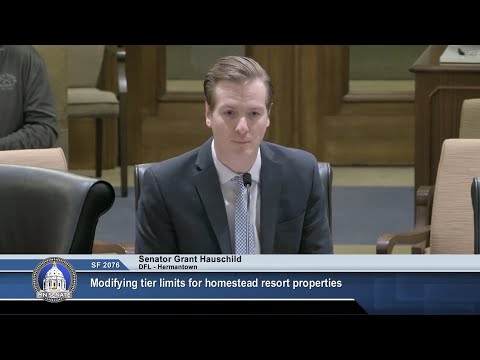
The Minnesota Senate Taxes Committee on March 13 adopted an amendment to add the language of Senate File 2,076 — a bill that raises the classification tiers for Class 1C homestead resort properties — to an early omnibus tax bill, Senate File 132, and voted to send the amended SF132 to the Senate floor.
The amendment, offered by Senator Hauschild and adopted by voice vote, inserts the SF2076 tier adjustments into the A2 amendment to SF132; the committee then adopted the A2 amendment as amended and passed SF132 as amended to the floor. Earlier in the hearing SF2076 had been presented and initially laid over for further consideration.
Proponents told the committee the tier changes aim to preserve small, family-run lakeshore resorts by aligning the tax treatment with how those properties operate and by offsetting sharp increases in assessed values. "This bill increases the 3 classification tiers applied to Class 1C Homestead Resort properties, also called Mom and Pop Resorts," Senator Hauschild said when presenting the proposal.
The bill would change the tier breakpoints used to calculate the Class 1C homestead resort tax: the first tier would increase from $600,000 to $1,500,000 of taxable market value; the second tier would cover the next $3,000,000 (previously up to $2,300,000), and a third tier would apply to value above $4,500,000. The per-tier tax rates would remain at 0.5%, 1.0% and 1.25%, respectively. The legislation would take effect for assessment year 2026, and the bill leaves the state general levy treatment of the highest tier unchanged.
A department revenue estimate cited at the hearing indicates about 1,901 parcels qualified as Class 1C property in 2025 with a combined statewide taxable market value of about $813,000,000. According to the estimate, roughly 45% of these properties currently have taxable market value exceeding the existing first-tier limit of $600,000; under the bill's new limits, about 72% of the total number of homestead resort parcels would fall under the first tier with the 0.5% rate, about 22% of value would fall in the second tier, and about 6% would fall into the third tier above $4,500,000. The revenue estimate also notes a property tax refund interaction beginning in fiscal year 2028 (details in the committee spreadsheet).
Testimony centered on how resorts are assessed and the community impact of closures. Joel Carlson, representing the Community of Minnesota Resorts, told the committee that assessors frequently value resort land at its "highest and best use," which often assumes subdivision and sale of shoreline lots rather than continued resort operation. "The assessing system doesn't work for resorts because most times the assessor assesses your property at its highest and best use and the highest and best use ... is literally to break that property up individually and sell it off," Carlson said, describing the 2003 tier system as a "grand bargain" that has not kept pace with rising valuations since its last adjustment in 2008.
Several resort owners described both personal and local economic impacts. Beth Kielinski, owner-operator of Knotty Pines Resort in Nevis, said her family-run seasonal resort typically hosts about 135 families a summer and supports local businesses. "These families that we host, they look forward to this and they save up for it all year long," Kielinski said.
Emily Norris, owner of Pamush Resort near Bemidji, linked resort operations to community stability and said property tax burdens have grown for some operators. "At that time it was about 1.3% of our gross revenue that we were putting into property taxes. I'm at 2.8% right now," Norris said, describing how higher taxes shift funds away from operations and local spending. Michael Bolt, who owns Cedar Point Resort and serves on the Community of Minnesota Resorts board, said resorts are often major local employers and bring hundreds of visitors during peak weeks: "We probably bring in, during the peak summertime, 6 to 800 people a week to our area," Bolt said.
Committee staff also walked members through the SF132 spreadsheet, which packages a range of mostly noncontroversial tax provisions that had been included in last year's tax bill but did not survive conference. The spreadsheet lists items across income, property, aids and credits, and public finance articles and includes fiscal notes for most provisions; committee counsel and staff explained that inserting SF2076 into SF132 would require updating those fiscal estimates.
Procedurally, the committee first laid over SF2076 when Senator Hauschild presented it earlier in the hearing. Later, following discussion of SF132 and the committee spreadsheet, Hauschild moved to add SF2076 language into the DE/A2 amendment; that motion was adopted by voice vote. The committee then adopted the A2 amendment as amended and voted to pass SF132 as amended to the full Senate.
No roll-call vote counts were recorded in the hearing transcript; the committee used voice votes on the amendment and on final passage. The meeting adjourned with a reminder that the committee will meet all three days next week and that agendas will be posted.
Votes at a glance
• Motion to insert SF2076 language into the A2 amendment to SF132 — moved by Senator Hauschild; adopted by voice vote (count not recorded). • Adoption of A2 amendment (as amended) — adopted by voice vote (count not recorded). • Motion to pass Senate File 132 as amended and send to the Senate floor — adopted by voice vote (count not recorded).